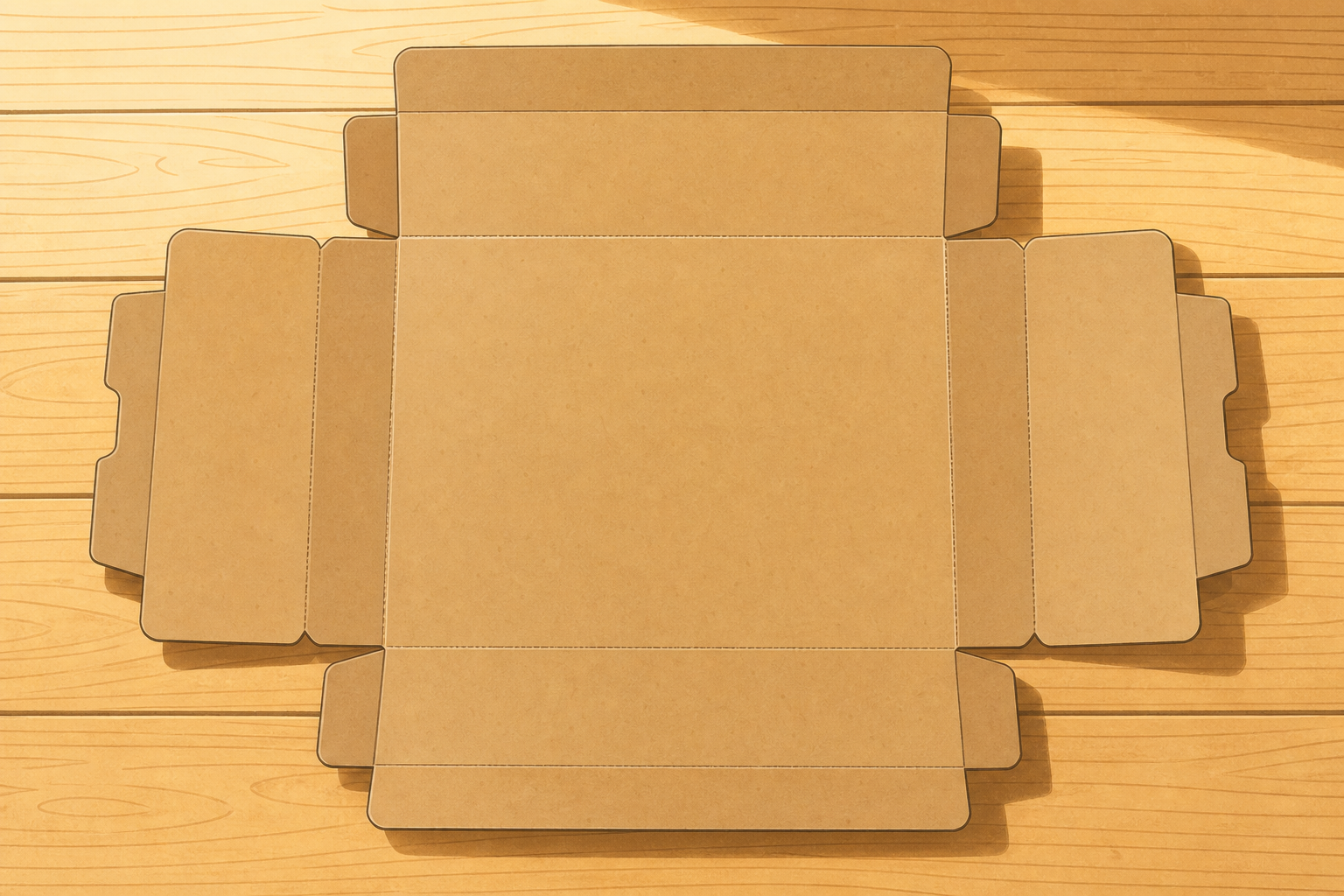
Look at the flat piece of cardboard on the screen. It used to be a box, but someone has opened it out completely and laid it flat.
What solid do you think it folds back up into? What clues are you using to decide?
Take three hands-up answers, not open call-outs. Push for the clue, not just the guess: how many flat panels can you count?
Watch each flat net fold up. The colours show which flat shape becomes which face of the solid.
First, six squares joined in a cross fold up into a cube.
Now six rectangles fold into a cuboid, with opposite faces matching.
This next one is a different shape, but it still folds into a cube.
Here is a triangular prism folding up. Notice the two triangle ends and the three rectangles between them.
This last arrangement has six squares too, packed in a block. Before it folds, decide whether you think it will close into a cube.
Now we build our own nets together on the front board and fold them to test. Pupils take turns coming up to place the squares, and everyone else predicts out loud before each one folds.
Before each one folds, everyone predict: will it close into a cube, or not?
We'll try these in turn:
Try Together: pupils take turns at the board and the class agrees or corrects out loud.
The pupil at the board places six squares on the grid, then taps Fold. Take the whole class's prediction first — hands up for 'folds' or 'does not fold'. The cross and staircase fold cleanly; the straight line and the block do not. When an arrangement does not close, the class watches the gap or overlap appear as it folds, and you draw the reasoning out from them rather than announcing it.
In your maths copy, sketch a valid net for a cube and a net for a triangular prism, like the cube nets we just folded on the board and the prism we watched folding. Label which face becomes the top of each solid once it folds up.
Walk the room glancing for six squares on the cube net and the two triangle ends on the prism net — this is whole-class copybook practice, not marking.
Take a printed net, cut it out, fold it along the lines and tape it into a solid. Once yours holds together, try the stretch: sketch a second net, a different shape from your first, that still folds into the same cube. To find one, try moving one square to a different edge, then predict before you check whether it would fold.
This is the practice round — pupils work individually at their seats while you circulate. Keep it moving: praise a neat fold, ask a stuck pupil which square will be the top.
Everyone can complete the first solid, so no pupil is left out. The second-net stretch stays genuinely open — there are eleven different cube nets, so no two pupils need find the same one. Pupils sketch the second net; folding it is an optional extra if there is time and a spare printed grid. If polydron sets are available, a group can build alongside to compare.
You're previewing this lesson. Get full access to this lesson and hundreds more — each one ready to teach, with interactive activities, printable resources and pupil progress tracking built in.