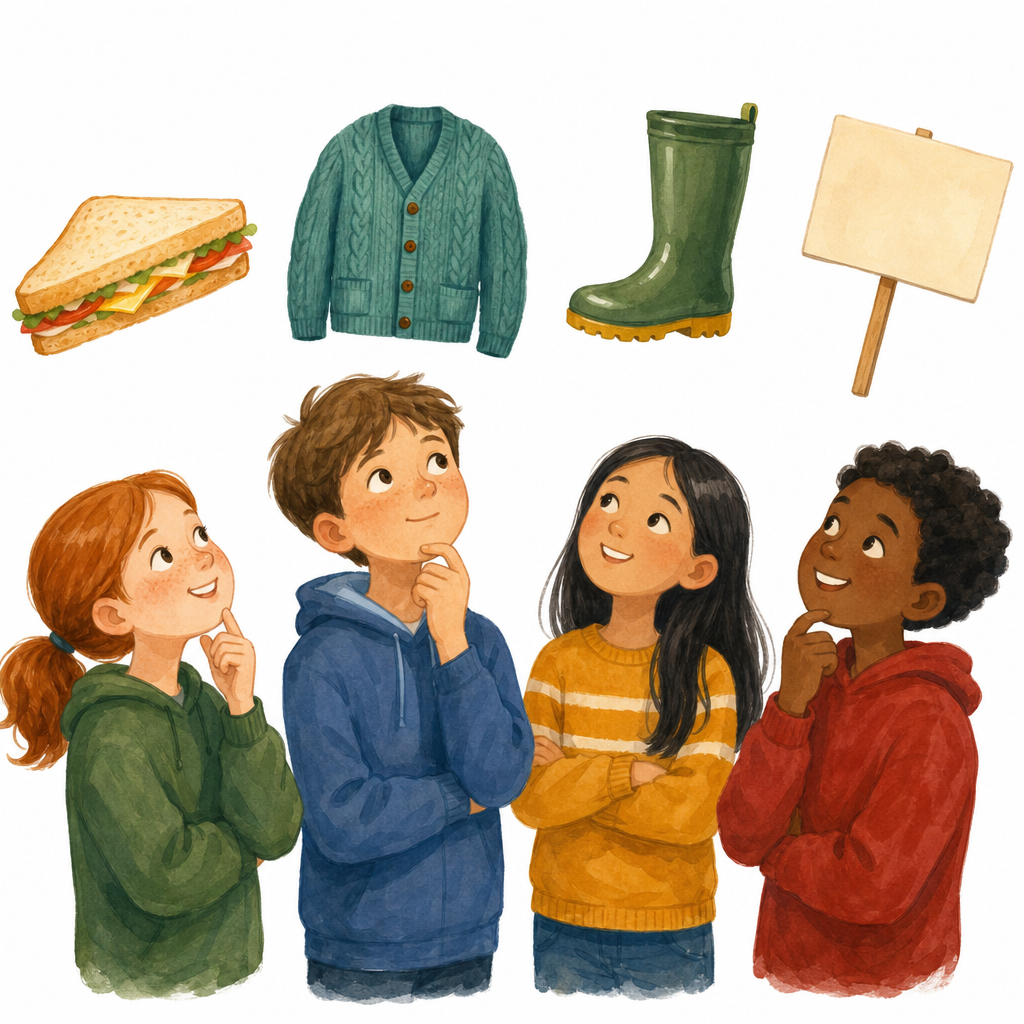
 Today we meet four everyday words that once belonged to real people: sandwich, boycott, cardigan and wellington. You use these words all the time, yet each one started life as somebody's name. Which of these four do you already know a story about?
By the end of this lesson, you will be able to:
- Spot everyday words that began as somebody's name
- Notice how a name-word can appear in more than one language
- Talk about how the word boycott left Mayo and travelled the world
Open the technology words on the board. Each one has a story packed inside it: telephone is 'far voice', television is 'seeing from afar'.
For each pair, say whether the two languages are true cousins or only look alike. Then ask today's question: what is hiding inside this word - a root, a place, or a person?
Listen carefully. Short clips will play, each in a different language. Guess which language you hear. After each reveal, listen again and ask yourself: does any sound remind you of a name-word from today?
When the clips finish, look together at how one Mayo name-word travels:
| Language | How the word appears |
|---|---|
| English | boycott |
| French | boycott |
| Spanish | boicot |
| German | Boykott |
The spelling shifts a little, but the Mayo name is still there.
Open your copy. Write two words that were somebody's name first, and who each person was.
- sandwich (from the Earl of Sandwich) : SAND-witch
- boycott (from Captain Boycott, a land agent in Mayo) : BOY-cott
- cardigan (from the Earl of Cardigan, an army officer) : CAR-di-gan
- wellington (from the Duke of Wellington, the boot) : WELL-ing-ton
Choose any two. Write the word, then a short note naming the person behind it.
Discussion time
The word boycott comes from a land agent in Mayo who was shunned by his neighbours. In 1880, people in County Mayo refused to deal with Captain Charles Boycott during a land dispute. The tactic worked so well that the word spread, and today boycott is used in many languages around the world.
- Was boycott a kind word or an unkind one for Captain Boycott?
- The neighbours in Mayo needed a word for what they did. Why do you think other countries borrowed Boycott's name too?
- Can you think of another word that might have come from a place or a person near where you live?
Unlock the full learning experience
You're previewing this lesson. Get full access to this lesson and hundreds more — each one ready to teach, with interactive activities, printable resources and pupil progress tracking built in.
This lesson is copyright of Coding Ireland 2017 - 2026. Unauthorised use, copying or distribution is not allowed.