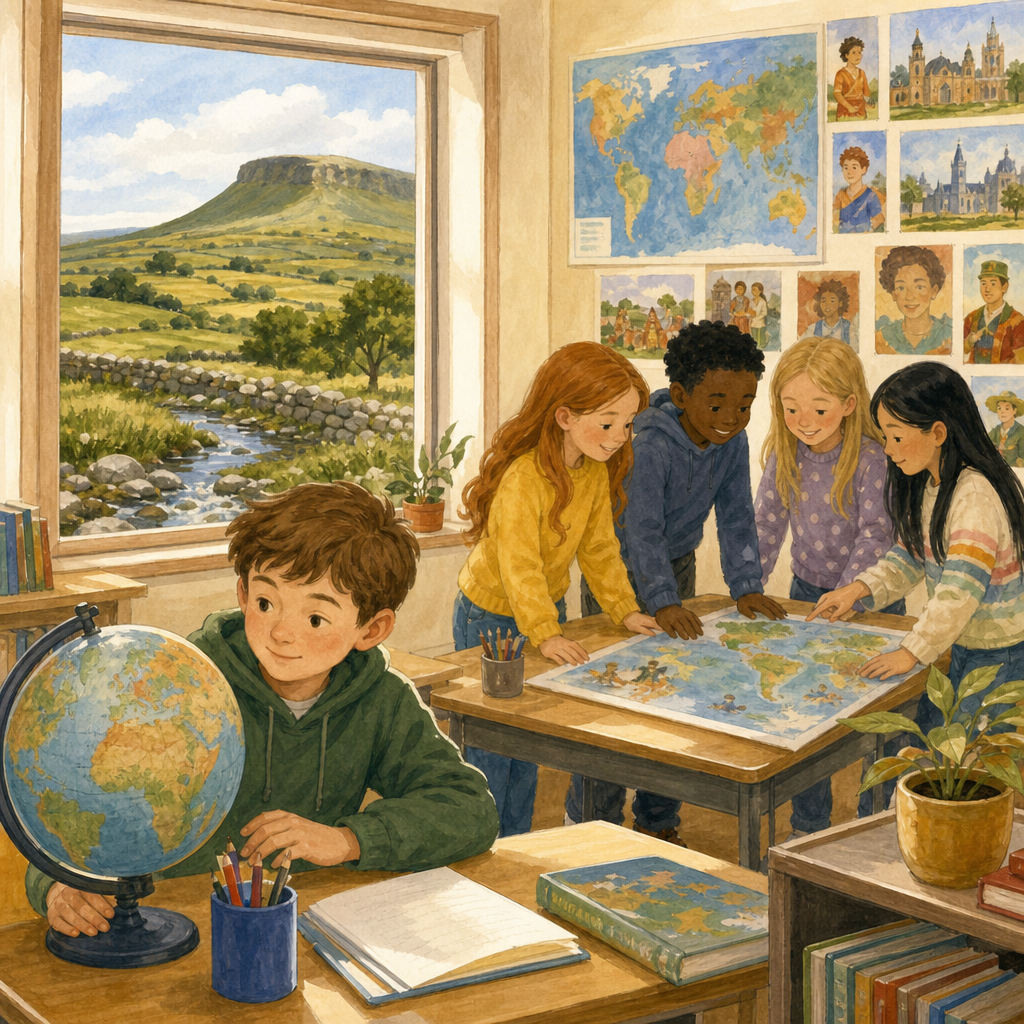
 If you had to name this school after one thing you can see from the window, what would it be?
A hill, a tree, a wall, a pitch? Irish placenames often did exactly that. They named a place for what was really there.
By the end of this lesson, you will be able to:
- Open landscape placenames and read the land inside them
- Spot when landscape words look like cousins across languages
- Invent an Irish-style name for a street from what is actually there
You are landscape detectives: every name hides a clue.
Watch the name come apart on the map. Spot the bit that means hill, marsh or shore.
Look for the landscape word inside the name.
After each name opens, whisper the landscape piece you heard, then show fingers on a count of three: 1 for hill or mound, 2 for wood or grove, 3 for well, water or marsh.
Trust your eyes and ears: a good reason beats a lucky guess.
Now look at landscape words across languages. Decide which pairs are true cousins and which only look alike.
A true cousin shares sound AND meaning. A lookalike only looks similar.
How to answer: thumbs up = true cousin · thumbs sideways = lookalike · thumbs down = different words.
Worked example before you start:
- mountain / montagne → true cousins (they look and sound related, and both mean a high landform)
- oak / once → lookalike only (a few shared letters such as o…, not a family link; once means “eleven” in Spanish)
Watch for pairs that share a root about hills, water or the land itself. Wait for the reveal after each thumbs vote.
Invent an Irish-style name for your own street, built from what is actually there, and write what it means.
Make a name you would actually want on a street sign.
You may use today's building blocks if they help:
- tulach (TUL-akh): a hill or mound
- mór (MORE): big or great
Board models (one real local feature is enough; block + Road, Lane or Park is fine):
- Tulach Park: the park by the mound
- Cnoc Lane: the lane by the hill
- Tobar Road: the road by the well
- Doire Street: the street by the oak wood
Real map shapes often keep the Irish look (Knock…, Ballintober). Today block + Road or Lane is fine so everyone can invent and explain.
Or build from something you can really see: a tree, a wall, a pitch, a corner shop. Write the name, then one short line that says what it means.
💬 Discussion time
Many Irish placenames come from natural features like hills, marshes, trees or rocks that shaped the place when it was named. Some of those features are still easy to see; others have changed under roads and houses.
Picture a place once called after a hill of oaks. The hill is built on. The oaks are gone. The street sign still says Oak Road.
- Is the old name still true, or is it a memory of what used to be there?
- Would you keep the old name, or invent a new one for what stands there now?
Unlock the full learning experience
You're previewing this lesson. Get full access to this lesson and hundreds more — each one ready to teach, with interactive activities, printable resources and pupil progress tracking built in.
This lesson is copyright of Coding Ireland 2017 - 2026. Unauthorised use, copying or distribution is not allowed.