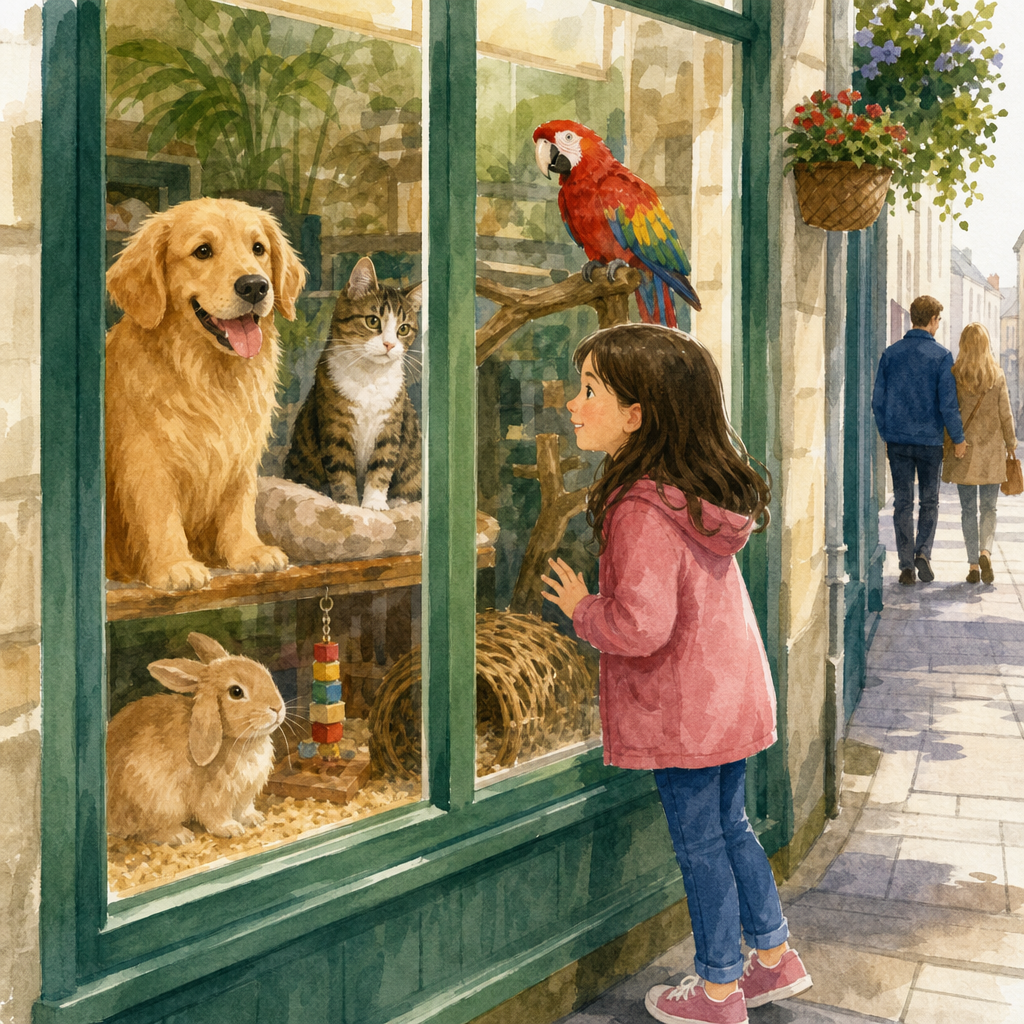
 Hands up if you have a pet at home! Keep your hand up if you can say its name in English. Today we are peeping into the window of une animalerie (a pet shop) in France. By the end of the lesson you will name eight common pets in French, and you will hear a short scene about a dog.
By the end of this lesson, you will be able to:
- Name eight common pets in French
- Label animals in an animalerie window
- Understand a short spoken scene about a pet
Here are today's eight pets from the animalerie window. Tap each one, listen, then say it back together. Watch which ones take le and which take la.
The animalerie window needs labels. Volunteers take turns matching a French word to each animal on the board. Everyone else points at the animal and whispers the full phrase (le chat, la souris) before the volunteer locks it in.
First we say it, then we write it.
Model (say together twice):
- J'ai un chien (zhay uh(n) shee-EN) — I have a dog
- J'ai une tortue (zhay oon tor-TOO) — I have a turtle
Write in French. Open your copy and write one line like the model, swapping in a pet you have or would like: J'ai un/une ___.
- le chien — Dog
- le chat — Cat
- le lapin — Rabbit
- le hamster — Hamster
- le cochon d'Inde — Guinea pig
- le perroquet — Parrot
- la souris — Mouse
- la tortue — Turtle
Time to listen. You will hear a short scene about a pet dog. Listen all the way through twice with the class, then answer the questions together. Your teacher can replay any line that was tricky.
Unlock the full learning experience
You're previewing this lesson. Get full access to this lesson and hundreds more — each one ready to teach, with interactive activities, printable resources and pupil progress tracking built in.
This lesson is copyright of Coding Ireland 2017 - 2025. Unauthorised use, copying or distribution is not allowed.