Hands up who has a pet at home. Keep your hand up if you can already say its name in any language other than English.
Today you will learn eight pet names in Spanish, so next time someone asks, you can answer properly.
Take a quick show of hands, then invite three or four pupils to name their pet in English only. Do not teach the Spanish yet; the word-table in the next step does that job. If nobody has a pet, ask which animal they would choose. After a few answers, smile and say something like: "Brilliant: by the end you'll say that pet the Spanish way." Keep this under five minutes so the present beat is not squeezed.
Here are today's eight pets. We will meet them in two groups of four. Tap each one, listen, then say it back together. Watch which ones take el and which take la, and listen for the rolled r in el perro.
Chunk the present so eight words do not land as one long list. First four: el perro, el gato, el pez dorado, el loro. Tap each so the class hears the audio, then everyone repeats twice (once all together, once by table). Quick point-and-say round on those four only. Then the next four: el conejo, el hámster, la tortuga, el ratón: same pattern. Finish with one brisk full run-through of all eight.
Point at the article every time so pupils learn el perro (el PEH-rroh) and la tortuga (lah tor-TOO-gah) as pairs, not bare nouns. Only la tortuga is feminine in this set. Highlight the accents on hámster and ratón.
The double r in perro is a Spanish superpower: have the class compete softly to roll it like a little motor, then praise the best attempt. Note for you: tortuga covers both turtle and tortoise in Spanish; accept either English meaning if a pupil asks.
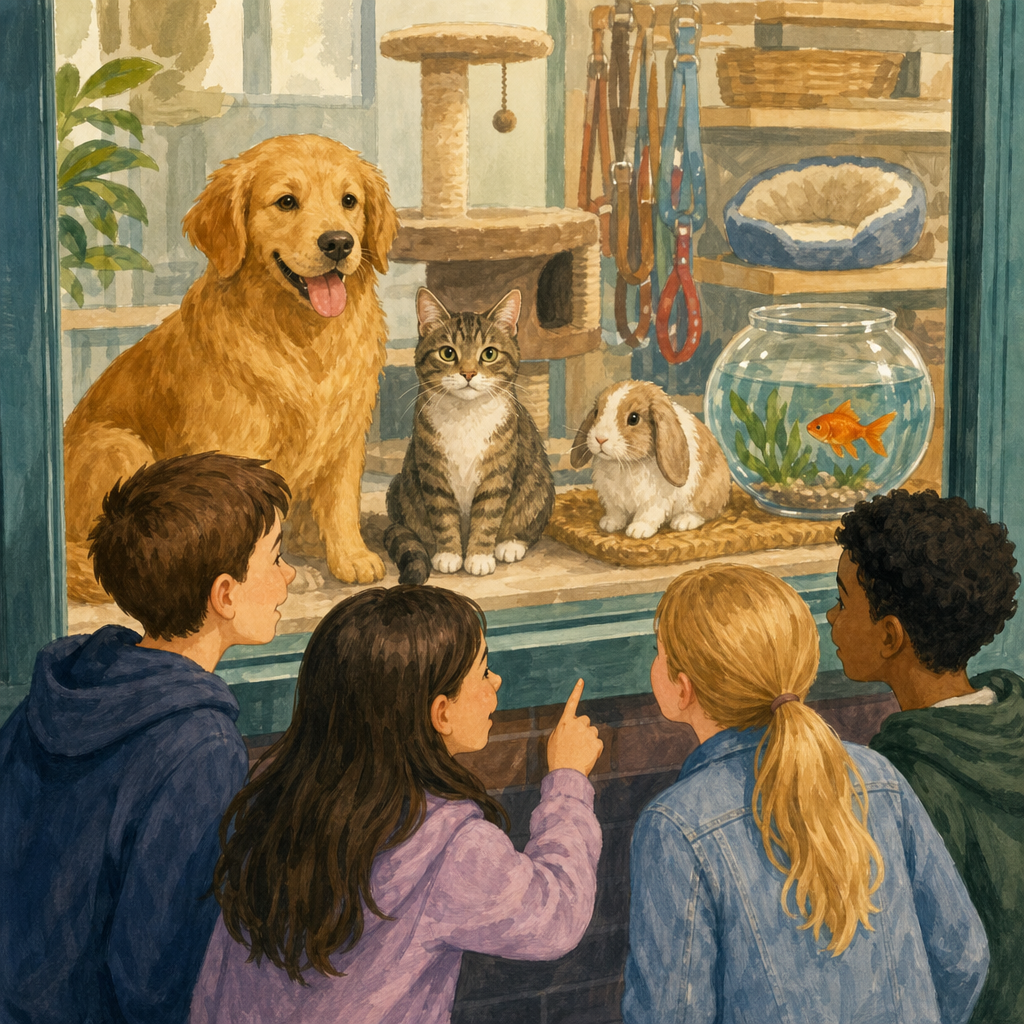
Imagine a pet-shop window on a side street in Seville: animals waiting for labels before the shop opens. Look at each picture. When it is your table's turn, say the full Spanish name with el or la. The teacher or a volunteer will tap the answer on the board.
Run this on the IWB with tables taking turns to call the answer, or invite volunteers to the board. Insist on the full form with the article: gato is not enough, el gato is. When they get it right, a quick warm line helps: "Nice full phrase: el conejo, not just conejo." If a label is wrong, replay the audio from the word-table and try again. Keep the pace brisk so every animal gets a turn.
First we say it together, then you write it.
Listen and repeat: Tengo un perro. Tengo una tortuga. Notice un with the el pets and una with the la pet.
Open your copy. Write the name of a pet you have, or pretend you have, with el or la, and one sentence with Tengo un or Tengo una.
Models:
el perro
Tengo un perro. (I have a dog.)
la tortuga
Tengo una tortuga. (I have a turtle.)
When you have finished writing, turn to a partner and say your sentence aloud. Your partner repeats it back.
Oral beat first (about two minutes), books closed. Leave the word-table on screen. Show and say clearly: Tengo un perro (TEN-go oon PEH-rroh) and Tengo una tortuga (TEN-go OO-nah tor-TOO-gah). Class repeats each twice. Quick substitutions chorally: Tengo un gato, Tengo un pez dorado, Tengo un loro, Tengo un conejo, Tengo un hámster, Tengo un ratón, and again Tengo una tortuga.
Article tip for you (keep it this simple): We learned el/la to name the animal; when we say what we have, Spanish uses un/una (a/an): Tengo un perro, Tengo una tortuga. Rule of thumb only: un before the el-words, una before the la-word. Do not explain grammar beyond that. If someone later writes Tengo el perro, smile and prompt: "a dog: un perro."
Then write (about three minutes). Everyone's pen should be moving. Pupils may swap in any of today's pets. Check that the article is written with the noun and that accents are copied carefully on hámster and ratón. Do not collect these.
Pair say-aloud (about one minute). One pupil says their Tengo un/una… sentence; partner repeats or shows thumbs if the full phrase was clear. This is the structured speaking moment before the summary claims they can say it.
You will hear a short chat about a pet dog. Listen all the way through twice on the class speakers before anyone answers, then choose the best reply for each question.
Play the full clip twice on the class speakers with books closed and hands still. Only then open the questions. If the class looks unsure, play a third time and pause after key phrases. Useful words they may catch: el perro (el PEH-rroh), me gusta (meh GOOS-tah). Go through the answers together at the end and celebrate anything they understood, even a single word.
You're previewing this lesson. Get full access to this lesson and hundreds more — each one ready to teach, with interactive activities, printable resources and pupil progress tracking built in.