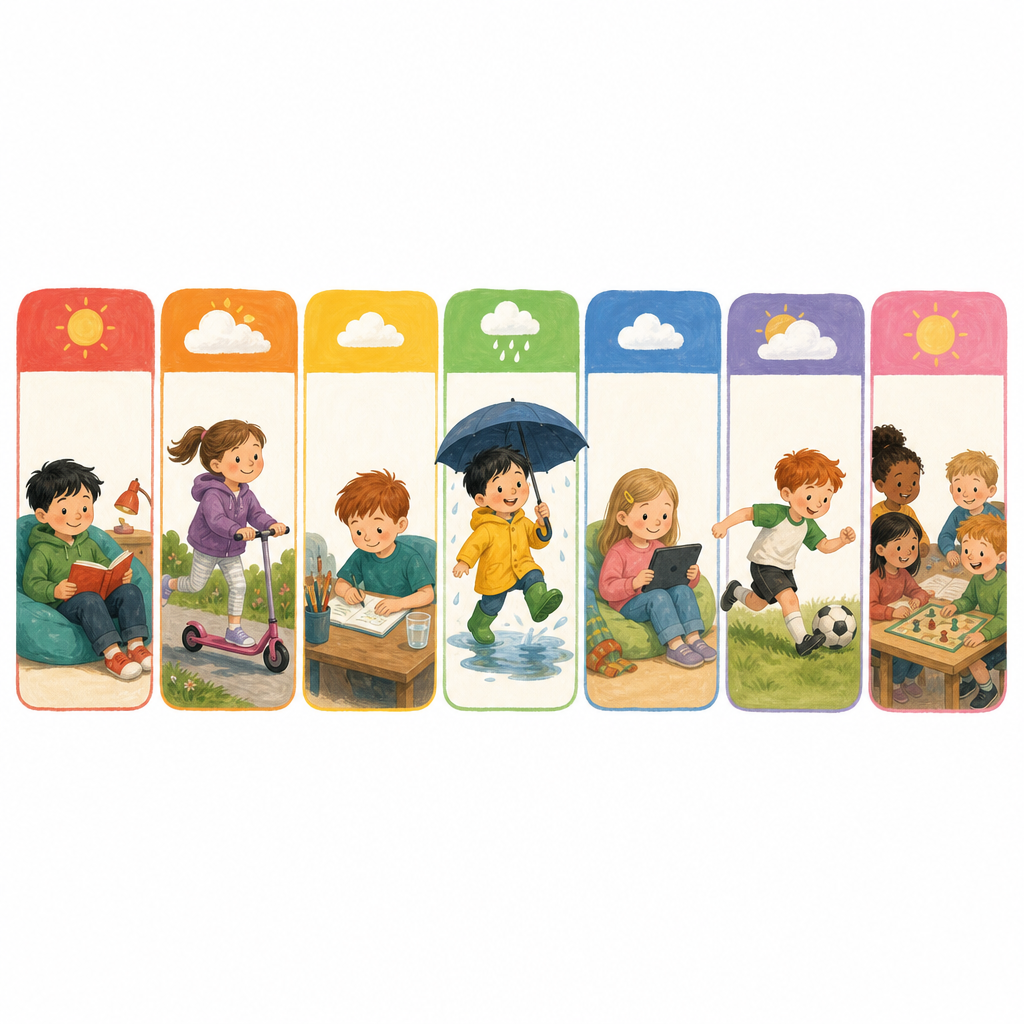
 Which day of the week is the best, and which is the worst? Say why in English, in one short sentence each.
By the end of this lesson, you will be able to:
- Name all seven days in French
- Say what you do on a day, with a time
- Spot where French day names come from
First: here are all seven days. Tap each one, listen, then say it back together. Notice how five of them end with the same soft dee sound.
A French school week
In France the week starts on Monday. On Wednesday, many primary pupils have no classes in the afternoon.
En France, la semaine commence le lundi. Le mercredi, beaucoup d'élèves n'ont pas classe l'après-midi.
Then: put a day together with a time to describe a routine. Say the model together twice before you try swaps.
Le lundi, l'école commence à neuf heures. (On Monday, school starts at nine o'clock.)
We will swap the day together (Le mardi…, Le vendredi…), then try a new time.
Click each French day, then its English name. Say the French quietly as you click each one.
First, say the model sentences together. Then open your copy and write two sentences about your week: one about school and one about you. Use the frames and the times bank on the board to help you.
Models:
- Le lundi, l'école commence à neuf heures. (On Monday, school starts at nine o'clock.)
- Le samedi, je joue au football à dix heures. (On Saturday, I play football at ten o'clock.)
- Le dimanche, je me couche à neuf heures. (On Sunday, I go to bed at nine o'clock.)
Frames:
- Le _____, l'école commence à _____.
- Le _____, je joue au football à _____.
- Le _____, je me couche à _____.
Times bank: huit heures, neuf heures, dix heures, quatre heures, six heures
Your teacher will give you a printed bingo card. Listen carefully: you will hear day names on their own and inside short phrases such as le vendredi à quatre heures. Cross off the day you hear if it is on your card. When every day on your card is crossed off, call Bingo!
Unlock the full learning experience
You're previewing this lesson. Get full access to this lesson and hundreds more — each one ready to teach, with interactive activities, printable resources and pupil progress tracking built in.
This lesson is copyright of Coding Ireland 2017 - 2025. Unauthorised use, copying or distribution is not allowed.