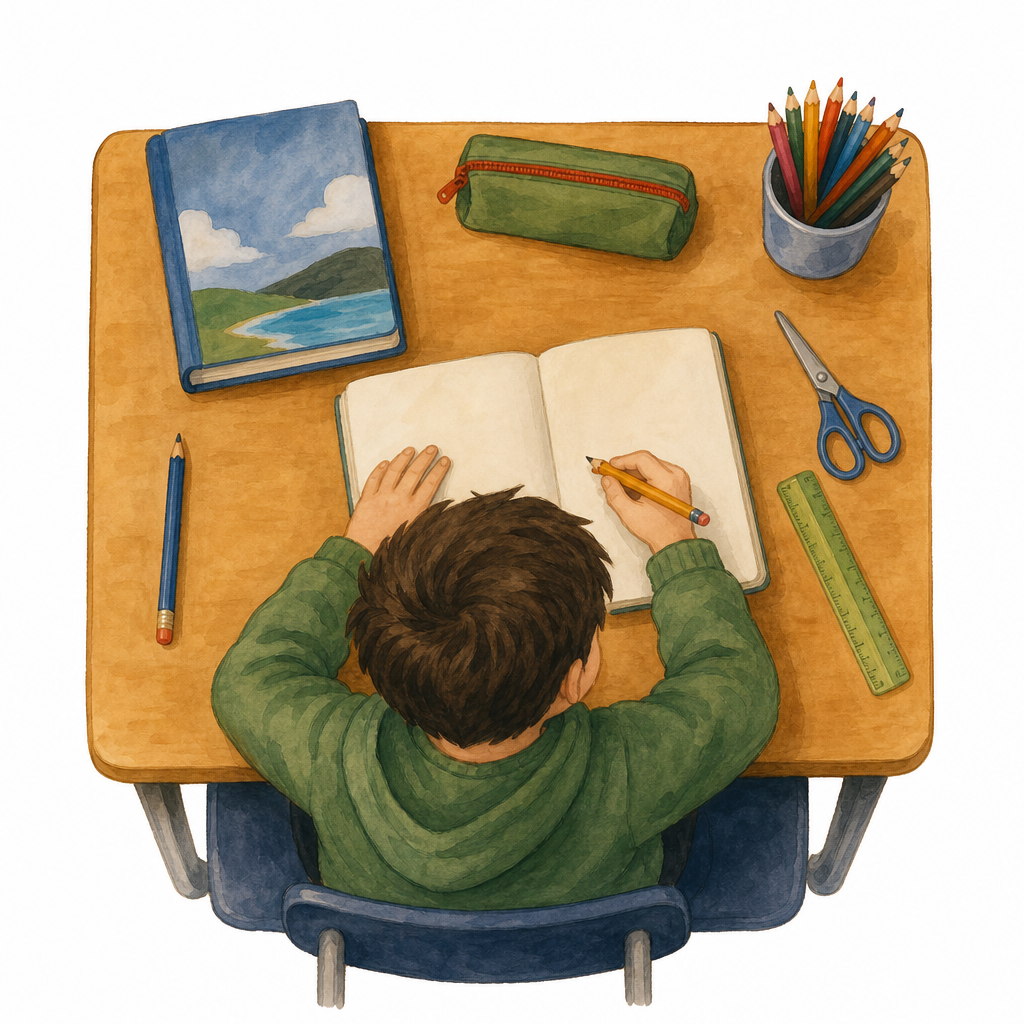
Everything we name today is already sitting on your desk. Hold up a pencil if you can see one. Can you guess how we say it in German?
Quick 20-second spiral before the pencil hook: greet the class with Guten Tag or Hallo and take three choral replies — a tiny recycle of earlier greeting work, then straight into desk objects.
Hold up a real pencil and invite three or four guesses for the German word. Do not confirm the answer yet; the word-table in the next step will reveal it. Keep the energy light: the point is that the vocabulary is already in the room, not that anyone gets it right first time.
Here are today's eight classroom words in two short sets. Listen to each word, then say it back together. Watch the article carefully: German nouns take der, die or das, and you learn them as a pair with the word.
Run this on the IWB in two chunks of four so the load stays manageable. You tap each word; pupils listen, then repeat.
Chunk 1 — writing tools: der Bleistift (dair BLYE-shtift), der Kugelschreiber (dair KOO-gel-shrye-ber), das Heft (das HEFT), der Radiergummi (dair rah-DEER-goo-mee). After these four, a quick choral recap: you point, class says each full pair once more. Kugelschreiber is a mouthful — clap the syllables together (Ku-gel-schrei-ber), then cheer the first table that nails it. Germans often shorten this to der Kuli (KOO-lee) in everyday talk — worth saying once so they recognise it later; keep der Kugelschreiber as the written target.
Chunk 2 — other desk items: das Buch (das BOOKH — the ch is like a soft scrape at the back of the throat, as in Bach, not like English ch in chip), die Schere (dee SHEH-reh), das Lineal (das lee-neh-AHL), das Federmäppchen (das FAY-der-mep-khen). Choral recap of these four, then a final whisper-pass of all eight. Point at the article every time so the pair is what they hear. Confirm the pencil from the hook when you reach der Bleistift.
Watch the classroom picture. First we say all eight words together once more. When it is your table's turn, call out the full German word with der, die or das. Everyone else whisper-says it too.
Before any labels move, lead one all-class choral pass of the eight full phrases (article + noun) while pointing at each object on the picture. Then run the activity on the IWB with tables taking turns to call out; one pupil or you places the label. If a label lands on the wrong object, pause and say the correct pair together with the article before moving on. Listen for bare nouns without articles and gently restate the full form. Warm beat when a table gets one right: "Nice spotting — say the full pair like you own it."
Choose any four of today's eight words. Write each one in your copy with its article (der / die / das) and a capital letter. Use the word-table on the board to check spellings — it stays up the whole time.
Pause the board interaction but keep the word-table fully visible for copying. This is scaffolded writing, not memory work. Everyone writes; this is the only few minutes where every pupil's pen is moving. Suggest shorter, high-frequency forms if anyone looks stuck (das Buch, das Heft, die Schere, das Lineal), but any four from today's list are fine. Walk the room and check that der, die or das sits in front of every noun, and that nouns are capitalised. A quiet "lovely article" or "nice capital" as you pass keeps the tone warm. Do not collect these.
Watch the cards on the board. When a pair is found, the whole class says the German word with its article together. Listen carefully so you are ready for your turn to call one out.
A different way at the same eight words after more oral practice. Whole class on the IWB works well, with volunteers flipping. When a pair is found, the whole class says the full phrase with the article: Buch alone is not enough; das Buch is the answer. Then the class gives a quick clap and calls Ja! before the next turn. After two or three matches, add a 30-second pair beat: one pupil points at a real desk object (or the picture), the partner names it in German from the list still on screen, then swap. If a pair is missed twice, stop and say it together before moving on.
Do not use Hier! here — that register reply is modelled and discussed in the culture step later so pupils are not asked to produce an untaught phrase mid-practice.
You're previewing this lesson. Get full access to this lesson and hundreds more — each one ready to teach, with interactive activities, printable resources and pupil progress tracking built in.