Can you show me your head? Can you wave your hands at me? Can you stamp your feet gently on the floor?
Today we will name the parts of our amazing bodies, and then you will draw a picture of yourself!
Keep this beat light and playful. Stand where everyone can see you and point to your own head, hands and feet as you ask. Do not teach the full list yet. Just spark curiosity.
Have the hand mirrors nearby but out of reach, and the Investigation Journal pages ready to hand out later. No special body outline is needed. Children will point on their own bodies and the on-screen child figure will do the rest.
Settle cue: a gentle clap pattern or a quiet stand-up stretch is enough. Keep only today's five words in play: head, arms, hands, legs, feet.
Stand up! We will play a body game.
When I say a body part, point to it on your own body. Ready: head… arms… hands… legs… feet!
Before the game: model one full cycle yourself so every child sees what to do. Think aloud: I wonder where my head is. I predict it is at the top. I point… yes, this is my head. My head helps me look and listen. Then invite the class to join.
How to run it:
Look-fors: children pointing to the correct part on themselves; joining in with a smile; saying the word if they can.
Differentiation: for children still learning the words, stand beside them and point with them. For confident talkers, ask them to call the next part for the class.
Misconception to head off: some children point to a friend instead of themselves. Gently redirect: On your own body. Find your head.
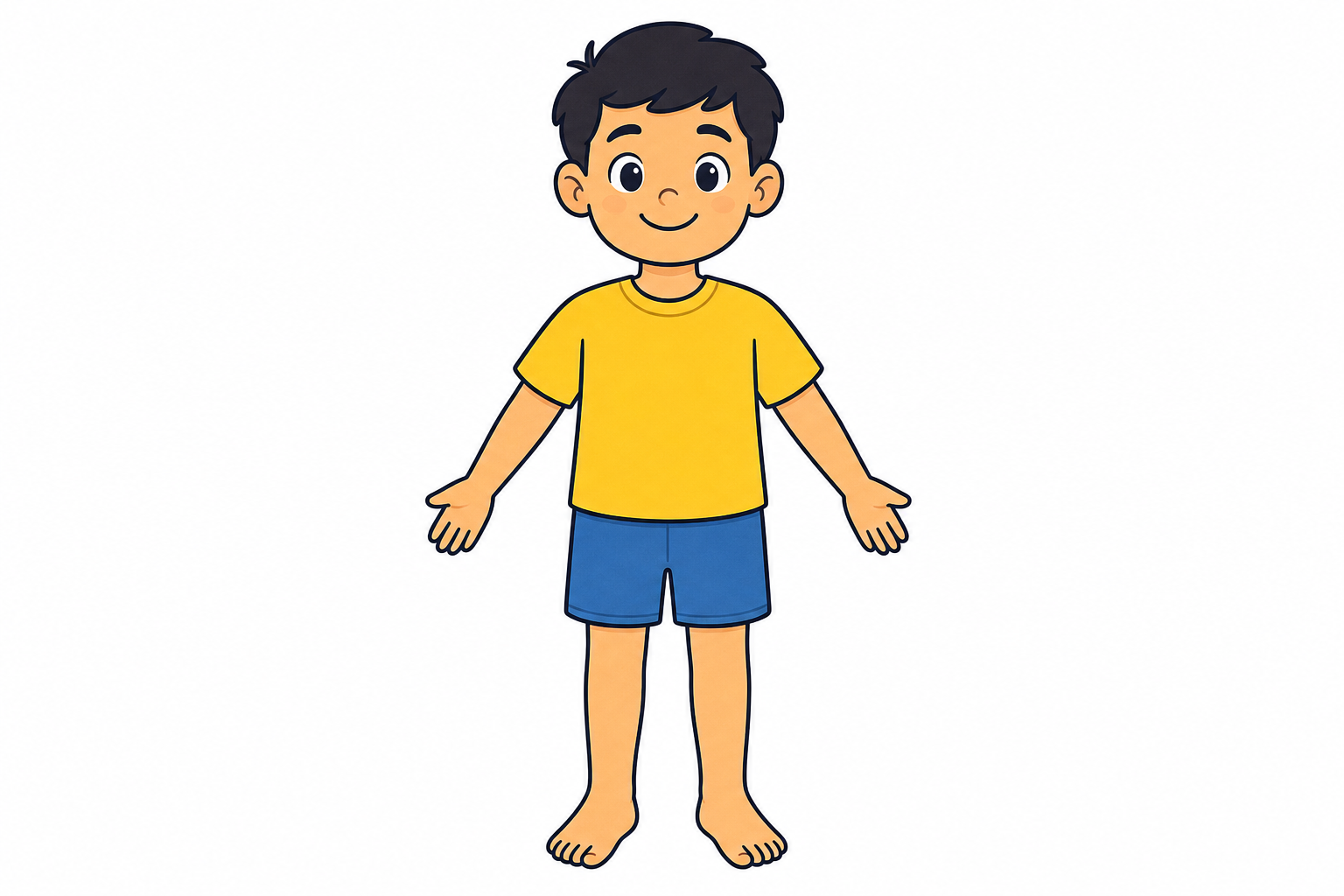
Look at the child on the board. We will name each body part, one at a time.
When I say the name, point to that part on your own body.
Open the diagram-labeller interactive on the IWB in display mode. The finished child figure is already labelled. Nothing is dragged. This is a teacher-led teach beat: the board is your visual aid, and the children's job is to point on their own bodies after each name.
On screen the class will see: a simple whole-child figure with the labels head, arms, hands, legs and feet.
One label at a time (do not rush the list):
Fold the watchers in by asking: Are they pointing to the right place? Show me on you.
Key concepts for you (not for projecting as a full table):
| Concept | Why it matters | Example |
|---|---|---|
| Body parts — the outside bits of our body we can see and point to | Knowing the names helps us talk about our bodies and stay safe and well | When we play the body game we point to head, arms, hands, legs and feet |
| Head — the top part of the body with the face | Your head holds your eyes, ears, nose and mouth so you can look, listen and talk | Nod your head to say yes |
| Arms and hands — arms join the body to the hands; hands hold and wave | Hands help us draw, clap, hold a spoon and wave hello | Wave your hands at a friend |
| Legs and feet — legs join the body to the feet; feet help us stand and walk | Legs and feet help us move around the classroom and yard | Stamp your feet gently on the carpet |
Misconception to head off: children may think only the face counts as the head, or mix up arms and hands. Point clearly from shoulder to hand for arm, and from wrist to fingers for hand.
Nature of STEM seed (save the full doctor talk for the close): a doctor knows the parts of our body. We will come back to that idea at the end.
Now you can look in a hand mirror. What can you see when you look?
Can you find your head in the mirror? Can you hold up your hands and see them too? Give yourself a big smile!
Setup: hand out one hand mirror per pair (or one between three if numbers are short). Children stay seated or kneel at tables so mirrors stay low and safe.
How to run it (short bursts, not one long sit):
Circulate and invite short oral noticing: I can see my head. I can see my hands. Guesses and notices are never wrong.
Safety: mirrors are for looking, not banging or putting near mouths. Collect them promptly when you call time.
Low-resource tip: if you have only a few mirrors, run a quick carousel: two pairs at a time with mirrors while others practise pointing on their own bodies, then swap.
Time to draw you!
On your Investigation Journal page, draw a picture of yourself. Show your head, arms, hands, legs and feet. You can colour them if you have time.
Hand out the Investigation Journal page and crayons. This is a real timed beat of the lesson, not homework. Protect the full slot so children can name the five parts while they draw. Colouring is optional once the five parts are on the page.
What good looks like at this age: a simple figure with a clear head, some mark for arms and hands, and some mark for legs and feet. Perfect proportion is not the goal. Naming while they draw is the goal.
As you circulate, ask each child to point on their drawing: Where is the head? Where are the hands? Where are the feet? Scribe a single word label only if a child asks and you have time. Do not require writing.
Support: for children unsure where to start, lightly sketch a circle for the head on a scrap to model, then let them draw their own. Never prepare a full body outline for them to fill. The on-screen figure already did that job.
Fast finishers: add a favourite colour on a jumper or shoes, or tell a partner one body part they drew. Not an on-device task.
Which body parts did we name today? Point to one on your drawing or on your body.
We know our body parts. Some people help us care for our amazing bodies. A doctor is one of those people. Can a doctor help us stay well?
Whole-class carpet talk. Display-only and oral. Nothing is typed or written now.
Lead with a concrete recap: invite three or four children to hold up their drawing and point to one part they included, or point on their own body. Revoice: we named head, arms, hands, legs and feet.
Who helps us (one short bridge only): a doctor (and sometimes a nurse) knows the parts of our body and helps us stay well. Keep it gentle and reassuring: doctors look, listen and help when we need them. No illness detail, no needles talk, no scary framing. Prefer a yes/no or choice response rather than an open "how" question.
Prompts:
Close with: Our bodies are amazing, and people like doctors help us care for them.
Crayons back in the pots. Mirrors to the tray. Well done, body experts!
Collect hand mirrors first so none are left on the floor. Journals stay with the children or go in the usual folder. Quick praise tied to the learning: You pointed to your head, arms, hands, legs and feet.
Optional tiny home noticing (oral only): tonight, show someone at home your head, hands and feet. No worksheet and no screen task.
You're previewing this lesson. Get full access to this lesson and hundreds more — each one ready to teach, with interactive activities, printable resources and pupil progress tracking built in.