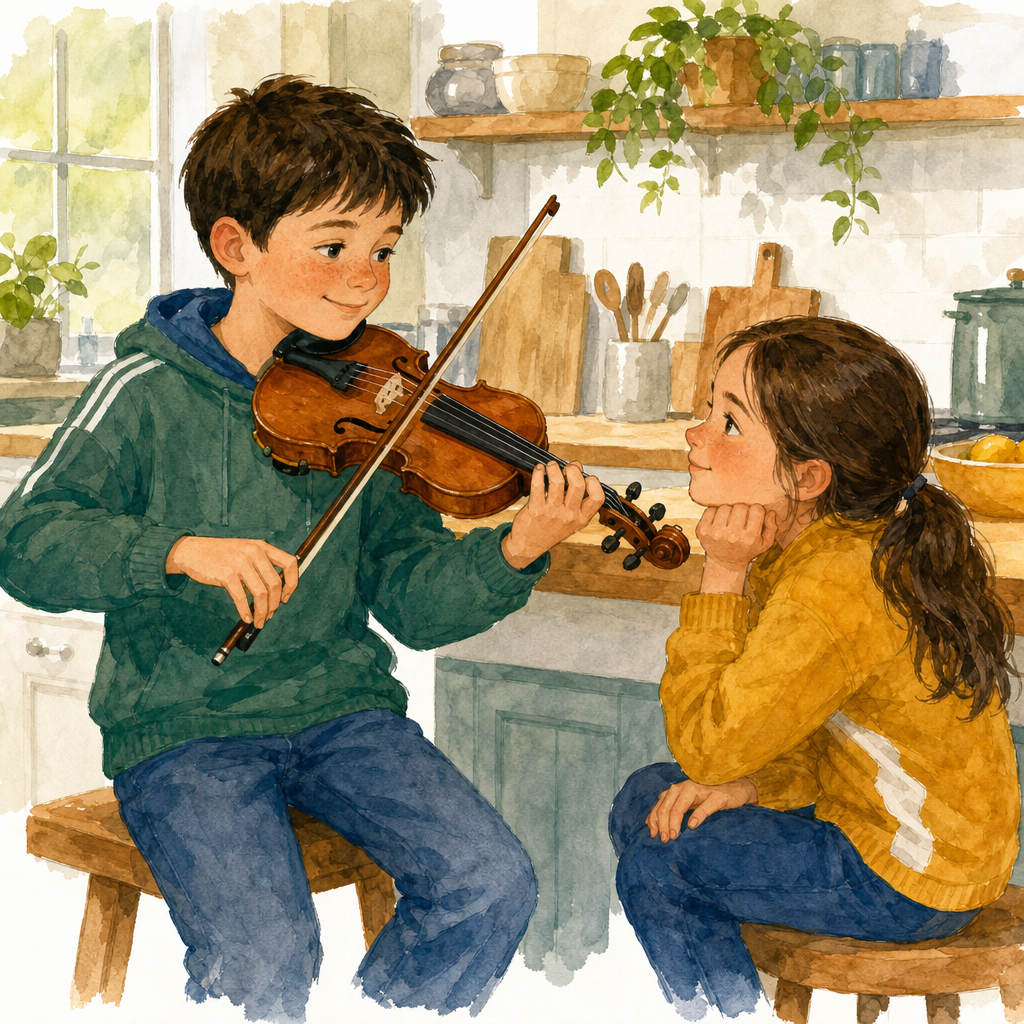
 Most Irish tunes were never written down. They were learned by sitting beside someone who already knew them, listening, then trying.
Today we follow one tune as it travels from person to person, name languages just by listening, and ask a hard question: if every person changes a tune a little, whose tune is it?
Two soft Irish labels for our story (not a test): ceol (music) and amhrán (song).
By the end of this lesson, you will be able to:
- Compare a tune passed by ear with the same tune fixed on a page
- Name languages by ear, just from how they sound
- Talk about who a tune belongs to when it keeps changing
 1. Kitchen chain
Imagine a short Irish reel (a lively dance tune). Someone shares it with a neighbour. The neighbour listens twice, then tries it. A few notes land differently. Years later the tune is still recognisable, but not quite the first version.
2. Page version
Now picture the same tune printed on a page. Every note stays still. Anyone who reads the page meets the same shape. The tune no longer drifts from person to person.
3. What to notice
- By ear: the tune travels, and it changes slightly each time.
- On a page: the tune stays still, and everyone meets the same version.
- Neither way is better. They keep different things safe.
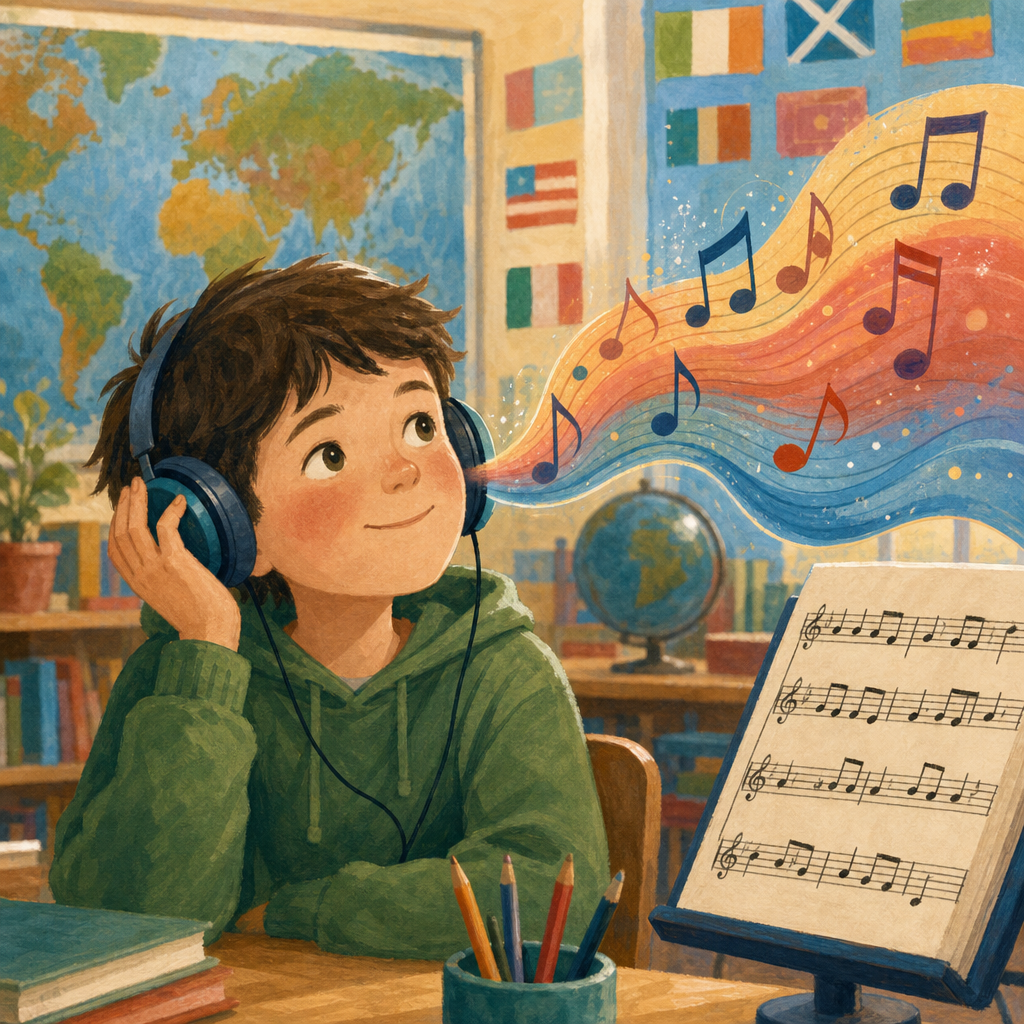
Now listen the way musicians learn a tune: by ear. These clips are short spoken lines, so listen for the music of each voice.
Each clip plays twice on the board. Listen, then show which language you think it is when asked (point or thumbs-up). We check the reveal together and spot the clues that give it away.
Watch the language choices on the board before the first clip starts.
Open your copy. Write the name of a tune or song your family knows, and who you learned it from.
- If you cannot remember the exact title, write the first line or how people at home name it.
- Write the person clearly: a parent, grandparent, sibling, neighbour, or teacher.
- If nobody at home sings much, write a song you learned by listening to someone else and still name that person.
Look at the North America map on the board. When people left Ireland, Scotland and other places, they carried tunes in their heads, not in folders.
Watch where we stop. When we land on a place, be ready to say what might happen to a tune there: keep its shape, mix with local styles, or grow a new name.
Unlock the full learning experience
You're previewing this lesson. Get full access to this lesson and hundreds more — each one ready to teach, with interactive activities, printable resources and pupil progress tracking built in.
This lesson is copyright of Coding Ireland 2017 - 2026. Unauthorised use, copying or distribution is not allowed.