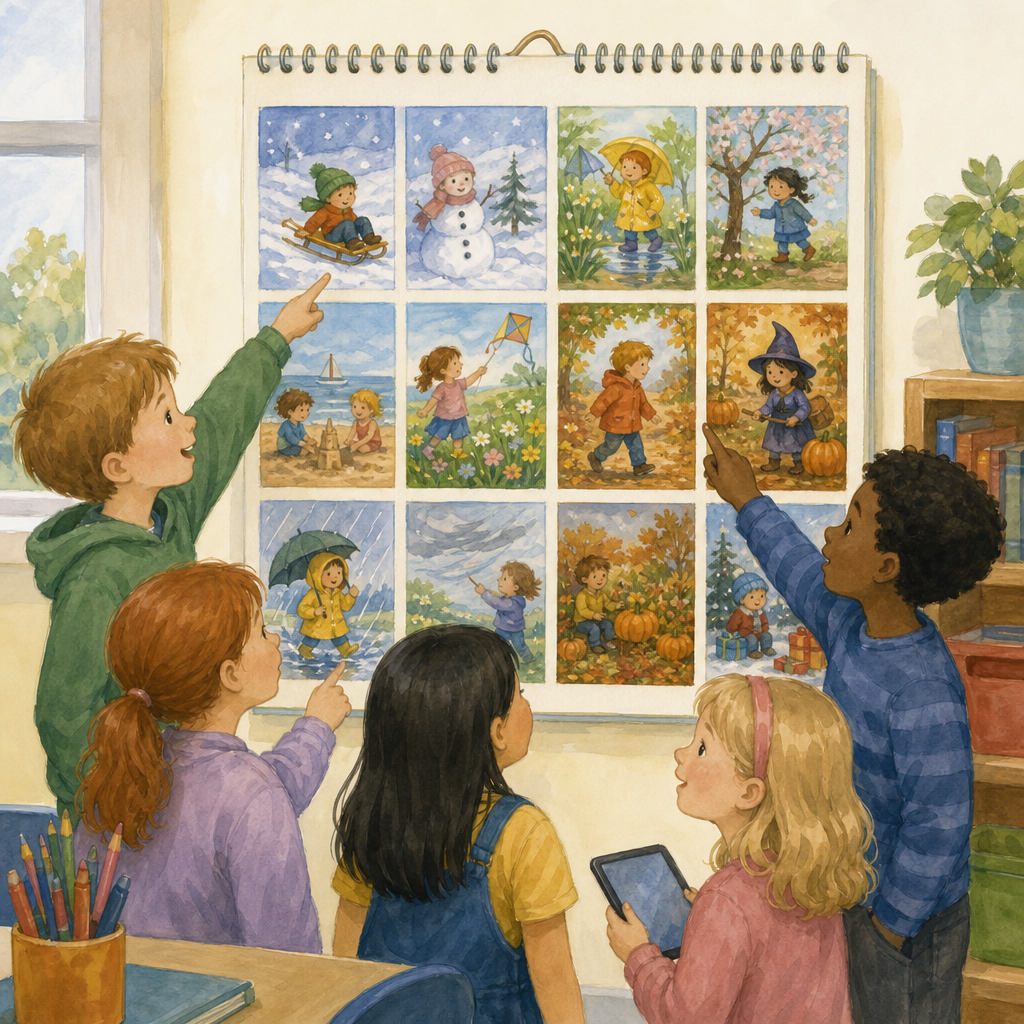
 Whose birthday is coming up next in this class? Say the month in English.
Today you will name all twelve months in German and write a full date, including your own birthday. You will hear each month, say it aloud, play for it on a bingo card and match it to its English name, and you will see why every German month starts with a capital letter.
Here are today's months, one card at a time. See the English, try the German aloud, then flip to check. Watch the capital letter on every month: German nouns always start with one.
A full date sounds like this:
Mein Geburtstag ist am 5. März. (My birthday is on the 5th of March.)
Listen for each month and mark it on your card. When every month on your card is marked, call Bingo! Say the German quietly to yourself as you mark it.
Open your copy and write your own birthday as a full date, then the date of a holiday you like. Keep every month capitalised, just as you saw on the cards.
- Januar — January
- Februar — February
- März — March
- April — April
- Mai — May
- Juni — June
- Juli — July
- August — August
- September — September
- Oktober — October
- November — November
- Dezember — December
Match each German month to its English name: click a month, then its name. Tap the speaker beside a month to hear it, and say the German quietly before you click.
Unlock the full learning experience
You're previewing this lesson. Get full access to this lesson and hundreds more — each one ready to teach, with interactive activities, printable resources and pupil progress tracking built in.
This lesson is copyright of Coding Ireland 2017 - 2025. Unauthorised use, copying or distribution is not allowed.