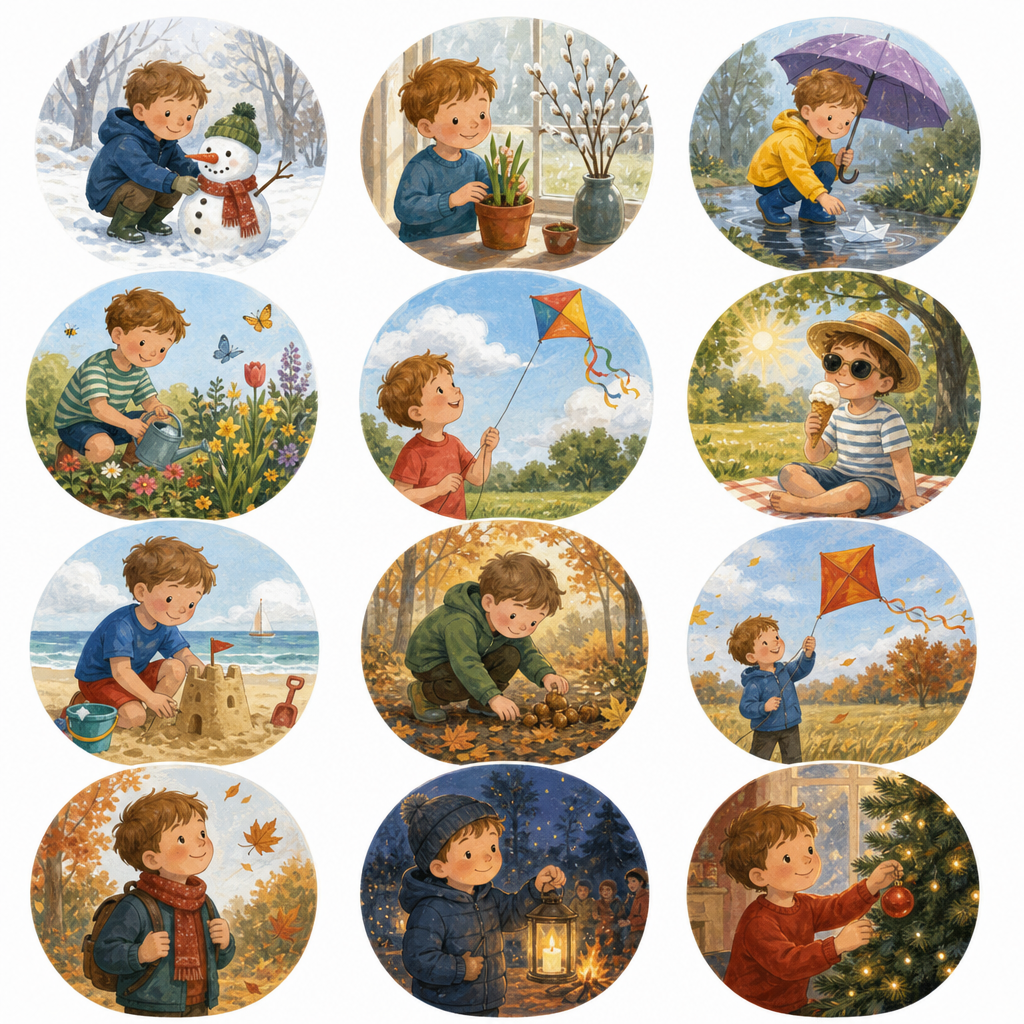
 Whose birthday is next in this class? Say the month in English first.
Today you will name the months in French and write a full date, including your own birthday.
In France, the big summer holiday month is often août: whole towns slow down while families head away. You will meet that month today, and a famous French date too.
By the end of this lesson, you will be able to:
- Name the months of the year in French
- Give a full date, including your birthday
- Notice something different about how French writes month names
Here are the French months on the cards. Listen to each one first, then say it with the class. Flip only after you have heard and repeated it.
Watch for short, sharp months and longer mouthfuls. Keep your eyes on the spelling when the card flips.
Date stem (say it with the class):
Mon anniversaire est le …
mohn ah-nee-ver-SAIR eh luh …
(My birthday is the …)
You each have a bingo card, and cards are all different. Listen for each month and cross it off if it is on your card. When every month on your card is crossed off, call Bingo!
Say the French quietly as you mark it so the sound sticks.
Open your copy. Keep the month list on the board in view. Write two full dates using the pattern below. You may copy the month spelling from the board.
Pattern:
Mon anniversaire est le 12 mars.
mohn ah-nee-ver-SAIR eh luh dooz mars
(My birthday is the 12th of March.)
- Your own birthday: Mon anniversaire est le …
- A French national day: le 14 juillet (Bastille Day), written in the same pattern, e.g. La fête nationale est le 14 juillet.
Month names stay in small letters. The day number sits between le and the month.
- janvier — January
- février — February
- mars — March
- avril — April
- mai — May
- juin — June
- juillet — July
- août — August
- septembre — September
- octobre — October
- novembre — November
- décembre — December
Click each French month, then its English name. Say the French quietly as you click each one.
Unlock the full learning experience
You're previewing this lesson. Get full access to this lesson and hundreds more — each one ready to teach, with interactive activities, printable resources and pupil progress tracking built in.
This lesson is copyright of Coding Ireland 2017 - 2025. Unauthorised use, copying or distribution is not allowed.