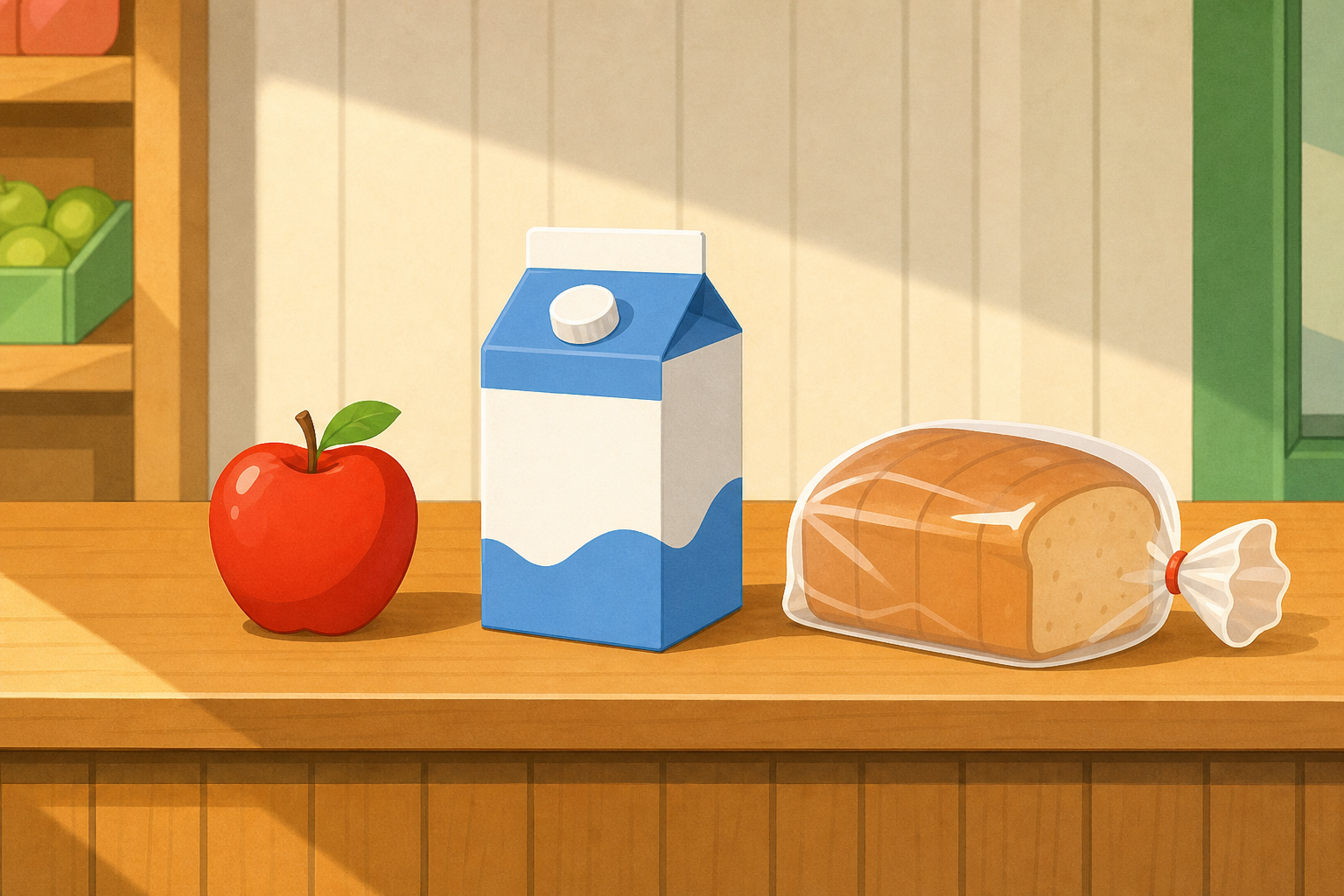
Here is a small shopping basket: an apple for €0.45, a carton of milk for €1.20, and a loaf of bread for €1.35.
Before we add anything: do you think the whole basket costs more than €3 or less than €3?
Take three hands-up estimates, not open call-outs. Do not add it yet — hold the estimate against the real total after the model step. Give five seconds of quiet think-time first.
Listen for pupils rounding to tidy numbers (about 50c + about €1 + about €1.50) — revoice one rounding estimate aloud as the sensible way to judge "over or under €3".
Watch me add each pair of prices on the board, keeping the euro under the euro and the cent under the cent.
I work each total out by hand on the board.
Work each one live on the board — do not read the worked answers aloud before pupils have watched the columns add. Keep euro under euro, cent under cent every time.
Now we add some baskets together on the coin-counter at the board. Pupils will come up in turns to lay the coins, and the rest of us count along.
Our first basket is €1.20 + €0.60. Then we do €0.95 + €1.05. Last we do €0.85 + €0.55 + €0.60. Watch the last one — the cent tip over a hundred and trade for a euro.
Talk this one through together — pupils take turns at the board and the class agrees or corrects out loud.
For each basket, one pupil lays the coins for the first price, another lays the second, then the class counts the whole tray. Say each running total aloud as coins go in.
In your maths copy, add this basket showing your working, keeping the euro under the euro and the cent under the cent:
Write the total in euro and cent underneath.
Walk the room glancing for aligned decimal points and a carried euro when the cent pass a hundred — this is whole-class copybook practice, not marking.
Now we work through these basket problems together, each one a step harder. For each one, read the prices and add them:
The later ones have cent that pass a hundred, so one hundred cent trade for one euro.
This is the practice round — pupils take turns at the board, check each answer, and the class confirms before moving on. Keep the board work brisk rather than over-explaining.
You're previewing this lesson. Get full access to this lesson and hundreds more — each one ready to teach, with interactive activities, printable resources and pupil progress tracking built in.