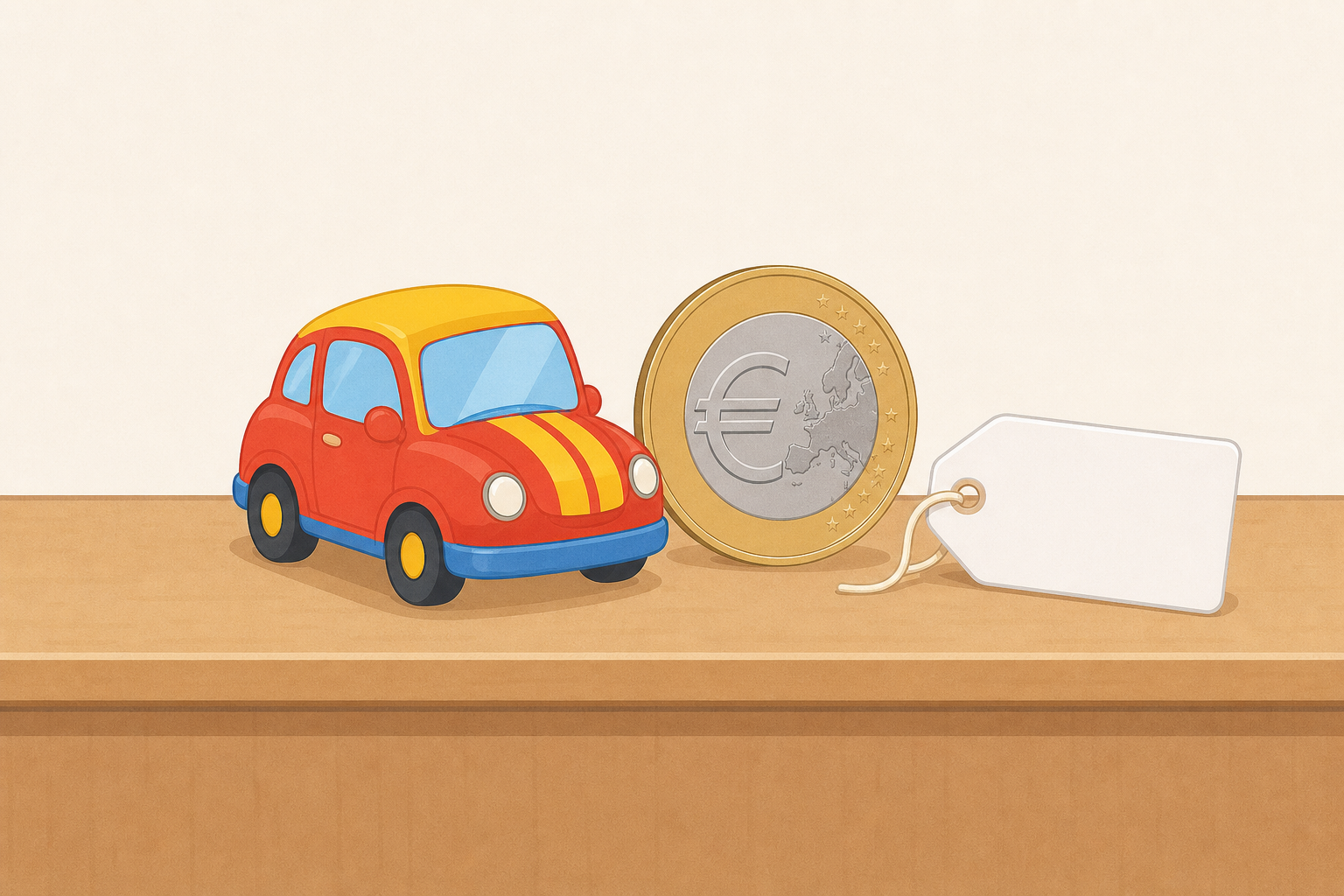
A small toy costs 70c. You hand the shopkeeper €1. How much money should you get back?
That money you get back has a special name. What do we call it?
Show the 70c price tag and the €1 coin side by side as pupils settle. Take three hands-up answers, not open call-outs. Draw out the word change, and hold out for how a pupil worked out the 30c, not just the answer.
Here are two purchases. For each one we count coins up from the price to the money handed over. Those coins are the change.
First: a sticker costs 80c and is paid for with €1. The display counts on as 90, then 100.
Next: a pencil costs €1.50 and is paid for with €2. The display counts up from €1.50 to €2.
Notice that we never take anything away. We only count up from the price.
Point at the price first each time, then count the coins up onto the tray aloud with the class: 80… 90… 100. Do not read the change out as a fact — draw it out by counting up so pupils see where it comes from. The trap is pupils reaching for take-away; keep saying we count UP from the price.
Each time we say the price. Then we count coins up to the money handed over. The coins we add are the change.
Today we work these out together on the board by counting up from the price. First we do a 90c sticker paid with €1. Then a 60c apple paid with €1. Last a €1.20 juice paid with €2.
Talk this one through together — pupils take turns at the board and the class agrees or corrects out loud.
For 90c paid with €1, count on 10 (one 10c coin) to reach 100 — the change is 10c. For 60c paid with €1, count 40 (a 20c and two 10c, or a 20c coin twice) up to 100 — 40c change. For €1.20 paid with €2, count 20 then 60 to reach €2 — 80c change. Listen for the pupil who tries to subtract; revoice their thinking as counting up: so from the price we hopped up to the money you paid.
In your maths copy, write three "cost — paid — change" lines for the examples on the board, filling in the change on each line.
Count up from the cost to the money paid to find each change.
Walk the room glancing at whether pupils are counting up rather than guessing — this is whole-class copybook practice, not marking.
Today we work through four fresh change questions together, each a little harder than the last. Read each story. Decide the money paid. Then count up from the price to find the change.
We start with a 70c pencil paid with €1. Then a €1.40 comic paid with €2. Then a €3 sandwich paid with €5. Finally a €2.40 book paid with €5.
This is the practice round — pupils take turns at the board, check each answer, and the class confirms before moving on. Keep the board work brisk rather than over-explaining.
Pupils count up to find the change and then type that counted-up total as the answer — the box grades the number, but the method we say aloud is always counting on, never taking away. Model the friendly hops on the board for the €5 questions: for €3 paid with €5, hop 300 → 400 → 500, so 200c change; for €2.40 paid with €5, hop 240 → 250 → 300 → 500, so 260c change. Before each Check, ask the class to predict the change. Head off the trailing-zero slip: €1.40 is 140c, not 14c.
You're previewing this lesson. Get full access to this lesson and hundreds more — each one ready to teach, with interactive activities, printable resources and pupil progress tracking built in.