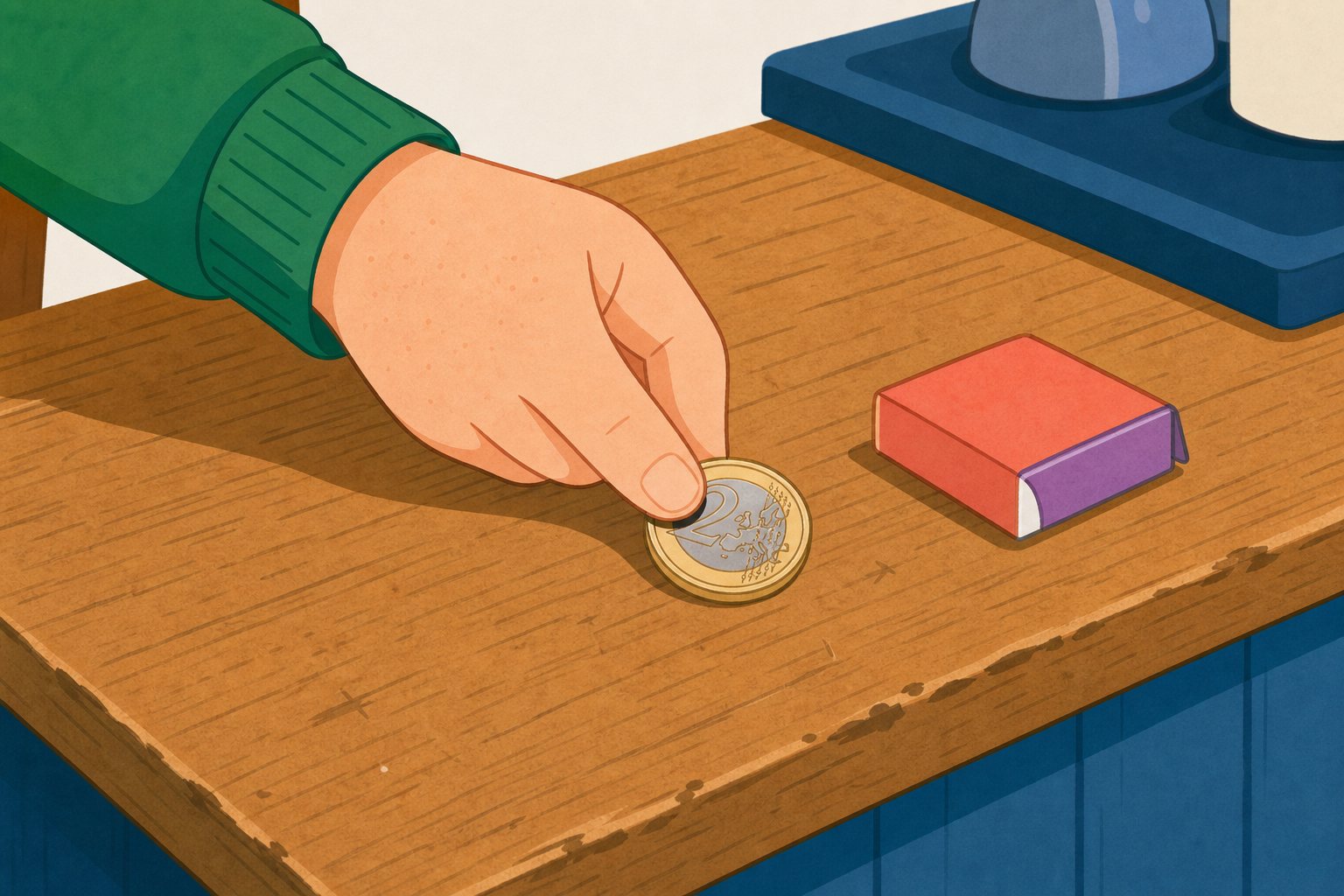
You buy a rubber for €1.30 and hand over a €2 coin at the till. How much change should the shopkeeper give you back? And could you count that change out to yourself, coin by coin, instead of taking the price away?
Take three hands-up answers, not open call-outs. Listen for whether pupils take away or count up — both can reach 70c. Revoice a count-up answer to seed the lesson: so you started at €1.30 and counted on to €2.
Watch how we find change by counting on from the price up to the money paid. The coins on the tray show counting on from the price up to what was handed over. Look for how we hop to the next whole euro first, then keep going.
Now look at a bigger one, where the change carries past a whole euro.
Point to each coin as you count on aloud. For the first tray say 70, 90, 100 — that's 20c to €0.90 and 10c to €1, so 30c change, touching the 20c then the 10c as you go. For the €5-from-€3.45 tray, land on €3.50 first, then €4, then €5 — hold out for the three separate hops. The bridge to the next euro is the move to make stick: crossing several euro is easy once you reach the whole euro first.
Today we build each change problem together on the coin tray. We start at the price and count on to the money paid:
The last one crosses several euro, so we hop to the next whole euro first.
Talk this one through together — pupils take turns at the board and the class agrees or corrects out loud.
Have the pupil at the board start at the price each time and drop change coins onto the tray while the class counts aloud. For the €3.85 item say 15c to €4, then €1 to €5 — €1.15 change. Watch for pupils who reach for subtraction on the tricky one; steer back to the count-on hops. Rotate four pupils.
In your maths copy, work out the change for two purchases, showing your count-on each time:
Write the hops you counted on, for example €1.20 → €1.50 → €2.
Walk the room glancing for the count-on hops rather than a subtraction sum — this is whole-class copybook practice, not marking. Prompt any pupil who is stuck to reach the next whole euro first.
Now it is your turn to solve these, and each one is a step harder:
The last two cross several euro, so count on to the next whole euro before going further. Count on to find the change as usual — when the tool asks for the change in cent, write the whole-euro-and-cent change as cent, so €2.25 is written as 225c.
This is the practice round — pupils take turns at the board, check each answer, and the class confirms before moving on. Keep the board work brisk rather than over-explaining.
Pupils count on to find the change; the tool records it as a subtraction (choose subtract, then type the change), but the thinking stays counting on. Before the two multi-euro items, model writing the change in cent: count on to €2.25, then say that's 225c, so pupils know what to type. The four items land at: 60c → 40c change (the tidy one, worth pausing on), €1.40 → 60c, €2.75 → €2.25 (225c), and €3.85 → €1.15 (115c). Revoice the count-on hops on the last two before checking.
You're previewing this lesson. Get full access to this lesson and hundreds more — each one ready to teach, with interactive activities, printable resources and pupil progress tracking built in.