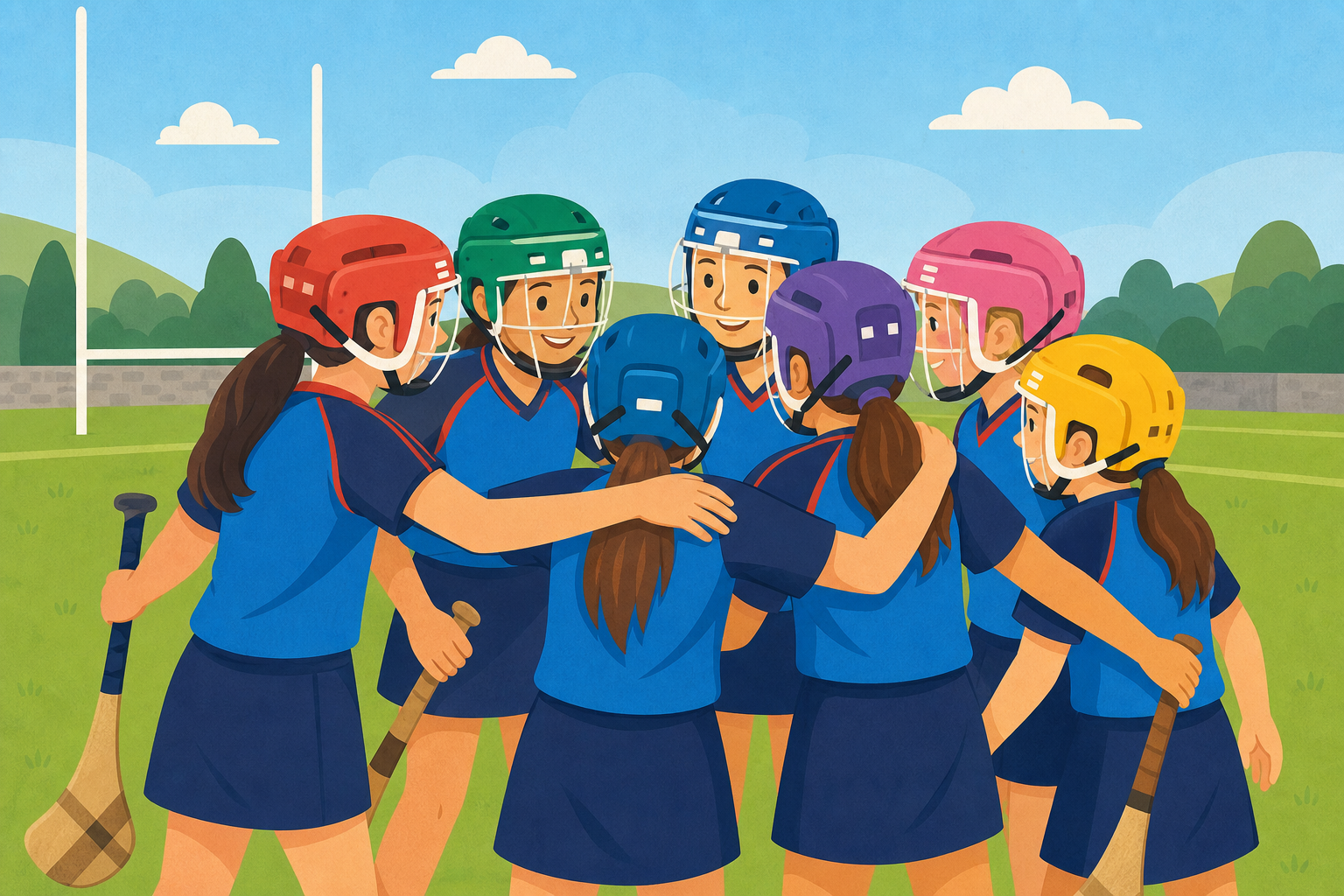
Is this a story where we add, take away, times, or share? What word or picture in the story told you?
Here is a story: a camogie club has 6 teams, and every team has 4 players. How many players are there in all?
You do not have to work out the answer yet. Just this: is this a story where we add, take away, times, or share? What word or picture in the story told you?
Read the story aloud slowly, then take three hands-up answers, not open call-outs. Do not push for the total yet — this hook is only about spotting the action ("6 teams OF 4" is equal groups, so it multiplies).
What in the story made you think that? Revoice a strong answer that points to the phrase, not the numbers.
We will read five short stories together. In each one, listen for the action in the story that tells us which operation to reach for, words like altogether, left, equal groups or shared. Watch the last story closely: it needs more than one step.
Notice how the numbers can be big, but it is the action in the story that tells us which operation to reach for, words like altogether, left, equal groups or shared, and sometimes a story asks for more than one step.
Work each story aloud, underlining the action word before naming the operation. Keep pulling pupils back to the action word — head off the reflex of grabbing numbers and adding.
Story 1, altogether: hurler scores 24 and 18, "in one match AND the next" joins them, adding, 24 + 18 = 42 points.
Story 2, left: Cian had €52, spent €27, "spent" means gone, taking away, 52 − 27 = 25, has €25 left. Ask: added or gone?
Story 3, equal groups: 6 teams, each has 4, "each" is the tell — six equal groups, multiplying, 6 × 4 = 24 players. Pause and let them predict the operation before you reveal it.
Story 4, share fairly: 18 medals shared equally between 3 teams, division, 18 ÷ 3 = 6 each. Link back to Story 3 — times and share are opposites.
Story 5, two-step: shop has 45 sliotars, sells 28, then 20 more arrive. Ask how many events happen before writing anything — two. Take away first: 45 − 28 = 17. Then add: 17 + 20 = 37 sliotars. Write both sentences one under the other so they see 17 feed into the second step.
We work through four stories together, one at a time. For each one: read it, find the action word, name the operation, then write the number sentence. Check each answer before moving on.
This round is for talking it through together — pupils take turns at the board and the class agrees or corrects out loud. Keep it brisk: four turns in eight minutes is about two minutes each.
Work the stories in the order shown; the round builds from a plain add through change, equal groups, and finally a fair share so all four single operations are met. For each story, before the pupil at the board writes, put the whole-class pacing question to the room — which word told you which operation? Take a couple of hands-up answers, then the pupil at the board underlines the action word and says "add / take away / times / share" before writing the sentence. This keeps the back rows with each turn instead of watching one pupil write in silence.
In your maths copy, choose one of the problems we worked on the board. Write the operation you chose, the number sentence, and the answer as a full sentence with its units.
For example: Operation: adding. 35 + 28 = 63. The team scored 63 points altogether.
Keep the four Try It Together stories visible on a chart or on a section of the board that you do not wipe, so pupils have the numbers to copy from. Walk the room glancing for the units in the final sentence (points, euro, cones, hurleys) and the correct sign in the number sentence — this is whole-class copybook practice, not marking. No collecting in.
Five stories for today's challenge, from easiest to trickiest. For each one, name the operation and write the number sentence, then check it before the next. The last story needs two steps.
These are the practice questions — five stories, five board turns. Pupils take turns at the board, name the operation, write the number sentence, and the class confirms the answer before moving on. Keep the board work brisk rather than over-explaining.
The stories rise in difficulty: a plain add, a "how many more" gap (subtract by counting up), equal groups (× 5), a fair share (÷ 6), and finally the two-step story that mixes take-away then add — the same shape as Story 5 in Watch and Notice. The last one is the key one — ask the class how many steps it needs before anyone writes, and remind them it needs two number sentences.
You're previewing this lesson. Get full access to this lesson and hundreds more — each one ready to teach, with interactive activities, printable resources and pupil progress tracking built in.