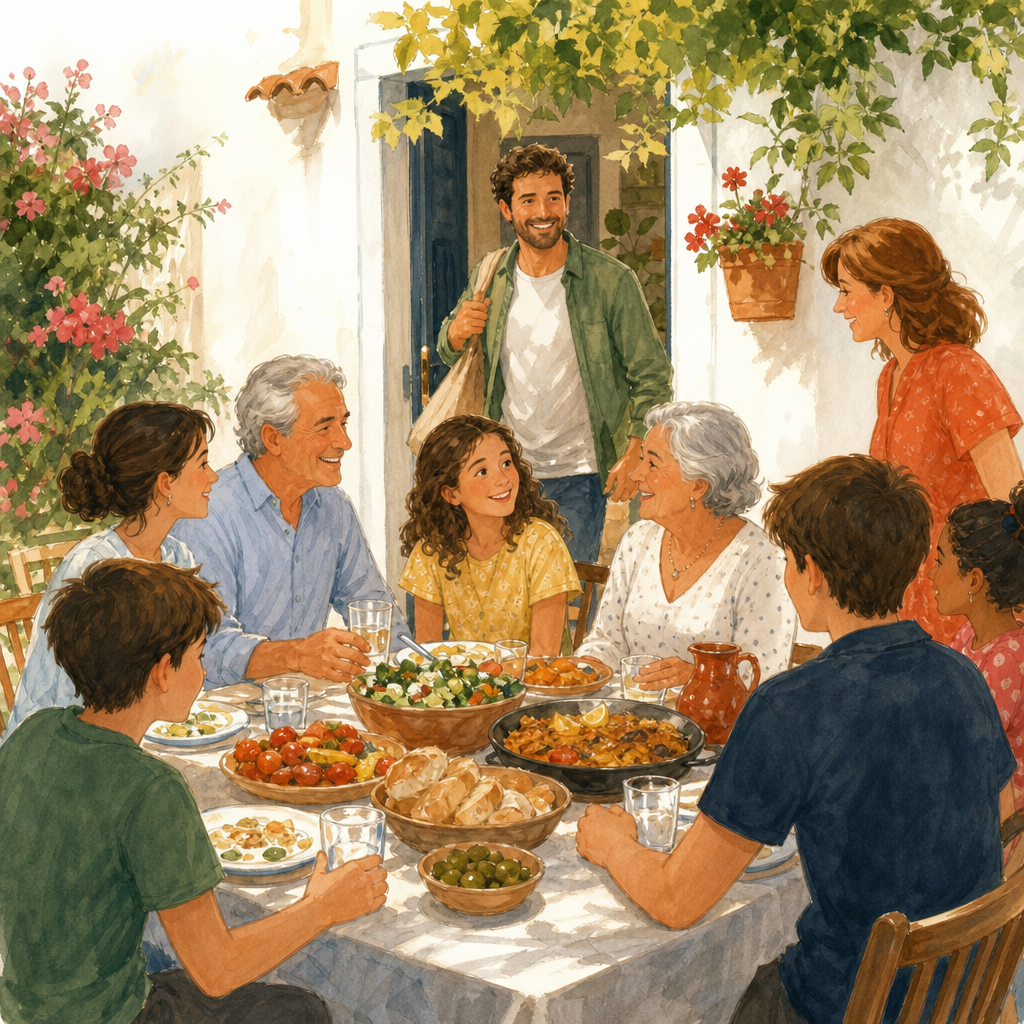
How many people would you name if you drew your family? Hold up your fingers. Today we meet Lucía's family in Valencia at Sunday lunch and learn seven Spanish words for the people around the table, always with the little words el and la in front.
Collect a few finger counts around the room, no more than half a minute. Do not list Spanish words yet. The flashcards in the next step introduce them one at a time with audio. Keep the Valencia Sunday-lunch frame light: abuelos at the table, tío at the door later in the listening scene.
English on the front, Spanish on the back. First time through each card: listen to the audio (or your teacher), look at the Spanish with el or la, then say the full phrase with the class. The letter h in hermano and hermana is silent: do not say it. If we run the deck a second time, you can try the Spanish before the flip.
For each card: play audio (or model from the guide) → reveal Spanish → class repeats twice with you pointing at el/la.
Run this on the IWB with volunteers taking turns. After each reveal, the whole class repeats twice: once together, once by table. Pronunciation guides: el padre (el PAH-dreh), la madre (lah MAH-dreh), el hermano (el ehr-MAH-noh), la hermana (lah ehr-MAH-nah), el abuelo (el ah-BWEH-loh), la abuela (lah ah-BWEH-lah), el tío (el TEE-oh). Celebrate the silent h when the class nails hermano: big reaction. Insist on the accent in tío. Optional second pass only if time allows: pupils try saying the Spanish before the flip.
First, a quick warm-up: look at the seven family pictures and say each full phrase with the class (el or la plus the word). Then listen to Lucía in Valencia describe who comes to Sunday lunch. Listen carefully; then we choose the match on the board together. You will hear today's words inside full sentences, not on their own.
Play the full clip twice on the class speakers, pens down and eyes on the board the first time. After the second play, take answers with fingers or a partner whisper, then check together and ask what clue gave each one away. The written text is shown on screen as well as spoken.
What the clip actually says.
Isabel: ¡Hola! ¿Tienes hermanos o hermanas? (Hello! Do you have any brothers or sisters?)
Carlos: Sí, tengo dos hermanos. (Yes, I have two brothers.)
Carlos: ¿Y tú? (And you?)
Isabel: Tengo una hermana. (I have one sister.)
Isabel: ¡También tenemos un bebé en casa! (We also have a baby at home!)
Carlos: ¡Qué bien! ¡Me encantan los bebés! (That's great! I love babies!)
The questions the class will be asked, and the answers.
Before you start: the only word from today's list that is in this clip is el hermano, la hermana. The rest of it is other vocabulary, so tell the class to catch what they can rather than hunt for today's words.
If the speakers or the interactive fail, read the lines above aloud yourself, twice, then ask the same questions.
Copy all seven family words into your copy, each with its article. Take the spelling from the list on the board. Then put a star beside the ones that fit people in your own house. Every family shape is welcome; we still practise all seven spellings.
Word bank (copy these exactly):
Pause the board on this step so the word bank stays visible. Everyone writes; this is the only three minutes where every pupil's pen is moving. Task order: (1) copy all seven with el/la from the list, (2) star the ones that match their household. Accept every family shape (no uncle, two grandmothers, carers, and so on). Do not ask pupils to invent words that are not on the list. Walk the room and check the article sits in front of every noun. A bare list of padre, madre will not carry the gender pairing. Do not collect these.
Every Spanish family word travels with a little word in front: el or la. Sort each family member into the right group. Say the full phrase out loud as you sort, like you mean it: el abuelo deserves a grand voice.
Run on the IWB. After each sort, the class repeats the full phrase once. Quick check key: el → el padre, el hermano, el abuelo, el tío; la → la madre, la hermana, la abuela. If a pupil drops the article, prompt "full phrase" and point at el/la. Cheer a clean sort of all four el words in a row.
Optional stretch (only if a pupil finishes early and asks for more): offer one of these backed extras, do not open the floor to unlisted words: la tía (aunt, lah TEE-ah), el primo (male cousin, el PREE-moh), la prima (female cousin, lah PREE-mah). You say it first; they repeat and sort.
You're previewing this lesson. Get full access to this lesson and hundreds more — each one ready to teach, with interactive activities, printable resources and pupil progress tracking built in.