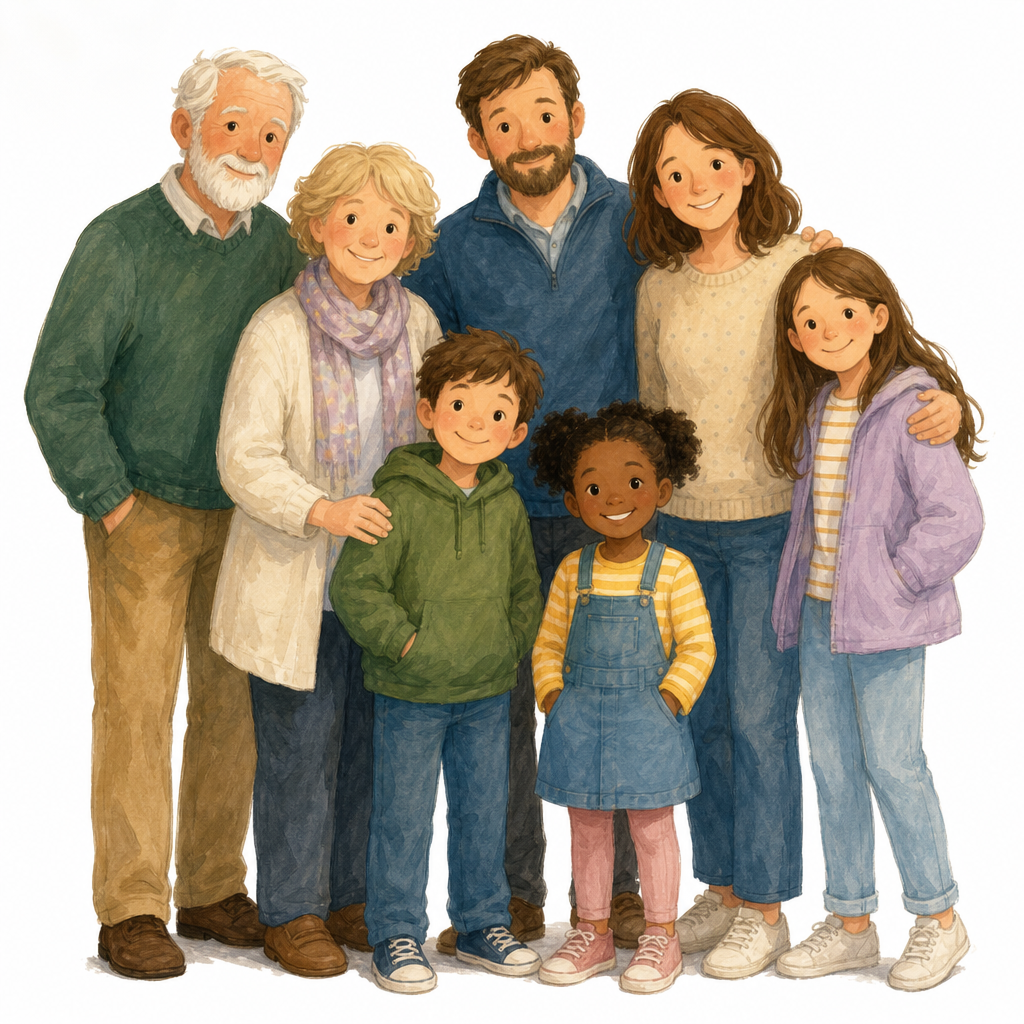
How many people would you name if you drew your family? Think for a moment: parents, brothers or sisters, grandparents, maybe a baby.
Today you will meet seven German family words through a photo from Sunday Kaffee und Kuchen (coffee and cake) in Munich. You will hear a short family description and sort the words by der, die and das.
Collect three or four quick answers about who pupils would draw. Keep it light and inclusive: some families are large, some are small, and some include grandparents or carers. Do not dig into private detail.
Tell the class that German gives every noun an article, just as they met with fruits and vegetables earlier in this module, and that family words do the same. Sketch the Munich Sunday scene in one line so the seven words feel attached to a real kitchen table, not a bare list.
These seven words unlock almost every family chat in German. Look at the English on the board. When the card flips and the audio plays, join in and say the full German form with der, die or das big and clear. Listen first, then say.
Run this as whole-class flashcards on the board. Do not ask for unaided German before the first audio model. For each card: show the image/English, play the audio, then have the class repeat the full form twice (once all together, once by table). Keep every card visible as a set once met.
Teach in two chunks so seven new pairs do not land in one burst:
Finish with a whole-set chorus of all seven full forms before leaving the step. Point at the article every time and say the pair as one unit. Watch for the soft sch in die Schwester and the open ah in das Baby. If anyone skips the article, gently restate the full form and have the class echo it.
Picture Sunday Kaffee und Kuchen in Mia's kitchen in Munich. You will hear a short description of who is in her family. Listen all the way through twice before anyone answers. You already know more than you think.
Then answer together:
Primary delivery (use this script — it uses only the seven taught forms): Do not depend on the interactive clip matching the taught set. Read the script below aloud twice on class speakers volume, books closed, eyes on the board. After the second reading, take answers to the three on-screen questions. Replay any short phrase if several hands go up.
Script (read slowly, full forms clear):
„Das ist die Familie von Mia. Hier ist der Vater und hier ist die Mutter. Das ist der Bruder und das ist die Schwester. Der Großvater und die Großmutter wohnen in München. Und hier ist das Baby!“
English sense for you only (do not read this to the class): This is Mia's family. Here is the father and here is the mother. This is the brother and this is the sister. The grandfather and the grandmother live in Munich. And here is the baby!
Target answers:
Before the first reading, set the Munich Sunday scene in one sentence and point at the still-visible word list so pupils know which seven forms to listen for: der Vater, die Mutter, der Bruder, die Schwester, der Großvater, die Großmutter, das Baby.
Optional board interactive: The listen-answer interactive may be opened if you have pre-checked it. Only use its audio when you are sure every prompt stays inside the seven taught forms above. If it names other family words, close it and stay with the teacher script. The pedagogical listening goal is met by the script either way.
Go through the answers together and ask what German word or clue told them each one.
Open your copy and write the family words that fit your family, each with its article. Use the word list on the board. Copy only the people who matter in your family; you do not need all seven.
Leave a full on-screen or board list of all seven forms visible for the whole three minutes: der Vater, die Mutter, der Bruder, die Schwester, der Großvater, die Großmutter, das Baby. Model one example line first (for example die Mutter), then pupils write.
Pupils choose the people who matter in their family. They do not need a full set of seven, and carers or grandparents who live elsewhere are fine. Walk the room and check that every noun has der, die or das in front of it. A bare list of nouns will not carry the gender pairing. Do not collect or mark these copies.
These are the people in Mia's family photo from that Munich kitchen. Drag each family word into the correct column: der, die or das. Think about the article you heard with each word. das Baby is the sneaky one. Celebrate if your table drops it in the right column first time.
Before any dragging, run a 60-second oral recap with the full list still visible: you say the English, the class answers with the full German form (der Vater, and so on). Then open the sort screen.
Lead with the column headers der / die / das. Treat masculine / feminine / neuter as small secondary labels only so the grammar jargon does not crowd the board.
Model the first drag yourself. Say the full form aloud as you drop it, for example der Bruder (dair BROO-der) into the der column. Then invite volunteers or let tables take turns on the board. Keep the Munich photo framing in one line so the sort feels like sorting Mia's family, not a bare word list.
If a word is sorted wrong, drag it back and ask the class which article they heard on the flashcards. Celebrate correct use of das Baby (dass BAH-bee) in the das column. There is no spelling rule that always predicts the article; the pair is what they learn.
You're previewing this lesson. Get full access to this lesson and hundreds more — each one ready to teach, with interactive activities, printable resources and pupil progress tracking built in.