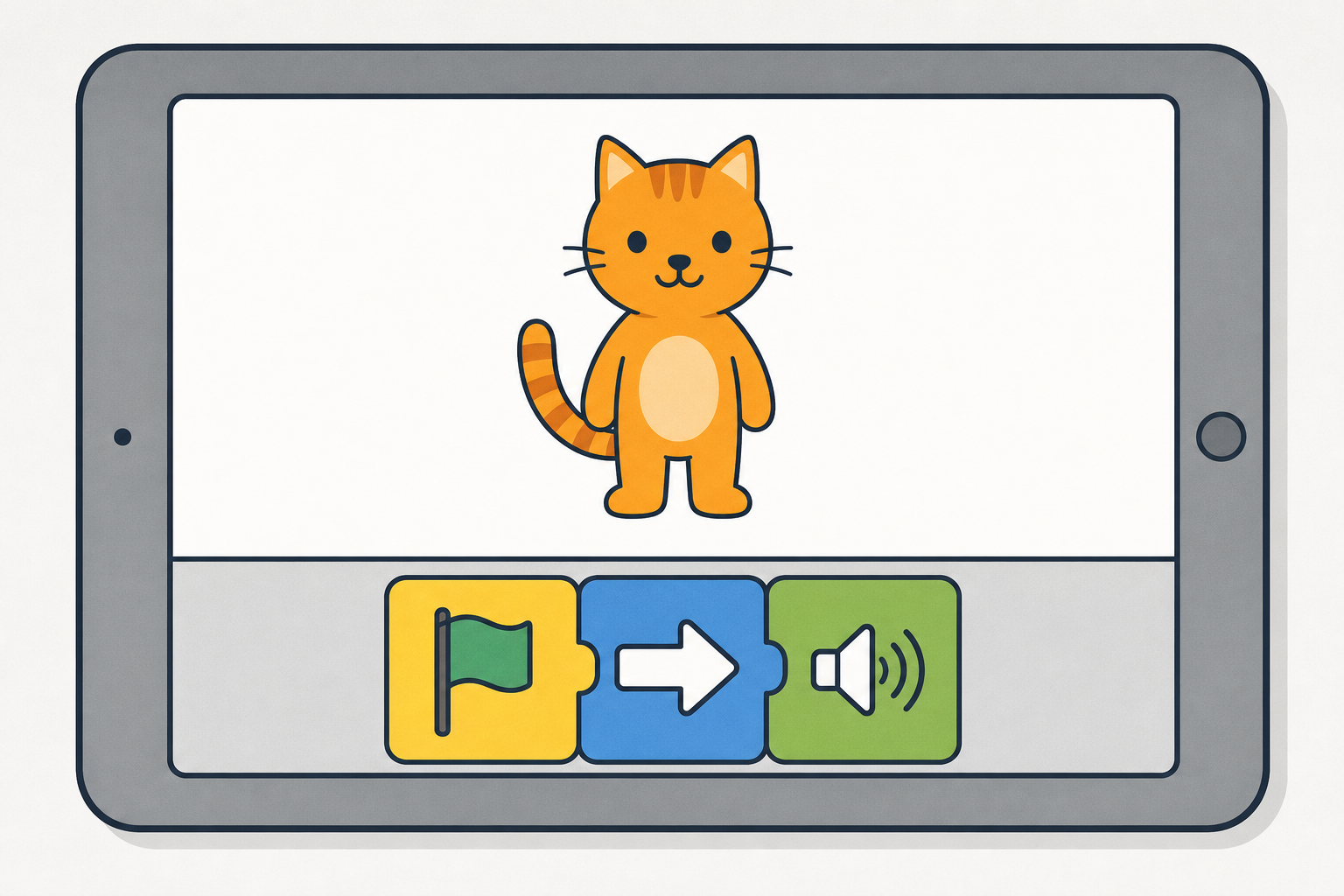
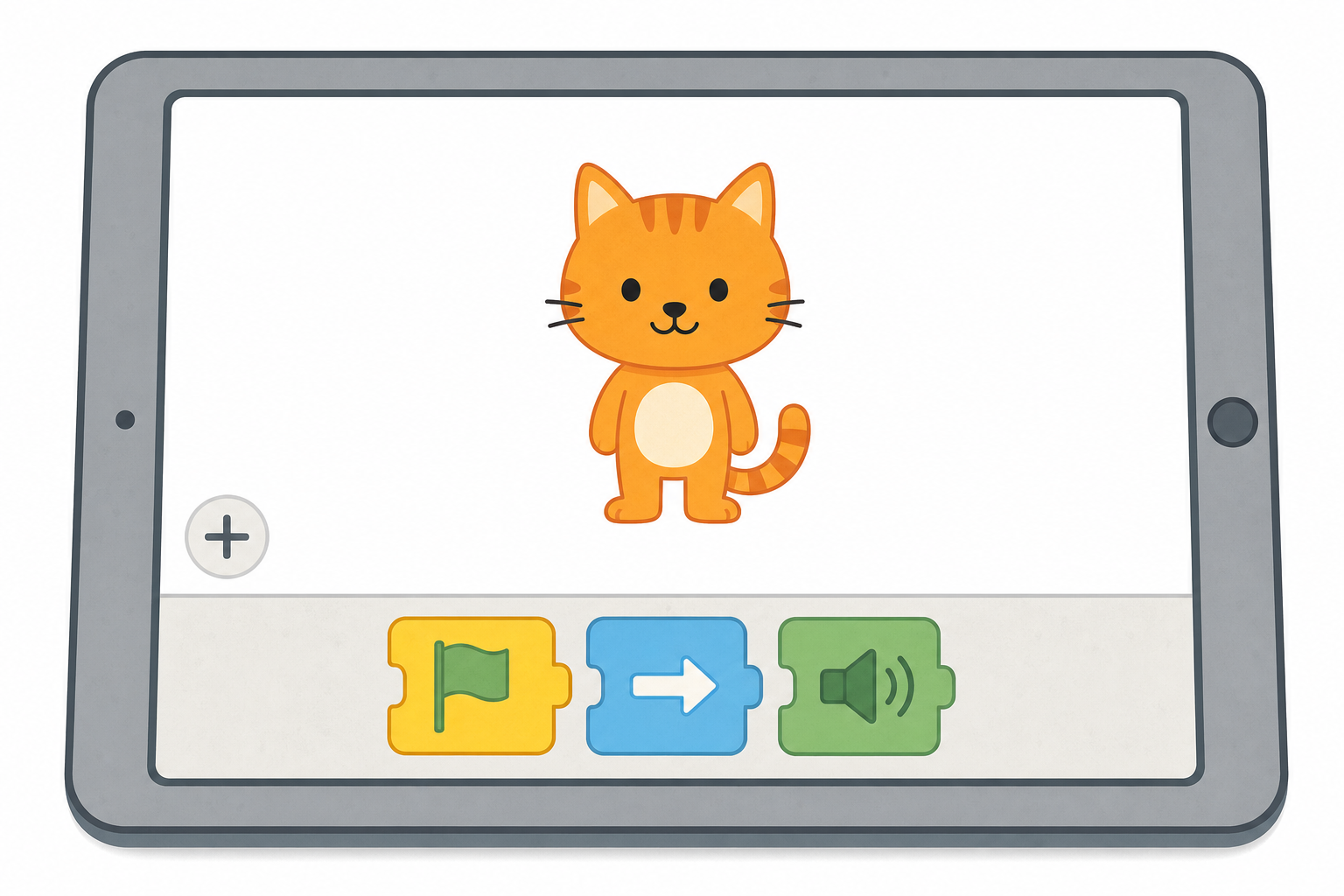
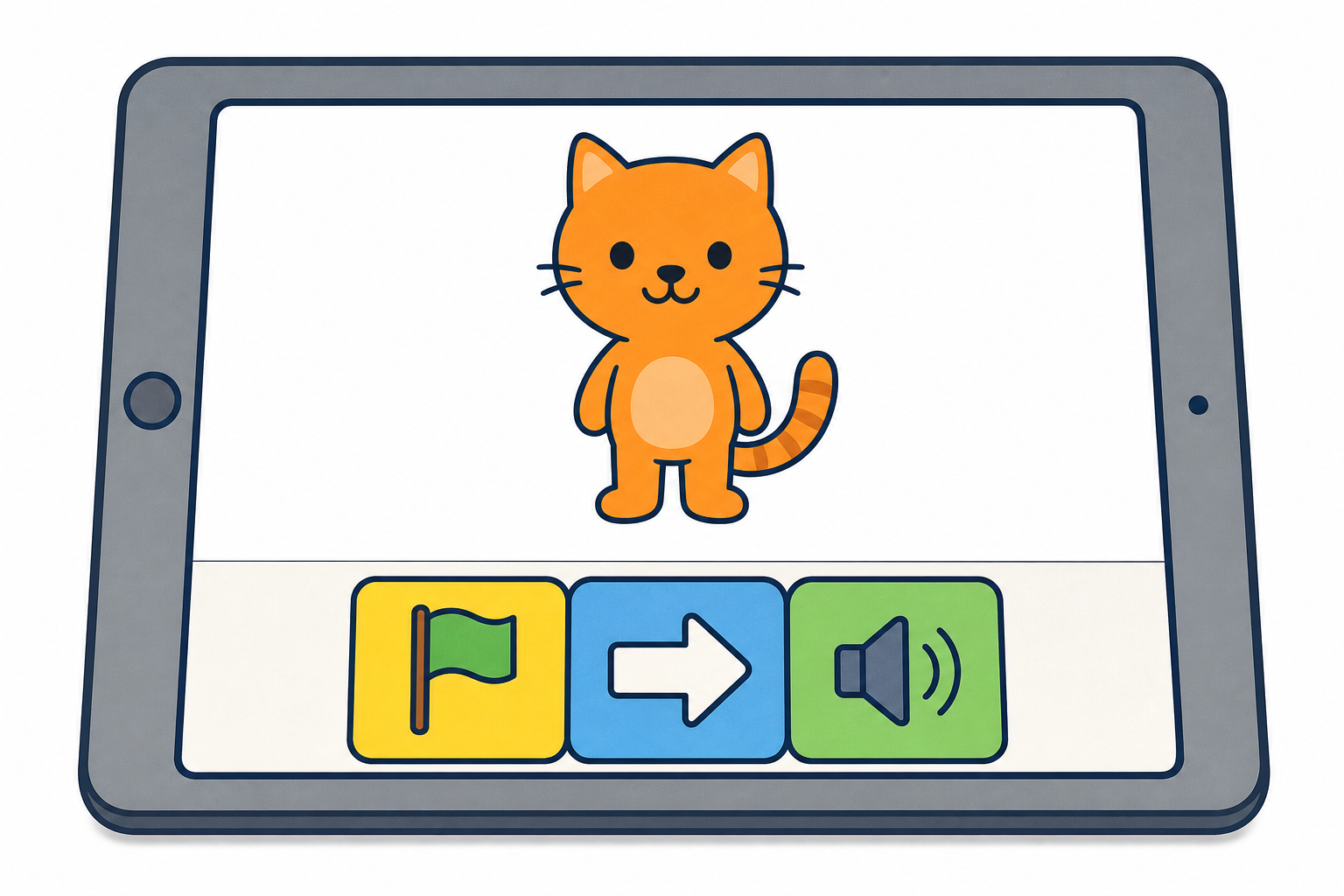
Today we open ScratchJr and snap picture blocks so a character moves and makes a sound.
When you tap a game and a character jumps or makes a noise, someone put those steps in order first, like a recipe. What do you think a picture block might tell a character to do?
Keep this light. Hold up a tablet (or point to the IWB) and ask one curiosity question only. Do not open ScratchJr or name every block yet. That comes in the model step.
STEM eyes: apps on a tablet are made from ordered steps, just like the everyday routines and floor-robot moves the class already knows.
Have tablets charged and unlocked nearby, but leave them closed until the exploration step.
Watch on the board. We open ScratchJr, add a character, and snap a short line of picture blocks. Predict: what will the character do when we press the green flag?
Drive ScratchJr on the IWB (or a tablet mirrored to the board). Think aloud at each beat so pupils hear the full cycle once before they try.
Key questions: Which block do we start with? What happens if we swap the move and the sound?
Misconception to head off: pupils may think the character guesses what to do. Stress that it only does the blocks we snapped, in order from left to right.
If the school has no pupil tablets, this same model is the whole-class path for the next steps: pupils call out which block to add while you drive the board.
With your partner, open ScratchJr. Tap the + to start a new project, just like we did on the board. Add one character you both like. Do not drag or snap any blocks yet. Wait until we say go.
If we are using one device on the board, watch closely. When it is your pair's turn, call out the next tap for the teacher.
Before the lesson: charge tablets, install or open ScratchJr, and set volume to a class-friendly level. One tablet per pair is ideal. Low-cost path: one device on the IWB and pairs take turns calling the next tap while others watch and coach.
Single-device path (run this if pairs have no tablet): Keep ScratchJr on the IWB. Invite one pair at a time to stand near the board and call the next tap (open app, tap +, choose a character). The rest of the class watches and checks the callers are following the model. Rotate so several pairs get a turn; watching and coaching counts as real participation.
Support: sit with pairs who stall at the home screen; use calm voice cues and point back to the IWB model of the + and character buttons.
Stretch: change the background once the character is on stage, still without coding yet.
Circulate with calm voice cues: Open ScratchJr. Tap the +. Choose one character. Leave the blocks alone for now.
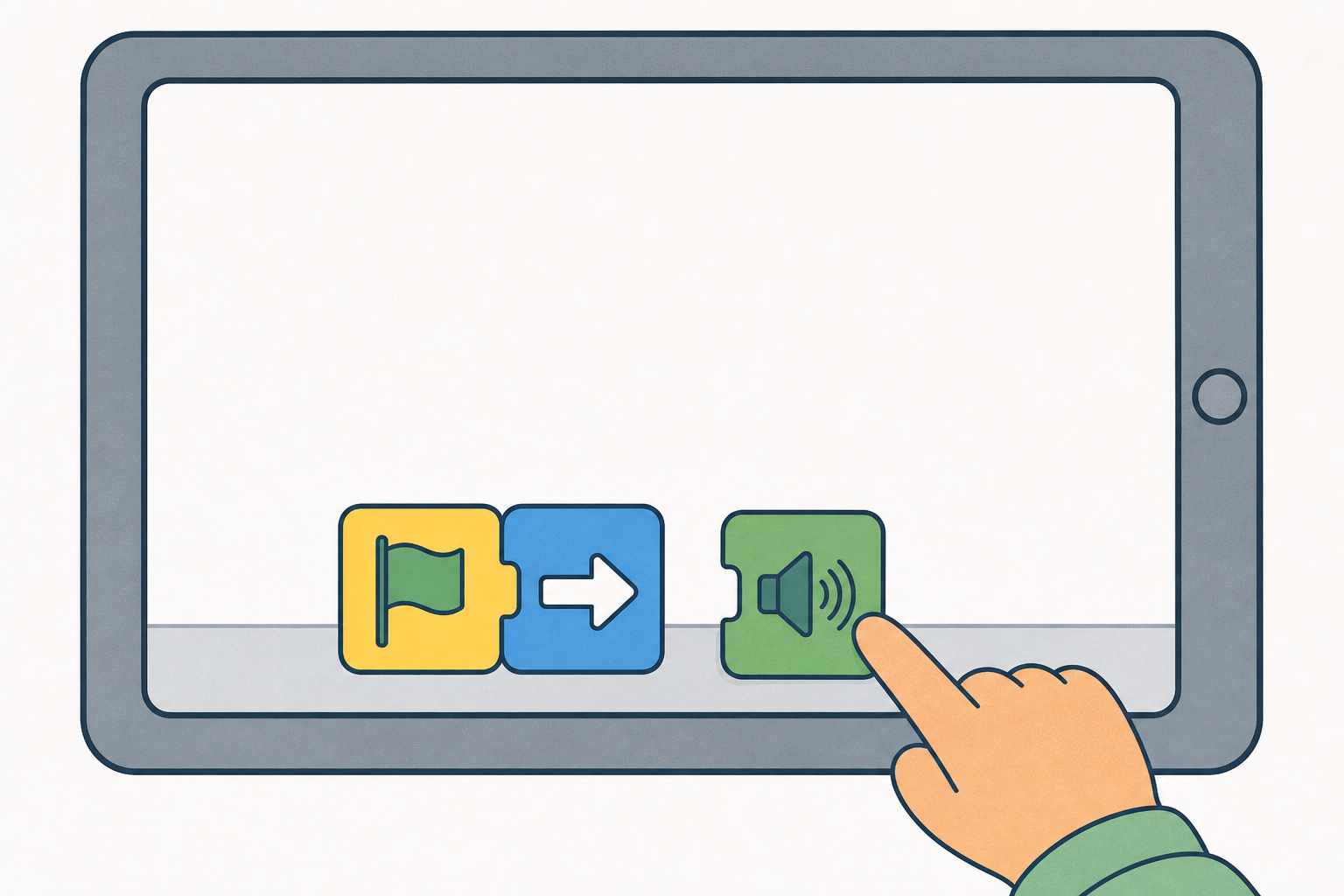
Snap a short line of blocks, just like the one on the board:
Then tap the green flag and watch. Your teacher will help if you need to fix anything.
This is the investigation heart. Keep the goal small: green flag + one move + one sound (or pop/looks block). Name the blocks on the board as pupils work so everyone uses the same words.
Pair roles (say once before they start): one partner chooses the next block, the other snaps it on; after the first run, swap jobs so both get a turn.
Mid-step gather (about halfway, ~6 minutes in): Pause the room. Put one clear working line on the class device (rebuild it yourself, or borrow a pair's short success and show it on the IWB if mirroring is easy). Run green flag → move → sound once for everyone. Ask: Are the blocks in a good order? What would you try next? Then send pairs back for one more short try if time allows. This guarantees every pupil sees a successful run before journal time, even if many pairs are still stuck.
Pacing lever: if most pairs still have no run after the gather, stop pair work and finish on the class device with pupils calling the next block. Do not overrun into the draw step.
Class fold-in: when a pair's line is on the board, ask the rest: Are the blocks in a good order? What would you try next? Watching is real participation. You do not need every pair mirrored; one shared success is enough.
Common snags: blocks not snapped (gap between them); missing green flag; too many blocks so the character leaves the stage. Celebrate a short working line over a long broken one.
No scoring on the device. Success is a working sequence the pair can show once.
Support without extra cards: point to the named blocks on the IWB model and sit with the pair for the first snap.
Before the next step: screens off and tablets closed (or collected onto charge). Do not leave live ScratchJr on desks during drawing.
Tablets are closed now. On your Investigation Journal page, draw the character and the short line of blocks. You can draw your own short line of blocks, or the class line from the board. Show the character, the blocks in order, and what the character did.
First: screens off; close or collect tablets onto charge before anyone picks up a pencil. Live ScratchJr on the desk will pull attention off the journal page.
Pupils record on the paper Investigation Journal page only. Do not invent extra columns or a second sheet.
Prompt aloud: draw your character; draw the blocks in order (even as simple coloured shapes); draw or tell what happened (moved, popped, made a sound).
If a pair only watched the IWB, or their own run did not work yet, they still draw the class sequence you built together. Say that clearly so nobody freezes.
Look-fors: blocks shown in a line; green flag at the start; a note or picture of the result.
You're previewing this lesson. Get full access to this lesson and hundreds more — each one ready to teach, with interactive activities, printable resources and pupil progress tracking built in.