Watch me: wave, then clap. Can you do those two steps in the same order?
Today we will tell a character on a tablet two steps, using an app called ScratchJr.
Stand where everyone can see you. Do two clear actions in order (for example wave, then clap). Invite the class to copy. Keep it joyful and short.
Say that the character on the tablet will only know what to do if we give it steps in order, just like the class did. You already know steps need a right order; today those steps are picture blocks in ScratchJr.
Before the lesson: charge the tablets, open ScratchJr once on each device so it is ready, and have one device (or laptop) ready to mirror on the IWB for modelling. If you have no class set of tablets, plan to drive ScratchJr on the IWB and let pairs take short turns choosing the character and blocks.
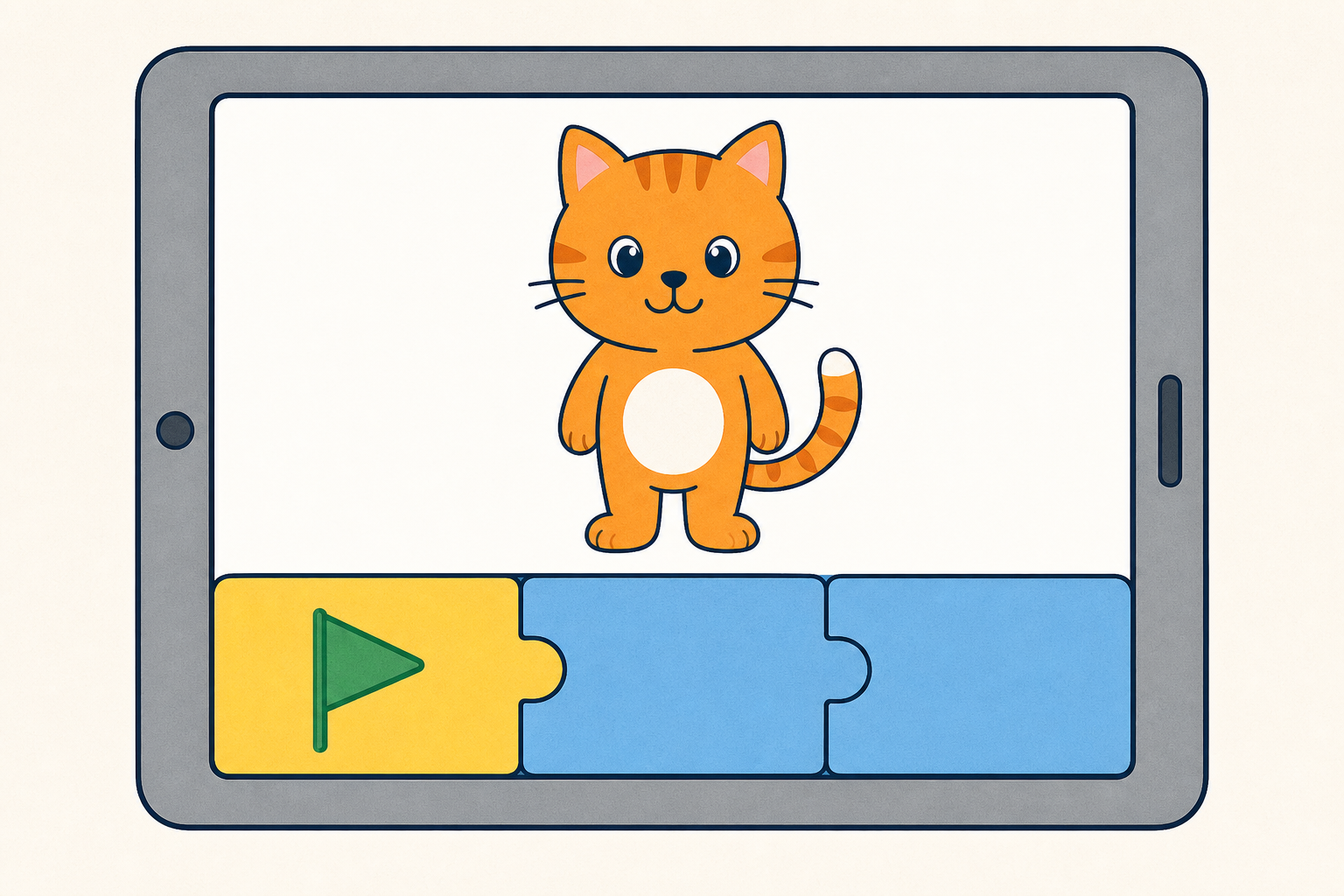
This is ScratchJr. Watch the board. What will the character do when I press go?
Drive ScratchJr on the IWB so every child can see. Think aloud through one full, simple model before anyone touches a tablet. Keep the board almost empty of text: the live stage is the teaching tool.
One idea for children to hold: the blocks run in order. Name ScratchJr, block and character only as you point to them on screen during the model, not as a list to learn.
| Concept | Why it matters | Example |
|---|---|---|
| Order — the line the blocks run in, from start to end | If the order changes, the dance or move changes too | Move then pop is different from pop then move |
| ScratchJr — an app where we snap picture blocks to tell a character what to do | It lets us give a character steps without needing to write words | When we press go, the character does each block in the order we put them |
| Block — a picture instruction we snap into a line under the stage | Each block is one clear job the character can do | A move block makes the character walk; a pop block makes a little sound |
| Character — the person or animal on the stage that follows the blocks | We need someone on the stage before any blocks will run | We pick a cat, a child or another friend and it acts out our steps |
I wonder: can I make a character move and then pop?
I predict: if I snap a yellow start block, then a move block, then a pop block, the character will walk first and pop second when I press go.
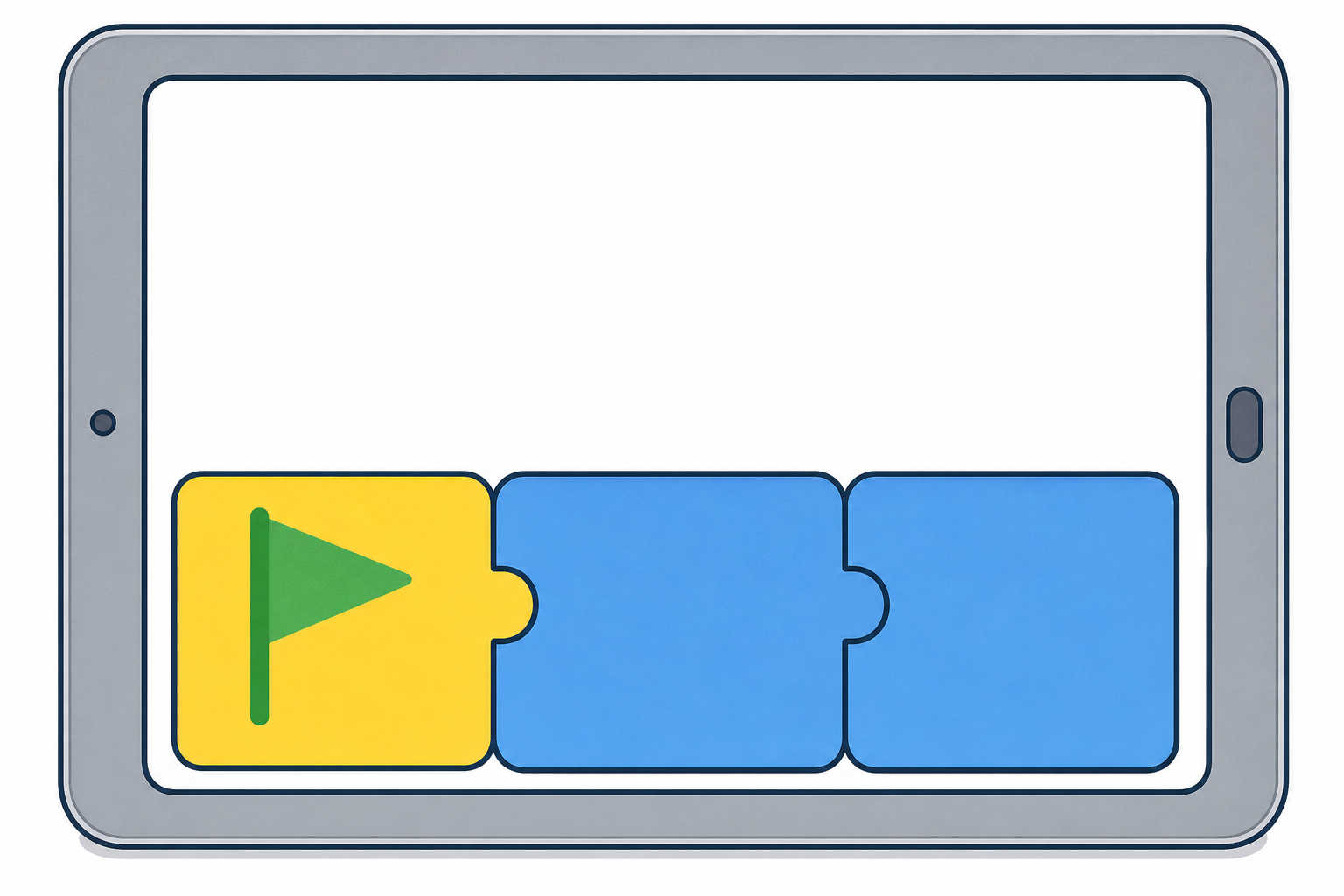
I try: open ScratchJr, add one character, drag the yellow Start on Green Flag block first, then snap a blue move block beside it, then snap a green pop (sound) block beside that, press the green flag. As each thing appears, point and name it once: “This is our character… this yellow block starts the line when we press go… these are our action blocks… now they are in order.”
I noticed: the character walked, then popped. It did the first action block, then the second.
I think: the character follows the blocks in the order we snap them, starting from the yellow start block.
If it misbehaves: check the yellow Start on Green Flag block is first in the line, that the action blocks are snapped tight beside it in that character’s scripting area under the stage, that a character is on the stage, and that you pressed the green flag (not only dragged the blocks). Without the yellow start block, pressing go will not run the line. If the room is noisy, mute the pop sound after one demo and watch the movement instead.
Misconception to head off: children may think tapping the character makes it move by magic. Name the blocks as the instructions. The character only knows what the blocks say.
Your turn to choose. Which two blocks shall we try on the board? Call out your ideas and we will snap them, then press go.
Keep this whole-class and teacher-driven on the IWB. Invite two or three children to name a block (move, jump, spin, pop or similar icon blocks available in your ScratchJr version). Keep the yellow Start on Green Flag block at the start of the line. Snap exactly two action blocks in the order the class agrees, then press go.
Ask the watchers: Did it do the first block first? What would happen if we swapped the two blocks? If time allows, swap the two action blocks once and run again so the class hears that order matters.
Fold everyone in by hands-up predictions before you press go. Do not send anyone to a tablet yet.
When it is your pair’s turn:
1. Pick one character
2. Stick the yellow start block, then two action blocks
3. Press the green flag
Watch what the character does!
If you are waiting, your job is to predict and watch the order until it is your turn.
Keep a large three-step picture sequence on the IWB and point to it while pairs work: (1) a character face or figure, (2) a yellow start block snapped to two stuck action blocks, (3) a green flag. Seat pairs at tables if you have a class set of tablets (one tablet flat between each pair). Adults open ScratchJr if a pair cannot. Keep the IWB model visible as a reminder of the short block line.
Drive ScratchJr on the IWB yourself. Invite pairs up for short chooser turns: the pair names the character and two action blocks; you (or a confident child under your hand) place the yellow start block first, snap the two action blocks, and press go. Between turns, the class predicts and watches the order. Aim for several fair pair turns rather than promising every pair a full independent session in 13 minutes. If time runs short, some pairs may only choose while others watch and talk; fold watchers in with prediction questions. The IWB text already names both jobs so you do not need to reframe ownership live.
Differentiation: some pairs only manage the yellow start plus one action block and go; celebrate that. Confident pairs may add a third action block if both partners agree, still without a target to hit.
Look-fors: yellow start block first, action blocks snapped in a line, green flag pressed, partners taking turns, talk about what the character did first and next.
Hands up: what did your character do first? What did it do next?
Whole-class oral share on the carpet or at tables. Invite three or four pairs to say one thing their character did first, then next (moved, popped, jumped). Revoice with the words block, order and character only as labels for what they just saw.
Keep the share concrete. If you want the Nature of STEM thread, add one gentle teacher sentence after the share, not as a hands-up question: People who build tablet apps put steps in order, a bit like our blocks. Use the label “app-makers” only if children are ready; do not require an answer.
No writing and no typing. Keep praise on trying, snapping and watching, not on a perfect dance.
Common misconception: “The tablet did it by itself.” Answer: we gave the instructions with the blocks; the character only followed our order.
You're previewing this lesson. Get full access to this lesson and hundreds more — each one ready to teach, with interactive activities, printable resources and pupil progress tracking built in.