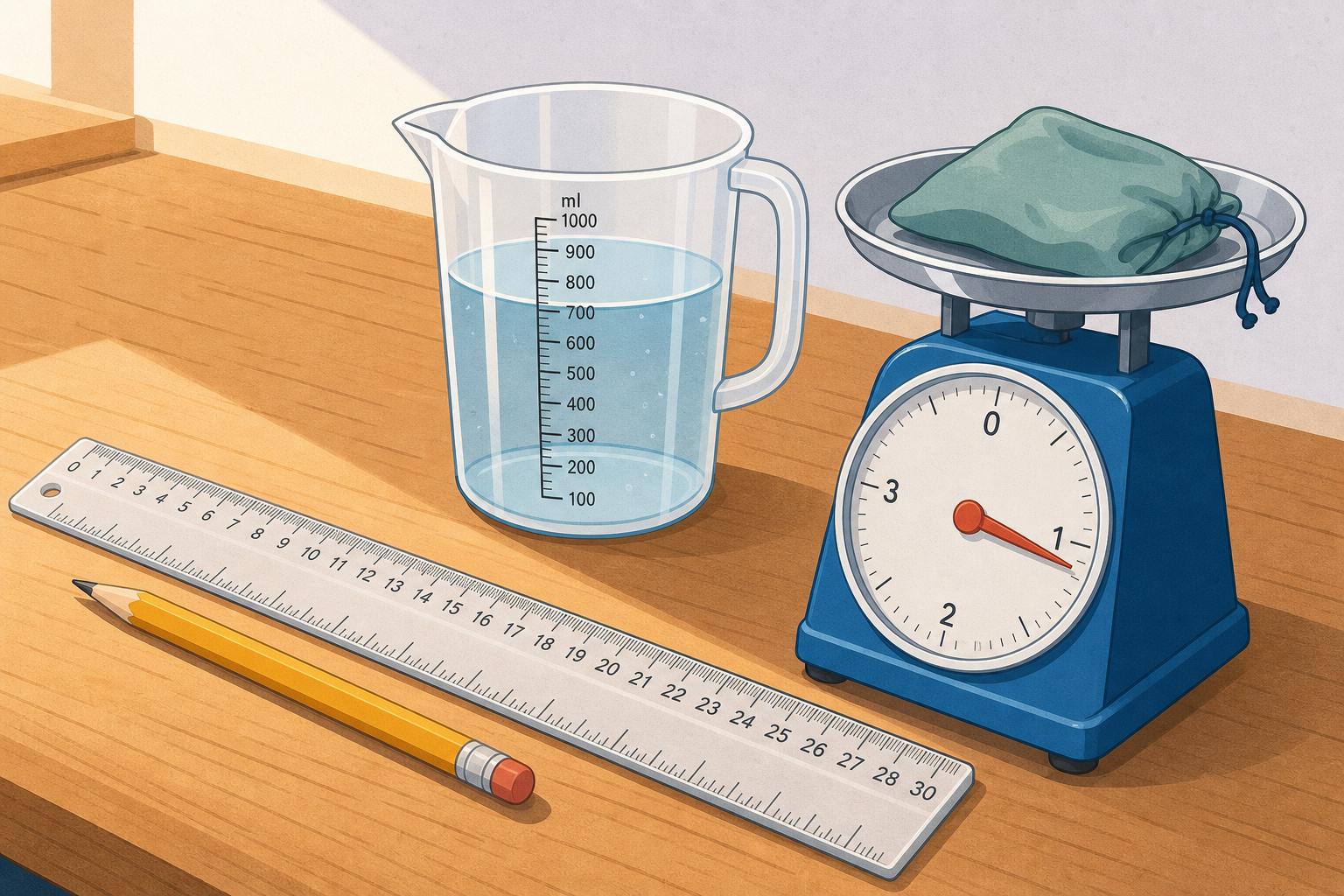
Here are three instruments, and on each one the pointer has stopped between two marks: a ruler measuring a pencil, a jug of water, and a weighing scale with a bag on it. What is each one reading? And how did you decide about the marks that have no number written on them?
Take three hands-up answers, not open call-outs. Hold out for the trickier third question: how did you read the marks with no number? Do not resolve it yet — that is the whole lesson.
The interactive shows a pencil measured against a ruler. Watch where the pencil's right edge lands and how we work out what one small mark is worth before reading it off. Then we will read a real scale and a real jug the same way — always check what one mark is worth before you compare.
Ruler on screen: pencil's right edge falls between 14 cm and 15 cm, halfway across the mm divisions, so 14.5 cm.
Point to two numbered marks, have the class count the small gaps before reading the pointer — this is the load-bearing move. Say the rule: work out one division first, then read.
Hold up a real ruler: read it from directly in front, then deliberately from the side so the reading shifts. Name it — parallax.
Real jug: marks 0 and 500 with 5 equal gaps, so 500 ÷ 5 = 100 ml per mark; water at third mark reads 300 ml.
Real mass scale: each small mark 50 g, needle two marks past 1 kg reads 1.1 kg.
Scale and jug are done with the real instruments, not on screen — the ruler is the only on-board example.
Now you measure with your own instruments. First, on your own at your desk, estimate then measure a pencil or copybook edge on your ruler to the nearest millimetre. Read it square-on. Say what one small mark is worth.
Next, take turns on the shared group instruments. Estimate then weigh a small object on the group scales to the nearest 50 g. Estimate then pour water into the group jug and read the level to the nearest 100 ml, with your eye level with the mark. Each time, estimate first, work out what one small mark is worth before you give your answer.
The length reading is individual (every pupil has a ruler); the mass and capacity are taken in turn on the shared group scales and jug. To stop a queue forming, stagger the start: have some groups begin with the mass reading and others with the capacity reading, so both shared instruments are in use at once. Circulate and catch alignment slips on the spot.
Listen for the value-of-one-division step being skipped — that is where readings go wrong. Revoice a good example: five gaps to 500 ml, so each mark is 100 ml.
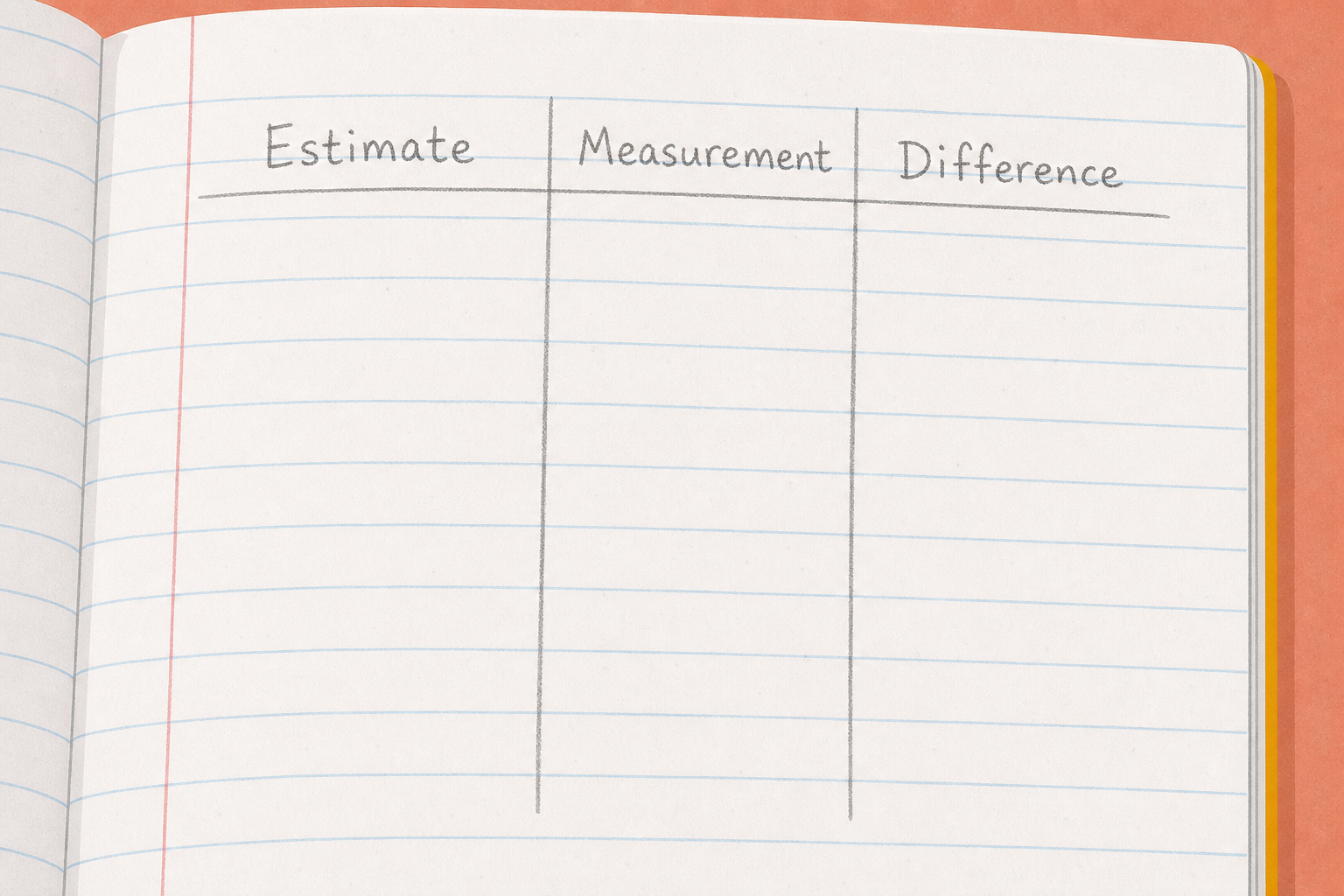
In your maths copy, make three columns: your estimate, your precise measurement, and the difference between them. Record each of your three items — the length, the mass and the capacity — one to a row. Write the unit beside every number.
Walk the room glancing at whether the unit is written on every value and whether the difference column subtracts the right way round — this is whole-class copybook practice, not marking.
Time to measure the long edge of three things in the room and rank them by length. In your groups, you will measure three edges. First measure the long edge of your desk top. Then measure the long edge of a book cover. Then measure the long edge of a notice board or wall display. For each edge, estimate first, then measure the length precisely and record it. When all three are done, put them in order from shortest to longest.
Which is the longest edge — the desk edge, the book edge or the notice board edge — and by how much?
Estimate each edge first. Measure the long edge of each surface to the nearest millimetre with a ruler or tape, reading square-on. Record all three, then rank them shortest to longest by length and work out the gap between the shortest and longest.
Ways to start:
Stretch:
Record: A table with one row per surface and columns for surface, estimate and precise length, plus a shortest-to-longest ranking line underneath.
Share back: Each group reads out its shortest-to-longest ranking and one measurement it was least sure of.
This is the practice round — groups measure the long edge of each surface with their own instruments and rank the three lengths. Keep the rhythm brisk; the class confirms each length ranking aloud at the end.
Manage the out-of-seat measuring safely: pick a notice board or wall display at a comfortable standing height rather than a window, and have only two pupils per group up and measuring at once while the rest record. Watch for the value-of-one-division step being skipped and for readings taken from the side. Prompt with read it square-on — what is one small mark worth? Ranking by length gives weaker readers a foothold: they can order by length even if a single reading is imperfect. The stretch prompt about error feeds directly into the journal beat.
You're previewing this lesson. Get full access to this lesson and hundreds more — each one ready to teach, with interactive activities, printable resources and pupil progress tracking built in.