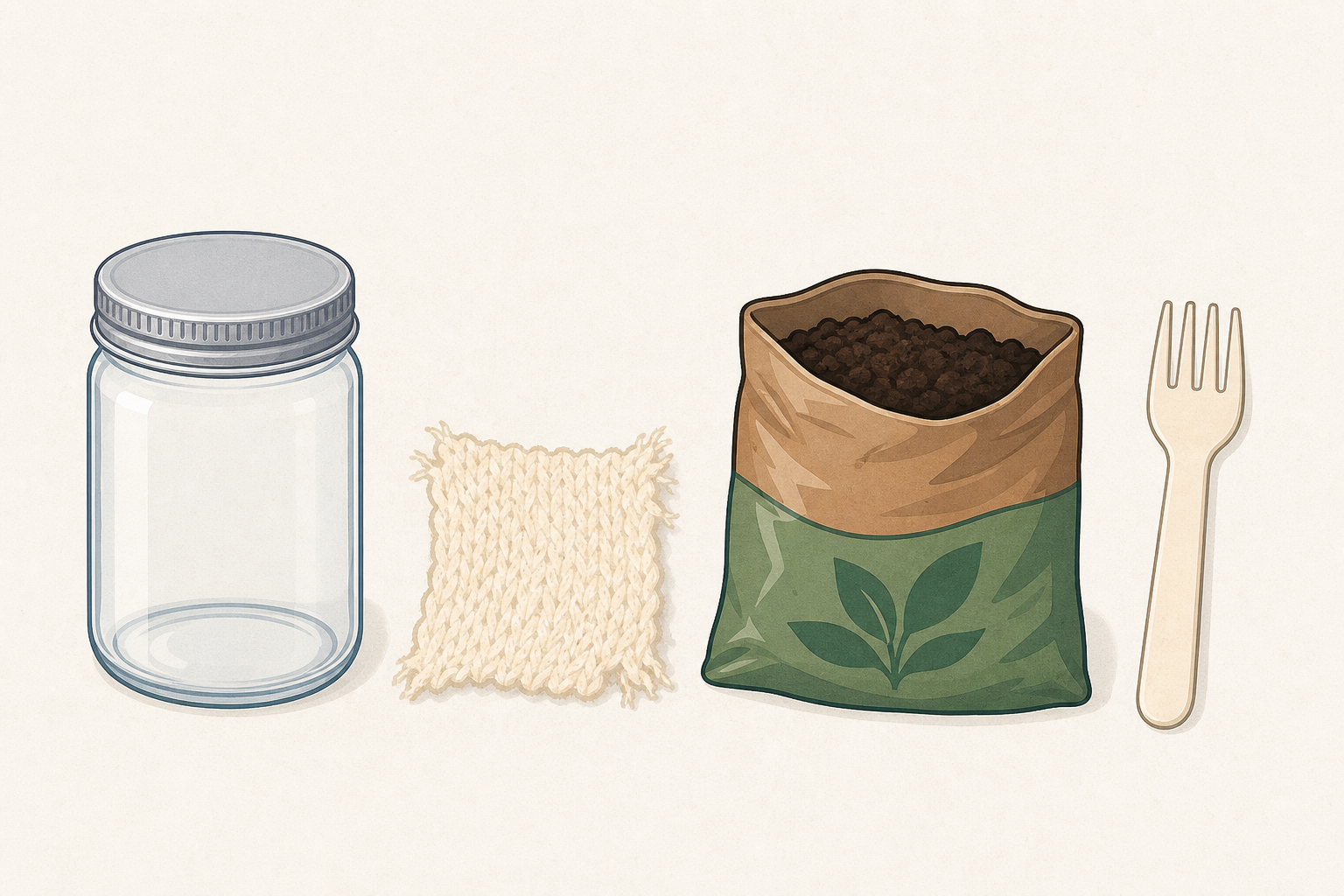
 Look at these four everyday things: a glass jar, a scrap of wool, a bag of peat-free compost, and a plant-based fork. Where did each one come from, and what should happen when we finish with it?
Hands up one idea for any of them.
 Look at the jar again. Source asks: where did this material begin before people shaped it? Glass begins as sand, soda ash (a white powder used in glass-making) and limestone, melted together.
Now the plant-based fork. End of life asks: what should happen when we finish with it?
Engineers in Ireland use those two questions before they pick a material. When you choose packaging for school lunches, how do both questions help, and which one would you check first, and why?
First, open your group tray. Compare the four samples: which feels heaviest, which bends or flexes, and which feels softest? Agree one quick property for each sample, then predict: which one do you think has the kindest end of life?
Next, each person takes one research card: glass, wool, peat-free compost, or bioplastics (like the plant-based fork). Read only your card. Use your sticky note boxes for short phrases: source, use, end of life.
Then teach your group those three ideas in short phrases you can say aloud. Underline one line on your card that felt surprising or less good: a watch-out the card wants you to notice.
Stay with the evidence on the cards. You will put the facts on your Comparison Table next.
 This table is your evidence bank for the pitch. Keep each cell short enough to say aloud without reading a paragraph.
Open your Investigation Journal Comparison Table page. For each material, record the source, a main use and the end of life from the cards, using short phrases you could explain aloud.
Write what the evidence says, not what you wish were true. You will decide your recommended swap in the next talk.
Now we name two engineer words. A sustainable swap is choosing a kinder material for the same job. A trade-off is the less good side you still admit. The watch-out line you underlined on a card is often that trade-off.
Choose from pairings tied to today's cards, for example: peat compost to peat-free compost; single-use oil-based cutlery or packaging to reusable glass, or to a carefully chosen bioplastic; a synthetic warm layer to wool.
Discuss in your group: which one sustainable swap would you recommend for our school or homes, and why? Name what you would move away from, what you would move toward, and at least two reasons from your table.
Be ready to hear a challenge: what is the trade-off you must admit?
Unlock the full learning experience
You're previewing this lesson. Get full access to this lesson and hundreds more — each one ready to teach, with interactive activities, printable resources and pupil progress tracking built in.
This lesson is copyright of Coding Ireland 2017 - 2025. Unauthorised use, copying or distribution is not allowed.