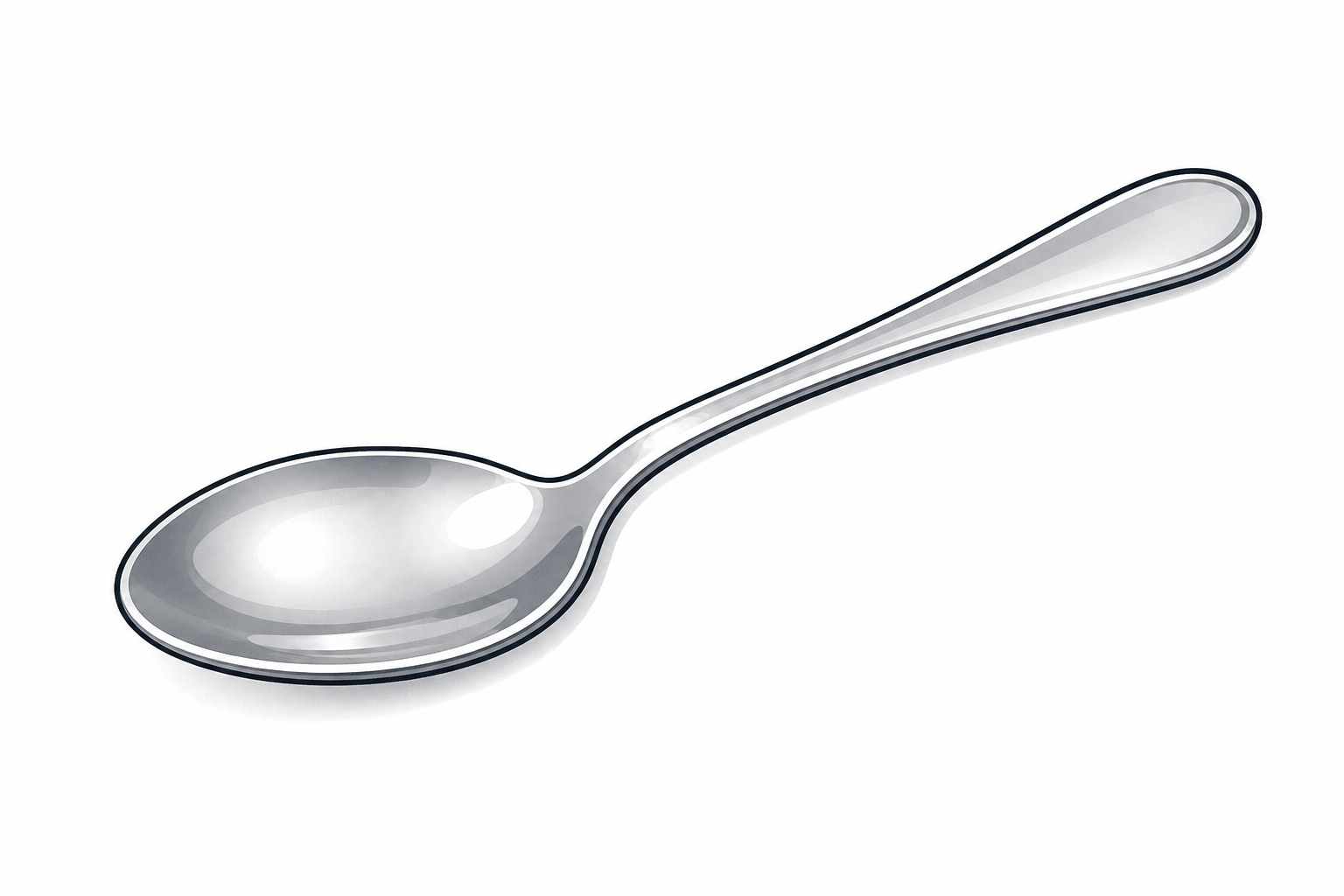
Look at this mystery object. What do you think it is made of?
Today we go on a materials hunt around our classroom. We will find things, name what they are made of, and put them on our sharing tray.
Hold up one everyday object the class already knows (a wooden block, a plastic cup, or a spoon). Ask only the curiosity question: what is it made of? Do not lay out the full materials set or list every material name yet.
Key question: What do you think this is made of?
Accept every idea warmly. Guesses are the start of the fun, never wrong.
Before the lesson: clear a low table as the sharing tray; print the provided material name cards (wood, plastic, metal, glass, fabric, paper); gather the sample objects and optional magnifiers.
Our big word today is material: what something is mostly made of.
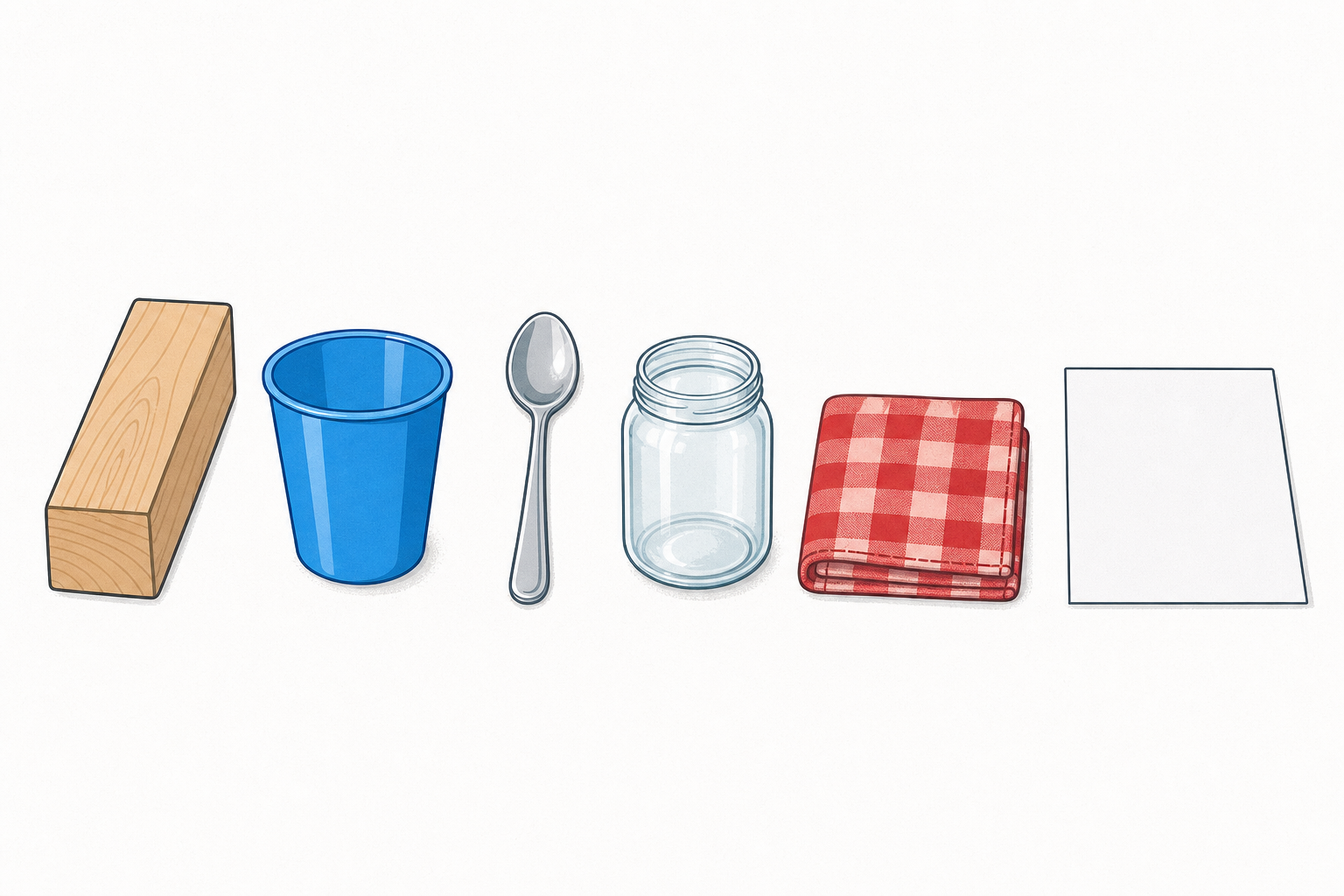
Look at each picture card and the object beside it. Can you point to something like it in our room?
Keep this light and oral. The six material names are a working picture bank for the hunt, not six definitions to memorise. Leave each card visible in a row as you go so the set builds slowly and stays up for the hunt.
On the board: only the word material and the pointing prompt. Do not project a full glossary.
Give a full cycle (card + sample object + short phrase + one controlled room-point) to only two or three materials, for example wood, plastic and metal. For the remaining cards (glass, fabric, paper), hold up the sample object, say the name once, place the card in the row, and move on. Do not run a full room-point for every card.
Room-point control: invite one child or one pair to point to something similar in the room. The rest of the class show a quiet thumbs-up if they agree. Do not ask the whole class to point at once.
Each card has a simple picture cue plus the material word in large letters. Non-readers match by the picture and the object you hold up.
| Concept | Why it matters | Example |
|---|---|---|
| Material — what something is mostly made of | Naming the material helps us talk about things clearly and choose the right one for a job later | A pencil is mostly wood; a water bottle is mostly plastic |
Word-bank reminder (for you only, not on the board): wood (from trees), plastic (smooth, often light), metal (hard, often shiny), glass (hard, see-through — handle carefully), fabric (soft cloth), paper (thin for writing and drawing).
Misconception to head off: children may say the whole object name ("it's a chair") instead of the material ("it's wood"). Gently revoice: Yes, a chair — and this part is made of wood.
Time for our materials hunt! With your group, find one safe thing in our classroom and match it to a picture card.
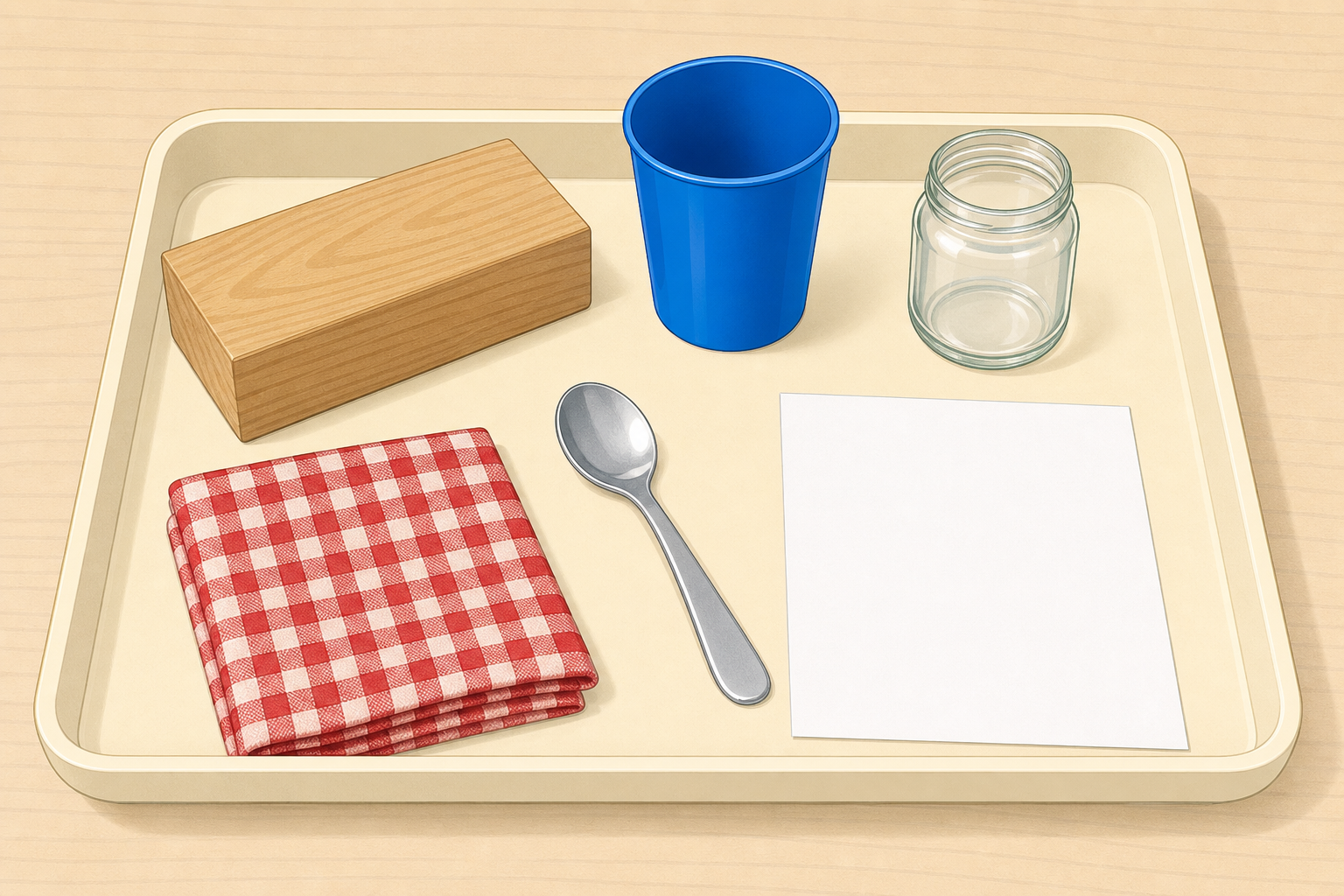
Keep the six picture name cards visible on or beside the sharing tray for the whole hunt. Children match their find to a picture rather than holding all six spoken names in memory.
Split the class into small groups. Give each group a collecting tray or basket. Point out the safe hunt zone (classroom only).
Call a few groups only in this main pass (about half the class, or as many as time allows while every group still gets hunt minutes). That group places one find and says the material name. Whole-class listening lever: revoice the name clearly, then ask the sitting class to show thumbs-up if they agree, or invite one quiet voice to offer the name with the placing group. Then the group returns to their places. Remaining groups keep their find ready and place it in the Share our finds step so every child still names a material aloud.
While one group is at the tray, other groups keep looking carefully or wait with their find ready — they stay folded in by agreeing or naming with the class, not by a separate desk task.
Circulate and ask: What material is that mostly made of? Which picture card matches? Encourage one clear material name. If an object is mixed (a pencil with a metal band), accept the main material and note that some things use more than one.
Glass rule: children do not carry glass. They may point to the window or to a real glass jar already on the teacher's tray and say "glass".
Differentiation: offer a sample set on a low shelf for children who need a prompt. Confident hunters can find two different materials.
Look-fors:
Come and gather at our sharing tray. We take turns naming each find. You say which picture name card it matches; the teacher moves the finds.
Look and touch gently. What does each one look and feel like?
Gather the class at the sharing tray. Children stay in a cluster or seated arc around the tray; they do not each need a turn handling every object. Place the six provided picture name cards in a row. As a class, sort finds beside the matching card. Children help decide by naming; you move the objects.
Magnifiers (optional, teacher-led only): if you wish, pass one or two magnifiers yourself for a quick modelled look at one find, then set them aside. Do not hand out a magnifier per group in this beat — touch-and-look with eyes is the default so card-matching stays the load-bearing action.
Minimum success bar for this beat: match at least one find to each material name that is present on the tray (use your prepared sample set to fill any missing material). Extra finds may stay in a small unsorted pile so you can move on on time. The next step only needs a clear labelled set of examples, not a perfect sort of every object.
Key questions: Does this feel hard or soft? Is it shiny? Can you see through it? So which name card does it go with?
Model one aloud: pick up the wooden block. I notice it is hard and I can see the lines from the tree. I think this is wood. Place it by the wood card. Then invite children to name the next few.
Keep any real glass on the teacher side of the tray. Fabric and paper can be felt gently; remind children not to tear paper finds.
Who can show one find and tell us what material it is made of? We will hear names like wood, plastic, metal, glass, fabric and paper.
Invite children (especially any groups who did not place in the hunt pass) to hold up or point to one find and say the material. Revoice full sentences: Ahmed found a cup. It is mostly plastic.
Check the tray has at least one labelled example for most materials. If a material is missing, add a sample from your prepared set and name it together.
One builder moment (teacher says this; no open careers question): point to wood and glass already on the tray. A builder picks wood for a door frame so it is strong, and glass for a window so light can come in — just like we named the right material for each find.
You're previewing this lesson. Get full access to this lesson and hundreds more — each one ready to teach, with interactive activities, printable resources and pupil progress tracking built in.