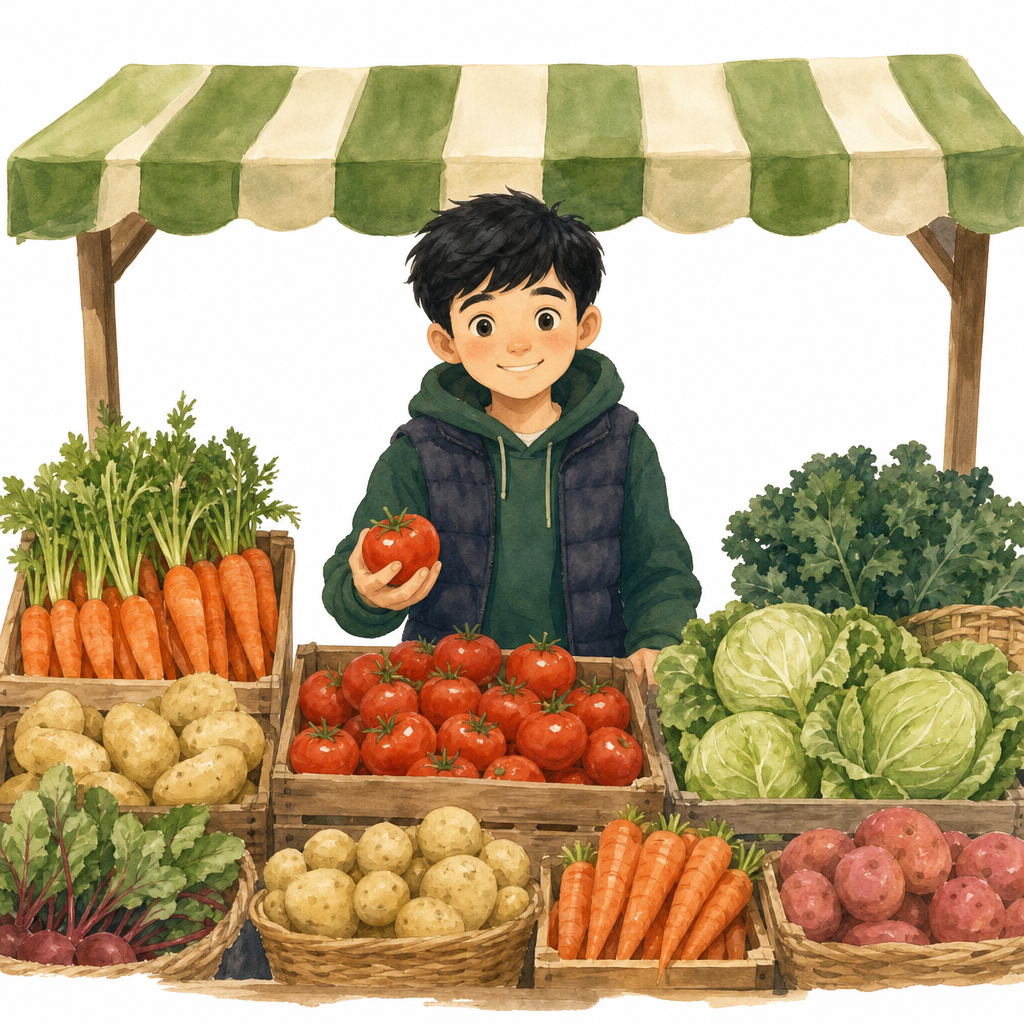
Some people say a tomato is a fruit, cooks say it is a vegetable. Today we learn die Tomate and seven more vegetable words in German, always with der or die.
Take a quick show of hands on tomato as fruit or vegetable, smile at the split vote, then move on without a long debate. The point is curiosity, not a science lesson. Tell the class that German treats the tomato as a vegetable word for everyday speech, and they will meet it on the next screen with its article.
Listen to each card, repeat the German with der or die, then flip to confirm the English. We will learn four vegetables, do a quick recap, then meet four more.
Run two batches of four so mouths stay busy and ears stay fresh. Batch 1: die Karotte, die Kartoffel, die Tomate, die Zwiebel. Batch 2: die Gurke, der Kohl, der Brokkoli, der Pilz.
For each card: play the audio, class repeats chorally twice (once all together, once by table), then leave the German visible a moment before flipping to English. Insist on the full phrase; Kartoffel alone is not the full answer, die Kartoffel (dee kar-TOF-fel) is. Point out that German nouns always start with a capital letter. Confirm die Tomate (dee toh-MAH-teh) as the tomato from the hook.
Pronunciation coaching: Zwiebel has that TS at the front, teeth on the ridge, then TSVEE-bel; give the table a grin when they nail it. Gurke ends with a soft schwa (GOOR-kuh), not a hard "keh". Pilz ends with a sharp TS sound (PILTS), not a soft s. After batch 1, rapid recap: you say English, class answers with article + noun. Then open batch 2 the same way.
You are at a Saturday market stall in Münster. Flip cards on the board to match each German label on the crate with what it means in English. When a pair is found, the whole class says the German with its article before the match is locked in.
Run this on the IWB only; one volunteer flips, the class is the voice. When a pair is found, whole class repeats the full German phrase once (article + noun) before you confirm. If the same pair is missed twice, pause and say the German together, then try again. Listen for full forms such as die Zwiebel (dee TSVEE-bel) and der Brokkoli (dair bro-KO-lee), not bare nouns. Cheer a clean match: "Nice, that sounded like a real market stall."
The eight vegetable phrases stay on the board. Choose four from today's list (ones you like or would eat) and copy each into your book: article + noun, capital letter on every German noun. No bare words.
Keep the full vegetable list clearly visible on the IWB. Before pens move, run one quick choral pass of all eight phrases so spelling sits on an oral base, then let pupils pick their own four. Three quiet minutes: you want to see der or die before every noun. Walk the room, catch a pupil who writes one they are proud of, and show it briefly as a model. Check capital letters on the nouns. Do not collect the copies. Optional colour: "These could go in a German stew (Eintopf) this week."
Drag each vegetable into der (words we say with der) or die (words we say with die). Use the article you learnt; do not guess from English.
Model the first drag yourself: take die Karotte (dee kah-ROT-teh) into the die column and say why the article tells you. Then invite volunteers. German has three genders, but today's list uses der and die only; keep masculine/feminine labels in your own head unless a pupil asks. If someone drops a word in the wrong column, say the full phrase together and try again. Remind them there is no sound rule that always works; the article travels with the noun. After a correct sort: "Nice, the article told you, not a guess."
You're previewing this lesson. Get full access to this lesson and hundreds more — each one ready to teach, with interactive activities, printable resources and pupil progress tracking built in.