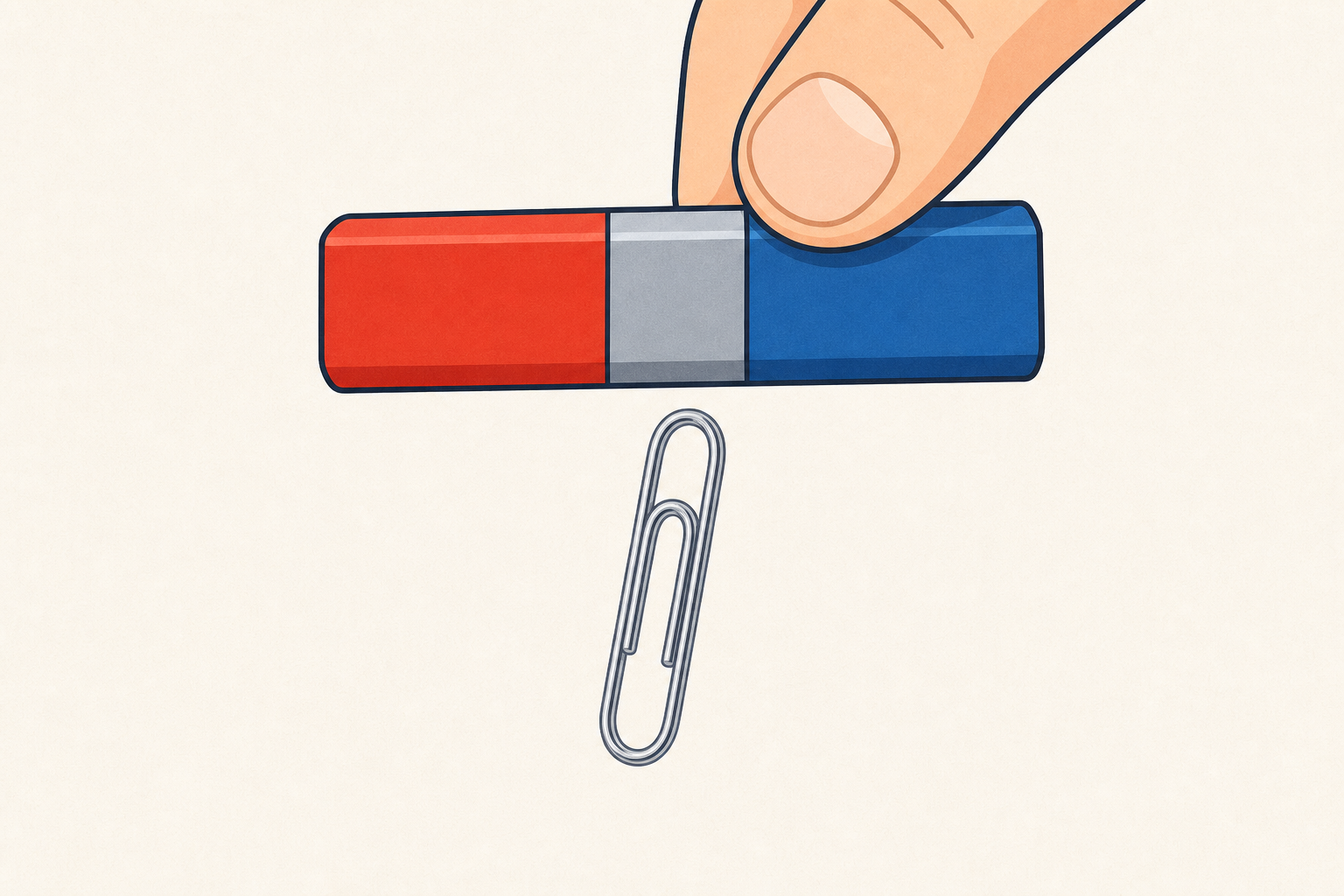
Watch this paperclip. How did it move without me touching it?
Hold a chunky magnet just above a paperclip on the table so the paperclip jumps up. Keep the moment short and playful. Ask once: How did it move without me touching it? Take two or three ideas. Do not name "magnet" or "metal" yet; leave that for the next step.
Have ready: one chunky magnet and one paperclip in your hand. The full object tray stays covered until step 2.
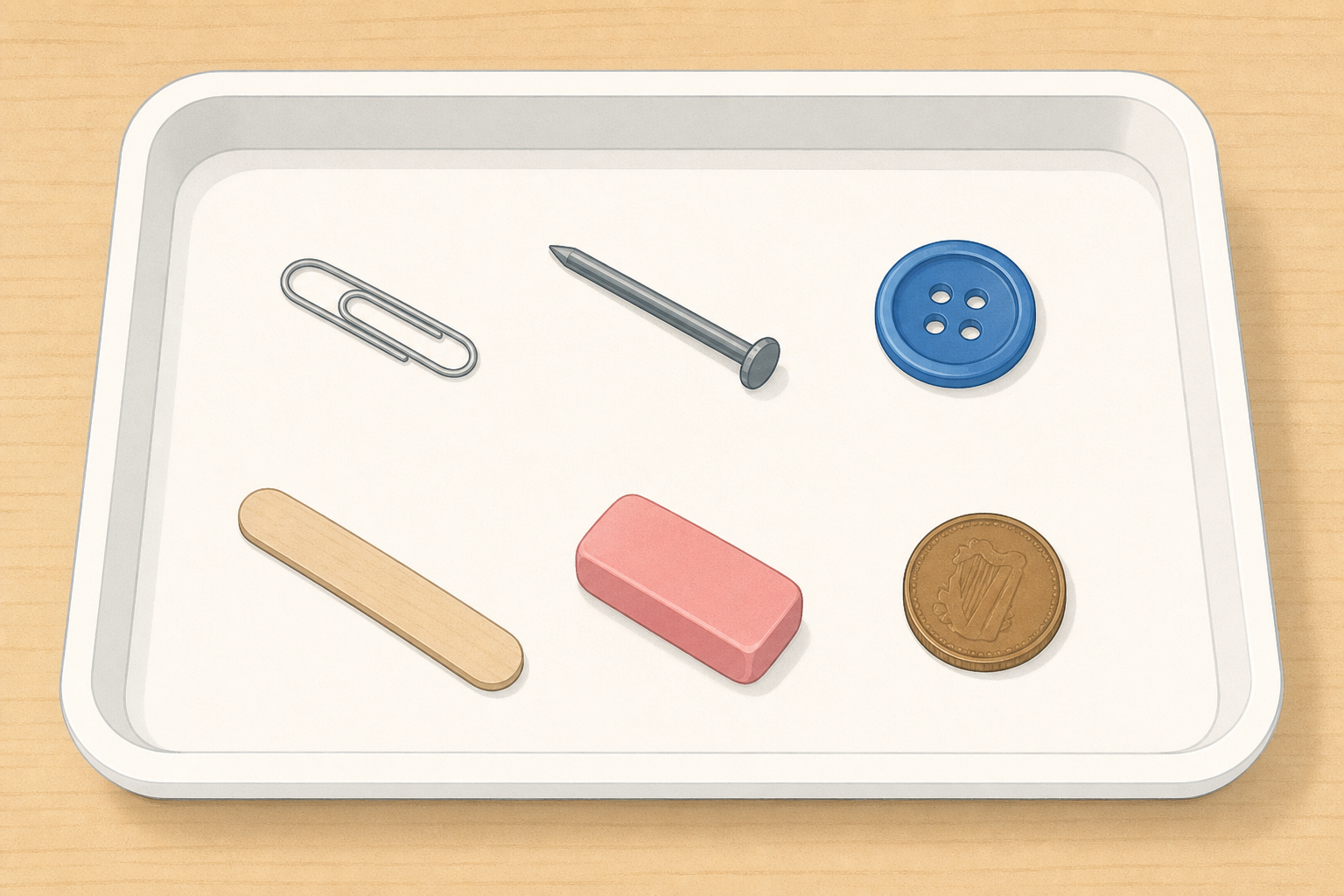
Look at our tray. Which things do you think the magnet will pull?
Magnet: a special thing that can pull some things to it. Pull: when something jumps or sticks to the magnet.
We wonder, we guess, then we try.
| Concept | Why it matters | Example |
|---|---|---|
| Magnet — a special object that can pull some things towards it without you having to push them | Magnets help us hold things and lift metal, so knowing what they pull keeps play safe and fun | The chunky magnet making the paperclip jump on the table |
| Pull — when something jumps or sticks to the magnet | Feeling the pull helps children notice the force, not only the result | A paperclip tugging as it moves to the magnet in your hand |
Model one full cycle before they guess the rest (think aloud; do not write this on the board):
Then uncover the tray (paperclip, steel bottle lid or washer, wooden peg, lolly stick, and any steel spoon or key you pre-tested). Children guess by pointing for two or three objects only: "pull" or "not pull". Guesses are never wrong — they are the start of the fun.
Misconception to head off gently: children may say the magnet "sucks" or is magic. Accept the wonder, then use the word pull. Save the word metal for the make-sense talk if they are ready.
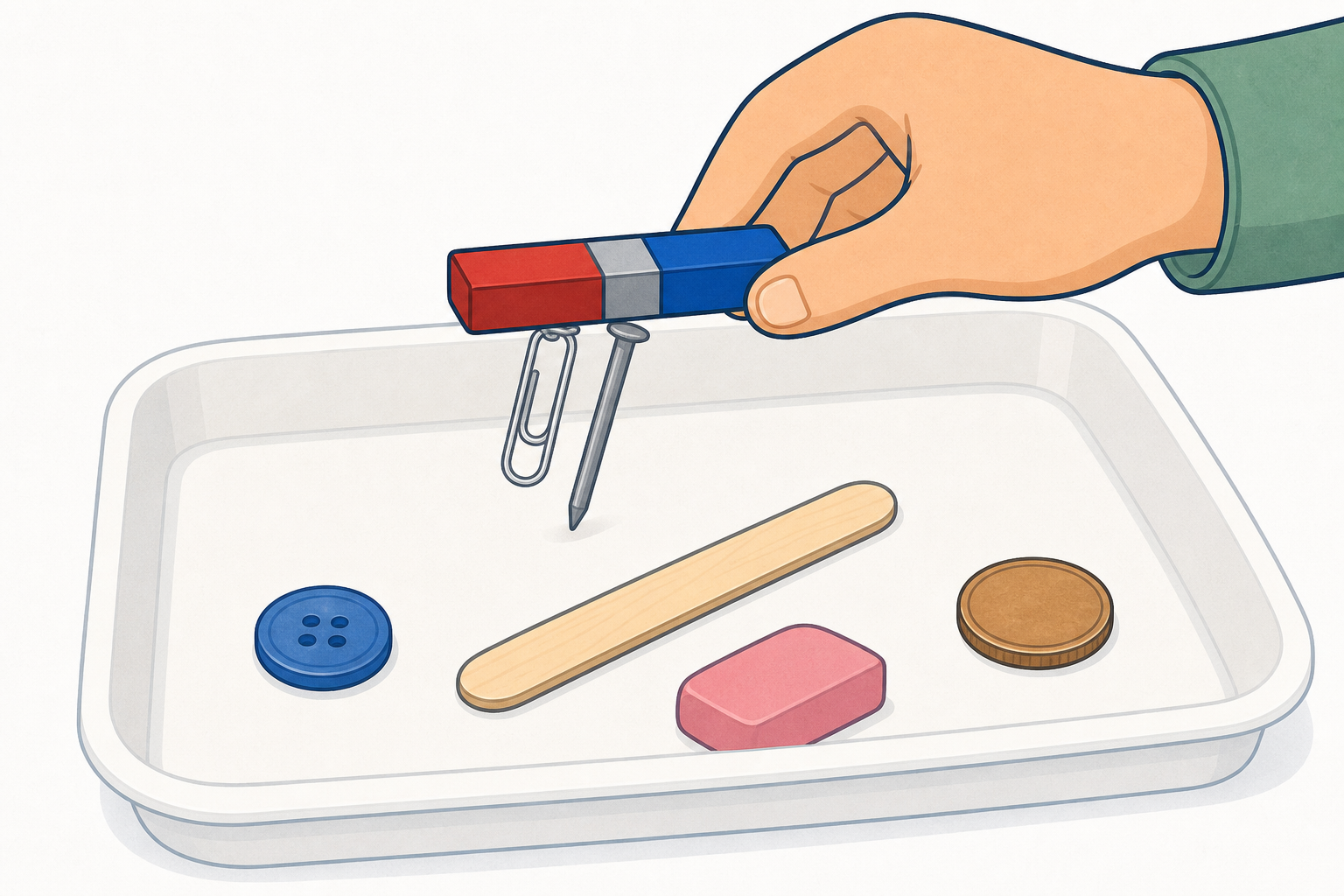
Hold your magnet over each thing on the tray. Feel which ones jump. Take turns with your partner.
Before the lesson (class scale): for a typical Junior Infants class of about 24, set one chunky magnet and one mixed tray per pair (about 12 pairs; groups of three if odd numbers). Pre-test every object on every tray with the lesson magnet before children arrive. Paperclips almost always pull. Keys and spoons only pull if they are steel — swap any non-magnetic spoon or key for a steel bottle lid, washer, or screw so each tray has at least two clear "pull" items and two clear "not pull" items.
Station bursts (about 13 minutes total): run 2–3 short bursts with a quick whole-class carpet regroup between them. Use one clear stop signal (e.g. a clap pattern or chime) so magnets go down at once.
Purpose of each carpet return: share one notice so watchers stay part of the science talk, and reset focus before the next try.
What children do: hold the magnet above each object in turn and feel which ones jump or stick. Partners take turns: one holds the magnet, one watches, then swap.
What to expect: paperclips almost always pull strongly. Steel bottle lids, washers and screws usually pull. Keys and spoons only pull if they are steel (many classroom ones will not). Peg and lolly stick do not pull. A modern euro coin may pull weakly or not at all — treat that as a discovery, not a mistake.
Key questions while you circulate: Did it jump? Can you feel a pull? What about this one? Fold watchers in: Do you think that one will jump? Were they right?
Safety: chunky magnets only; magnets stay away from mouths and faces; no putting objects in mouths; keep magnets away from tablets and classroom devices.
Differentiation: less confident pairs try three objects only. Confident pairs can whisper a new guess before each try, or find one more safe metal or non-metal item from a teacher-approved extras tray.
Look at the things the magnet pulled. Choose one. Draw that one on your drawing page.
Hand out the Investigation Journal page (hold it up and call it the drawing page so children know what is in their hands). Children draw one thing their magnet pulled. They may point to the real object on the tray while they draw. Scribe a single word label only if a child asks and you have time (paperclip, lid, spoon).
Observation focus: which objects moved to the magnet, and what the pull felt like (a tug, a jump, a stick). Ask pairs: Show me the one you will draw. Did you feel a pull?
What good looks like: a clear attempt at one pulled object (even a simple shape is fine at this age), and the child can point to or name it when asked.
Fast finishers draw a second pulled object on the back of the page or point to one thing the magnet did not pull and tell a partner.
Keep this step in the live lesson so every child has a drawing ready for the make-sense talk. Do not set the drawing as homework.
Which things did the magnet pull? What were they like?
Whole-class circle or carpet talk. Invite three or four children to hold up their drawing or point to the real object. Revoice their words: So the magnet pulled the paperclip… the lid… the spoon.
Gently gather the pattern: many of the things that jumped were metal (steel). Pegs and lolly sticks did not jump. If something metal did not pull, wonder aloud together — not every metal thing pulls the same.
Who helps us (familiar first): a fridge magnet holds a picture or note on the fridge at home. Same pull as our chunky magnets. If you have a fridge magnet in the room, hold it up while you say this.
Optional bigger-world line: A huge magnet on a crane picks up old cars and metal bits in a scrapyard — same pull as ours, just much bigger. Only use this if you can show a simple photo; many 4–5-year-olds will not know what a scrapyard is without a picture.
Keep it oral and short. No writing. Guesses that were "wrong" still count as good science starts.
You're previewing this lesson. Get full access to this lesson and hundreds more — each one ready to teach, with interactive activities, printable resources and pupil progress tracking built in.