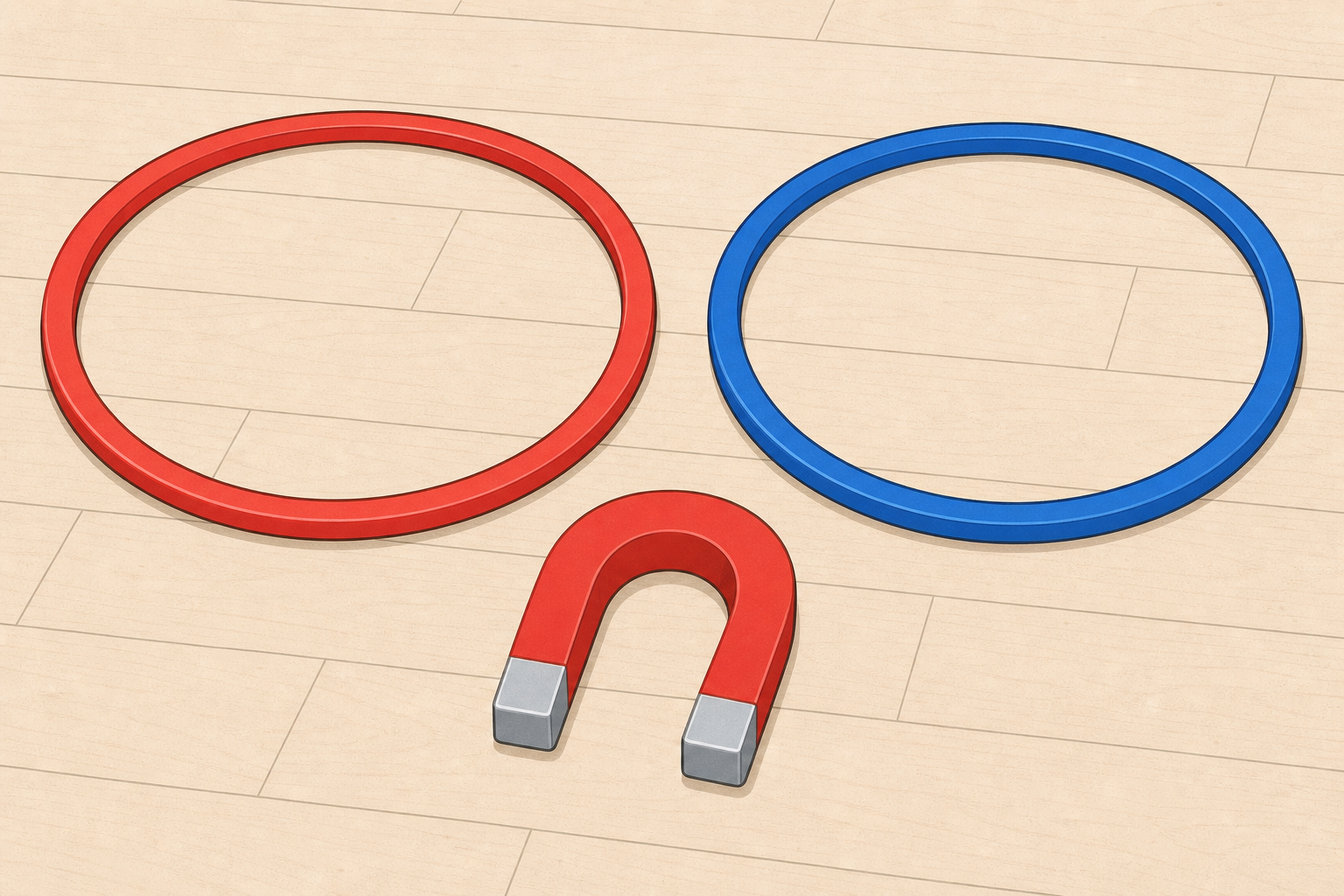
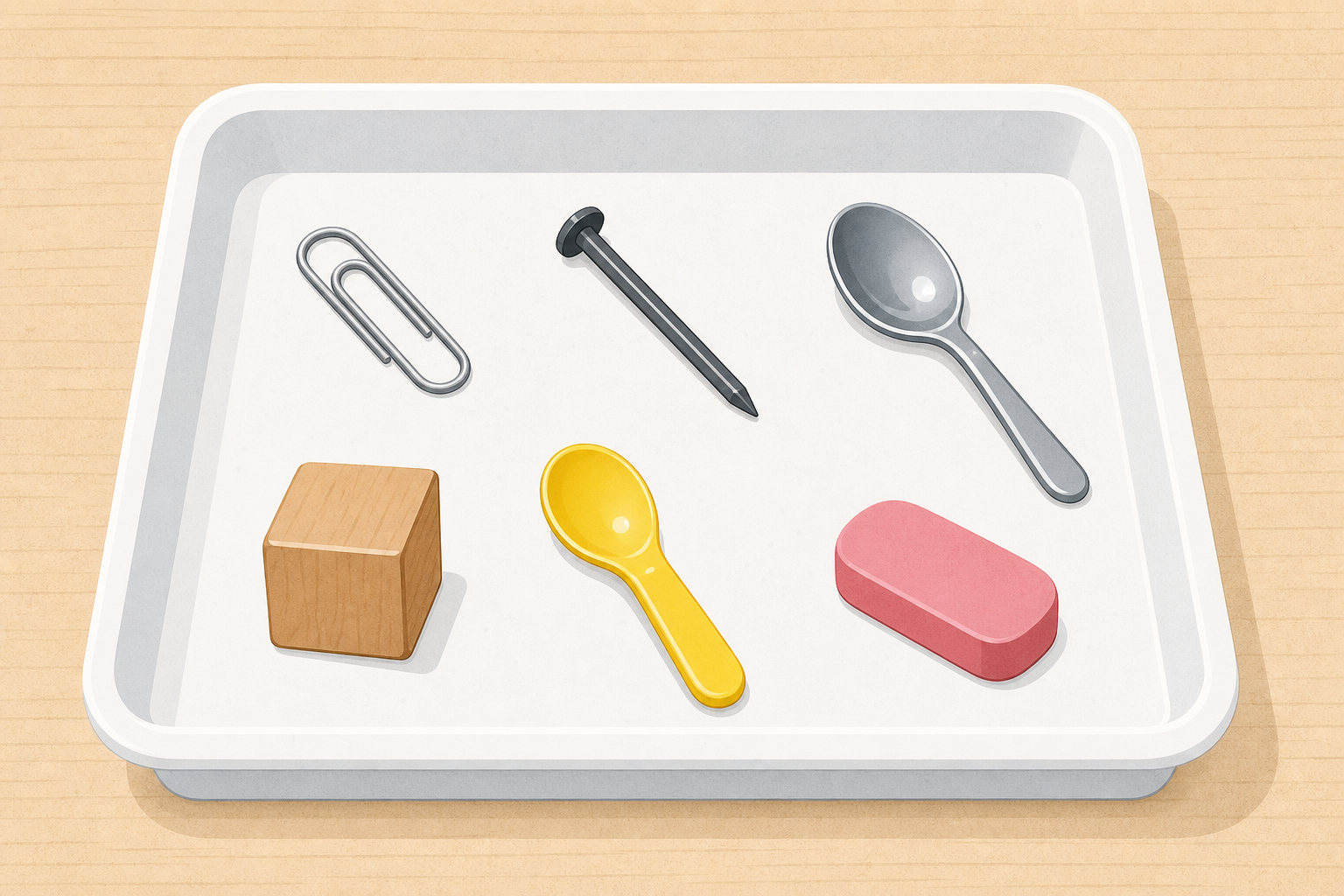
Here are two empty hoops and a chunky magnet. One hoop will be for things the magnet pulls. The other hoop will be for things it does not pull. In a moment we will meet the things we can test.
Hold up one chunky magnet and the two empty sorting hoops. Keep the tray of objects covered or behind you so the class meets them in the next step. Ask: Who has seen a fridge magnet holding a picture or a note? You might gently mention that people who make fridges and bags often put magnets in the doors and clasps so they stay shut. Do not set out the full test tray yet.
Look at the things on the tray. For each one we name, point to show your guess: will the magnet pull it, or will it not?
Show the tray so every child can see. Keep this beat short and light. Name only three or four objects for a quick point-guess (for example paperclip, wooden peg, crayon, metal spoon). For each one, children point to the magnet pulls hoop or the does not pull hoop. Guesses are never wrong; they start the fun.
Model one short wonder and think only (save the full test reveal for the next step):
Do not run a long board talk or full concept table here. Children need to feel a pull first. Move straight on to supervised testing.
Misconception to head off gently later: children may say the magnet pulls everything metal-looking, or only shiny things. Gold-coloured plastic can fool them. Keep the talk about what we feel and see when we try.
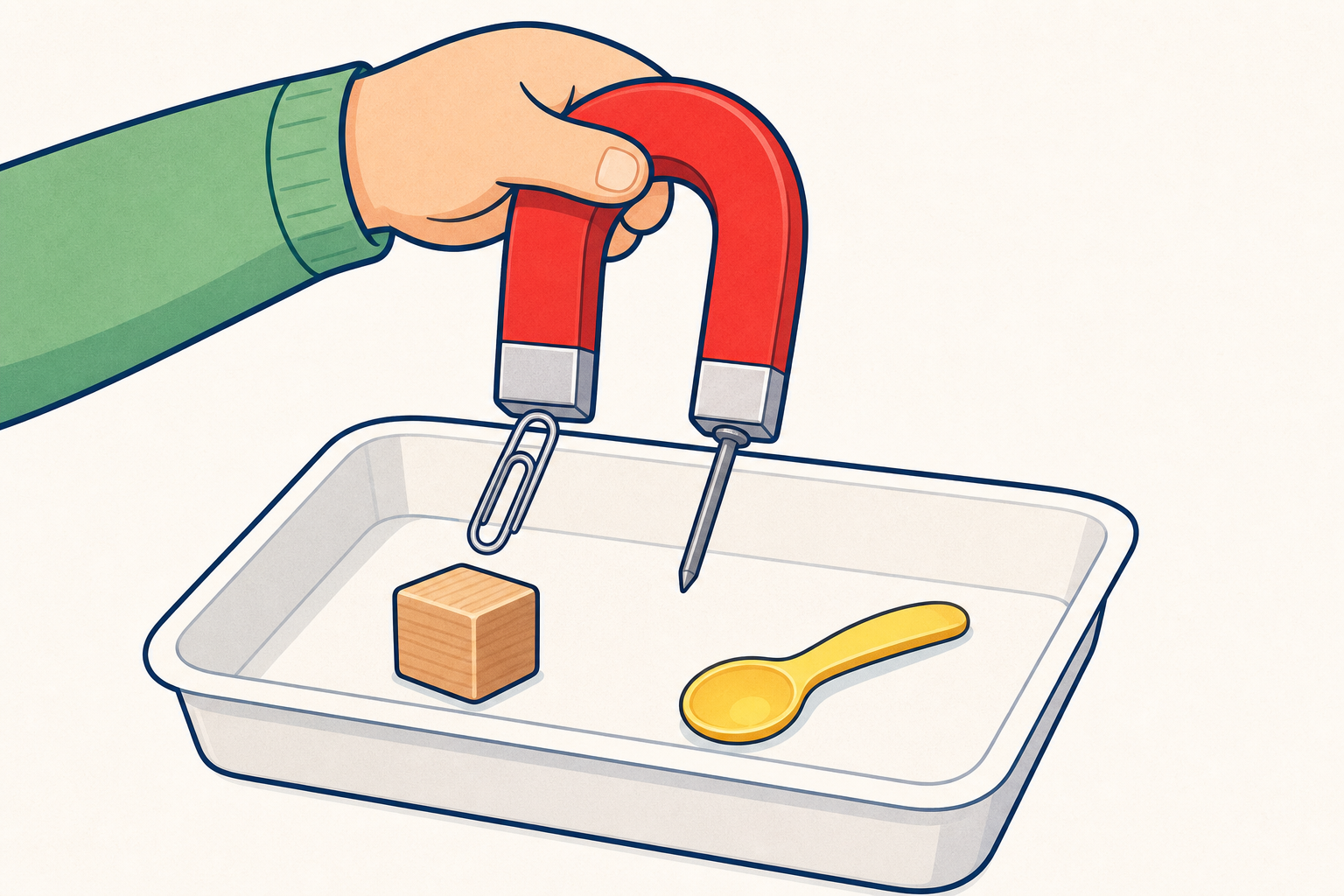
We will test at the magnet station. When it is your turn, hold the magnet close and feel if it pulls. When it is your friend's turn, watch carefully and say yes if it pulls, or no if it does not.
Short supervised turns, whole class folded in. Do not send every pair off with their own magnet.
Model once aloud:
Test set: paperclip, key, metal spoon, wooden peg, crayon, plastic button. Prompt holders and watchers: Did you feel a pull? Stick or no stick? Do we agree?
Turn-taking words for children: your turn to hold · watch your friend's turn · we all say yes or no together. Watching and saying the result is still part of the science.
What to expect: paperclip and many steel spoons pull; peg, crayon and plastic button do not. Keys vary (brass, aluminium or mixed alloys often will not stick). If a key or spoon does not pull, accept the evidence and sort by what happened. Prefer a known steel paperclip and a clearly steel spoon or bottle opener as your dependable pull examples when you can.
After the first clear pull, name the anchor idea in child words: The magnet pulls some things and not others.
| Concept | Why it matters | Example |
|---|---|---|
| Magnet pulls some things — a magnet sticks to some objects or tugs them closer, and leaves other objects still | We only know which group an object belongs in when we try it | A paperclip jumps onto the magnet; a wooden peg stays on the table |
Use hoop labels orally as doing-words only: pulls / does not pull. Do not treat “sort” as a third concept card.
Safety: magnets stay away from mouths; adult at every active station; stop any putting-in-mouth play at once.
Differentiation: less confident children test with your hand over theirs; confident children name a second thing that felt the same as the first pull.
Now we sort together. We put each object into one of our class hoops. One hoop is for things the magnet pulled. One hoop is for things it did not pull.
Use one shared pair of class hoops on the floor or a low table where everyone can see (not two hoops per group). Simple picture cues on the labels help (magnet picture / stop sign). After each object has been tested at the station, a child helper places that real object into magnet pulls or does not pull while the class watches.
Ask as you sort: Why does this one go here? What did the magnet do? If children disagree, re-test together at the supervised station so the class sees the evidence again.
Look-fors:
Do not force the word metal if it does not arise; you can gently say lots of the ones that stuck felt hard and metal-like in the make-sense talk.
Now some new pictures on the board. Listen to the question: does the magnet pull it? Tell us which hoop each picture should go in.
Open the picture-sort interactive on the IWB in explore mode after the real magnets have been tried. Read the one question aloud every time: Does the magnet pull it?
Four new cards appear (not the tray objects already sorted): nail, wooden block, scissors, rubber. Children call out the hoop; you drag each card. Nothing is scored; a wrong hoop is a friendly “how could we check?” chat, not a red cross.
Expected talk: nail and scissors (steel blades) go in the magnet pulls it; wooden block and rubber go in it does not. If your classroom scissors are mostly plastic and do not pull when you check later, accept that evidence in a follow-up try.
Prompt at the end: What felt the same about the ones we think the magnet would pull?
You're previewing this lesson. Get full access to this lesson and hundreds more — each one ready to teach, with interactive activities, printable resources and pupil progress tracking built in.