Today you are going to be a detective, but the case you are solving is about yourself. Open your maths journal at the very first page from back in September or October, then flick right to the newest page. What is one thing on the newest page that you could not have done at the start of the year?
Take three hands-up answers, not open call-outs. Give twenty seconds of quiet page-flicking before any hands go up.
Set the room to a calm, unhurried tone from the start — this is a reflective lesson, not a race.
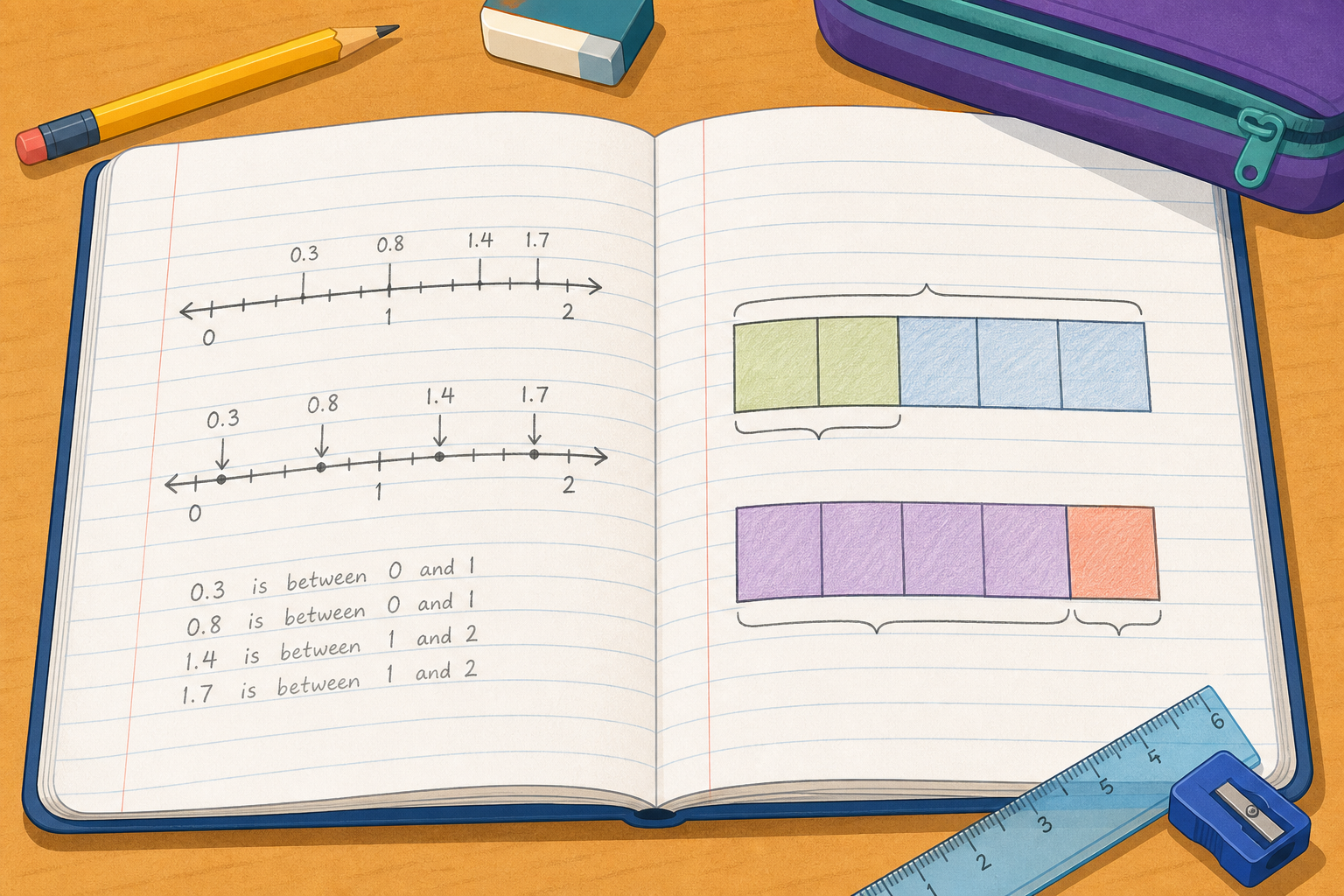
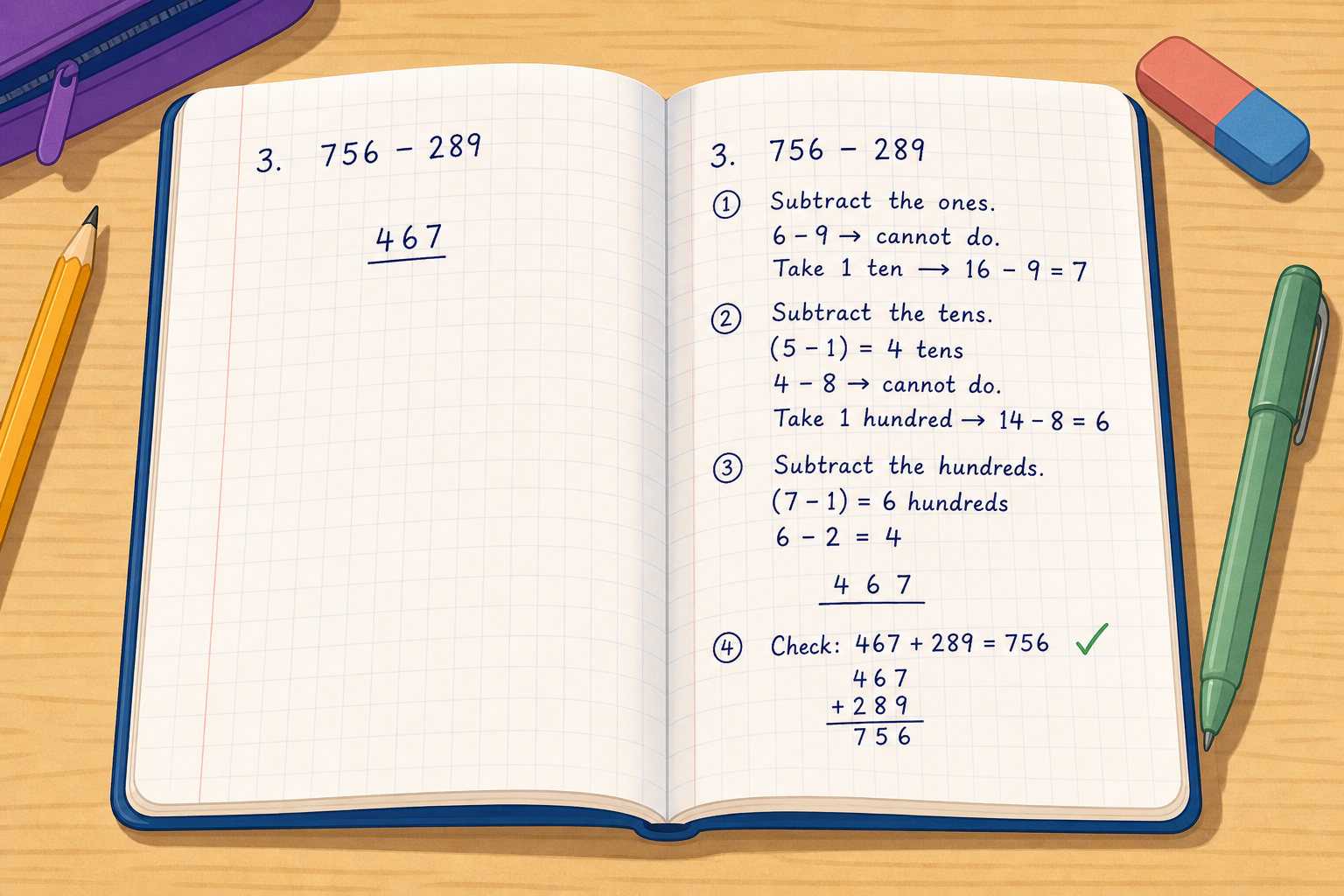
You are just watching for now — nothing to work out. Look at two pieces from the same pupil's journal, months apart, and notice what changed. Watch for clearer thinking, more steps shown and a check at the end, not just neater work. When you review your own journal, look for three things: a piece where you tried something hard, one that surprised you, and one that taught you something you still use.
Hold up (or display) one real early piece and one late piece — anonymised past-class work or your own. No samples? Use the spoken before/after example below.
Early piece: placing a decimal like 0.085 on a number line felt tricky. Later piece: a ratio share felt steady.
Ratio share = splitting an amount into fair parts, e.g. sharing €120 into 2 parts and 3 parts.
Point to the concrete difference: working laid out step by step in the late piece, rushed in the early one.
Name the three review lenses once — hard, surprising, still-useful — as a hook for their own search.
Don't turn it into a checklist they copy; it's a way of looking.
First we talk through one review together, then you review your own. Listen while your teacher describes a journal piece out loud: a class-shop plan that used adding, subtracting, multiplying and a fair share. Together we ask three questions about it: What was hard about it? What surprised us? Would we do it differently now?
Open your own journal and start hunting for your three pieces.
Review your own maths journal from across the whole year and choose the three pieces you are proudest of.
Ways to start:
Stretch:
There is no sample piece on screen to point at — this shared review is a spoken walkthrough. Describe the class-shop plan aloud and think through the three questions with the class; pupils take turns naming a review question and the class agrees or adds to it out loud.
Model the reasoning aloud for two or three minutes only, then release pupils to their own journals. Circulate and prompt individuals: which piece are you proudest of, and can you say why in one sentence? Keep the room quiet and focused; this is individual reviewing, not group chatter.
This is a real-world-problem beat because the task is genuinely open — every pupil's journal is different and there is no single right choice. Eleven minutes covers the short modelled review plus the start of the journal hunt; the writing itself is the next step.
Stop hunting now and start writing. If you have found your three pieces, you are ready; if you have two, that is fine to begin with.
For each of your three chosen pieces, write the name of the piece and one honest sentence saying why you are proud of it. Here is what a good sentence looks like: I am proud of the garden-bed plan because it was the first time I worked out perimeter, area and volume for the same shape. That is much better than I liked shapes. A good sentence names the piece and names the maths.
Then finish with one sentence about a maths mistake you used to make that you would not make now. You can start it like this: I used to think… but now I know…
Take your time — a short, true reflection is worth more than a long, vague one.
Share back: Volunteers read one of their three sentences aloud in the maths-talk wrap; nobody is required to share.
This is the writing round: every pupil produces their own reflection, so there is no single right answer to check. Move quietly around the room confirming each pupil's three choices make sense and their reasons are becoming specific, rather than marking anything. Keep the room calm; this is quiet writing, not board work.
Push for specific sentences: I am proud of the garden-bed plan because it was the first time I worked out perimeter, area and volume for the same shape beats I liked shapes. If a pupil is stuck on 'why', ask them what was hard about it at the time.
For pupils who need it, hand out the printable Maths Year Reflection Frame: I am proud of ___ because ___ and I used to ___ but now I ___. Fast finishers take the stretch prompt: pick a piece they would improve and write what they would change. There are no devices in this lesson — this is journal and pencil throughout.
Think about one maths mistake you used to make early in the year that you would not make now. What changed in your thinking? Would anyone like to share theirs?
Listen for pupils naming a specific mistake and a specific change — I used to think 0.5 was smaller than 0.45 because it looked shorter; now I line up the place value first. Revoice a strong answer so the whole class hears the shape of it: so you don't trust 'longer looks bigger' any more — you check the columns.
Keep it to three or four voices. Celebrate the honesty of naming a past mistake; it is a sign of confident learning, not a weakness. Nobody who does not want to share should be pressed.
You're previewing this lesson. Get full access to this lesson and hundreds more — each one ready to teach, with interactive activities, printable resources and pupil progress tracking built in.