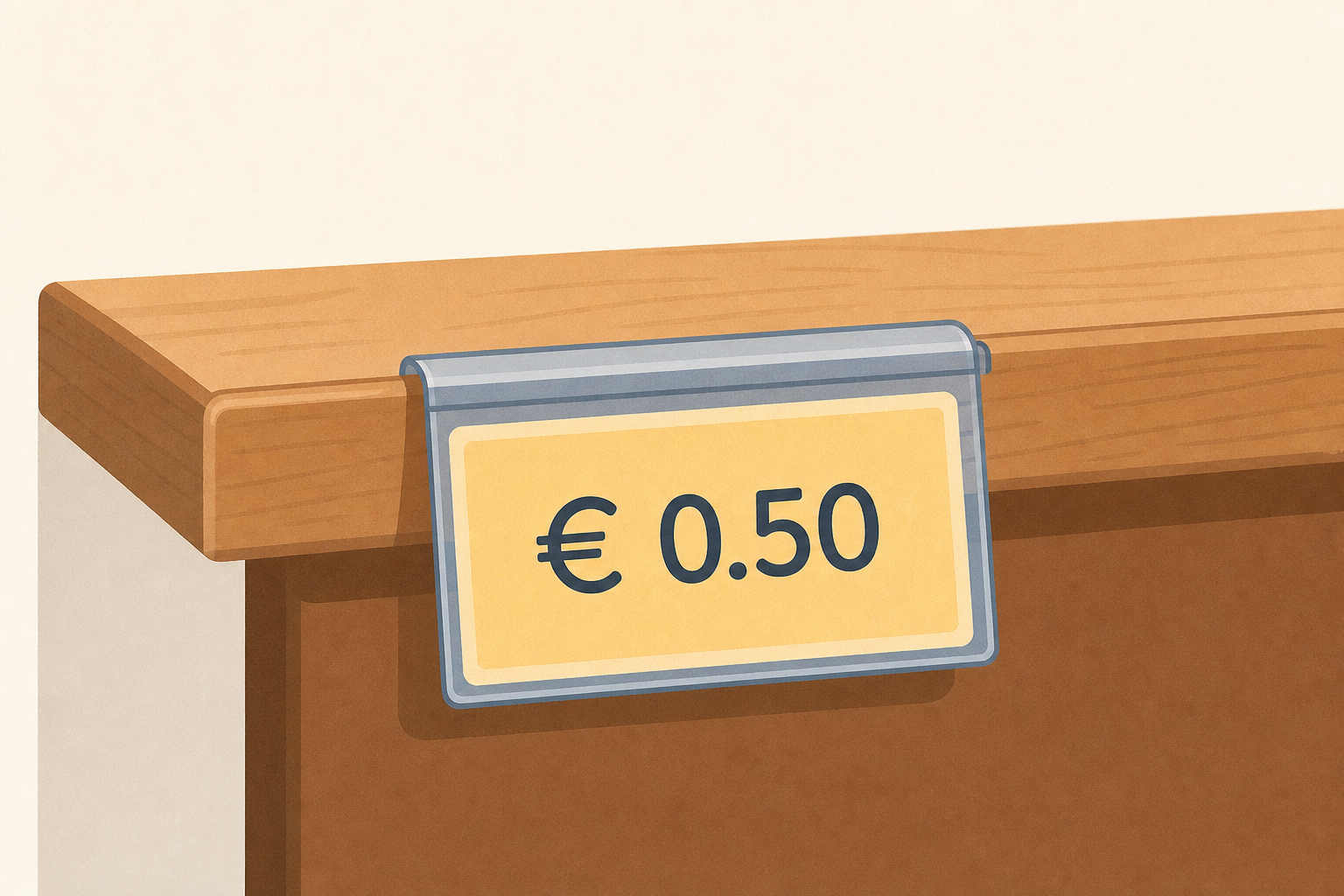
Here is a shelf tag showing half a euro. We can call this same amount two different names. What are the two names? One is a fraction, one is a decimal. Have a think, and get ready to say both out loud.
Display the €0.50 shelf tag beside one half of a shaded bar as pupils settle. Take three hands-up answers, not open call-outs. Listen for both one half and zero point five — if only one comes up, revoice: so it has two names, a fraction name and a decimal name.
The interactive shows shaded strips, each with its fraction name and its decimal readout. Watch how the shaded length changes and see the two names for the same amount. Be ready to predict the next decimal before it appears.
Half strip: 5 of 10 shaded, one half is 0.5. Point to the five parts and the readout together. Introduce the phrase decimal twin for later.
One tenth: 1 of 10 shaded, 0.1. Pause and ask the class to predict two tenths before moving on.
Three tenths: 3 of 10 shaded, 0.3. Link the shaded count to the single digit after the point; note the length grew each time.
Quarter: before revealing, ask more or less than one tenth. Let the tenths pattern settle first.
Then reveal the hundredths strip: 100 parts, each one hundredth, smaller than a tenth. A quarter of a hundred is 25, so 25 hundredths shaded. Point along them so pupils see why a quarter needs two places, 0.25.
Tie to money: a quarter of a euro is 25c, €0.25.
This quarter step is the make-or-break moment, don't rush it.
Today we shade the strip and read off its decimal twin together. We work through these in order: first one half, then three tenths, then seven tenths on the tenths strip. Then we move to the hundredths strip for one quarter.
The quarter is the tricky one, so we will say its two decimal places aloud and count the twenty-five hundredths before we check it.
This round is for talking it through together — pupils take turns at the board and the class agrees or corrects out loud.
For each one, ask the pupil at the board to shade the strip, then read both names — the fraction and the decimal — before the class confirms. The first three use the tenths strip. For the quarter, switch to the hundredths strip so the picture matches: pupils shade twenty-five of a hundred parts. Revoice: a quarter is not a tidy number of tenths, so on the hundredths strip it lands on twenty-five hundredths, 0.25, with two places. Rotate four pupils; keep it brisk.
In your maths copy, write these three matching pairs, one under the other:
Then pick one pair and draw a quick bar to shade and check it.
Walk the room glancing for the correct decimal beside each fraction — this is whole-class copybook practice, not marking. The common slip is writing the quarter as 0.2 or 0.5; if you see it, prompt the pupil to shade their check bar and recount.
Today we shade each strip to match the decimal on the card, then check. We work through these in order: one half, then one tenth, then one quarter, and finally three quarters. The last two use the hundredths strip, so watch the hundredths carefully.
These are the practice questions — pupils take turns at the board, check each answer, and the class confirms before moving on. Keep the board work brisk rather than over-explaining.
The challenge builds from the tidy tenths (0.5, 0.1) to the quarters (0.25, 0.75), shown on the hundredths strip where two places are needed. The point is three quarters landing on 0.75 — ask the class to predict the decimal before the pupil shades it. Watch for pupils shading only three parts for three quarters; revoice with the seventy-five hundredths on the hundredths strip.
You're previewing this lesson. Get full access to this lesson and hundreds more — each one ready to teach, with interactive activities, printable resources and pupil progress tracking built in.