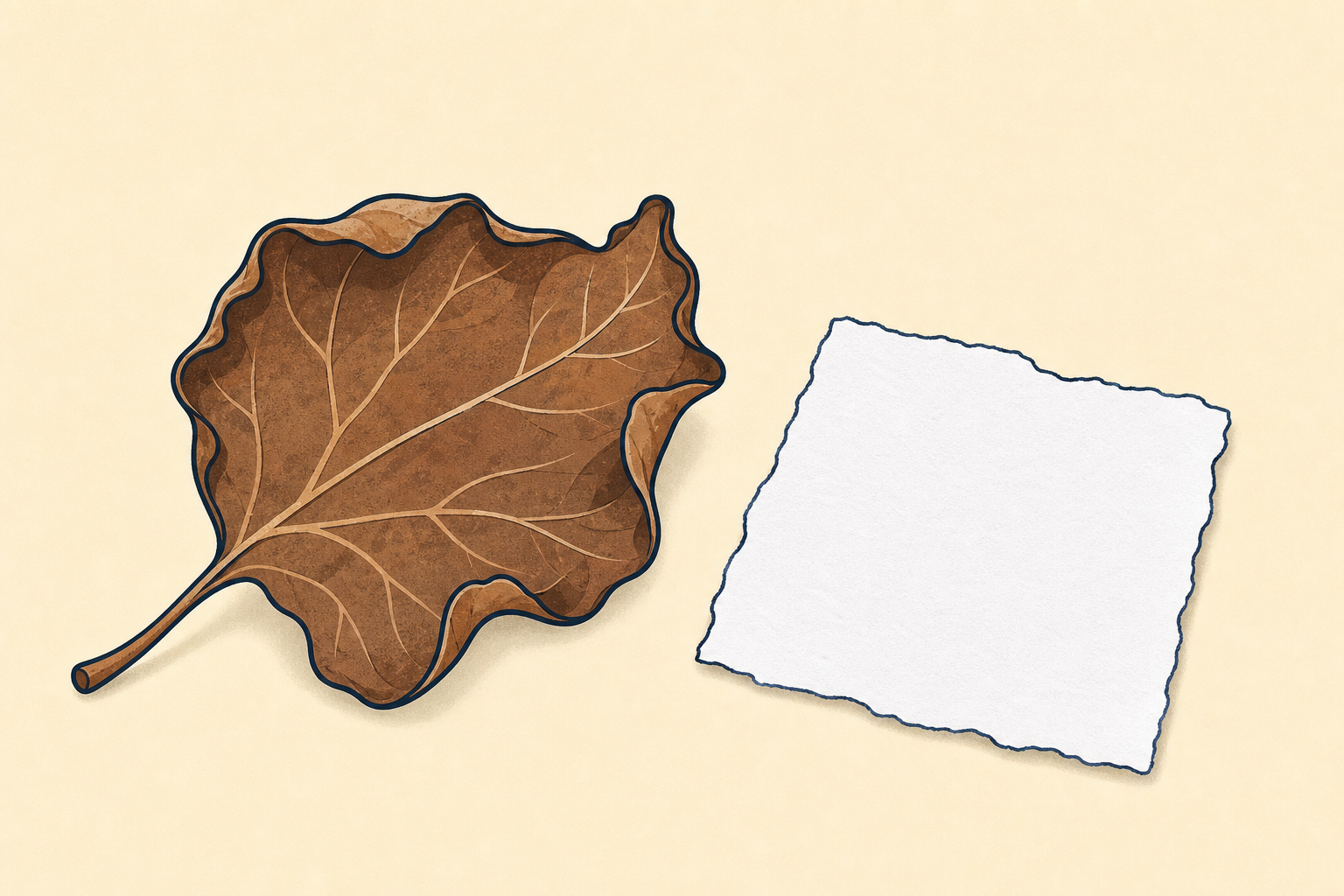
Look at this old leaf and this scrap of paper. What do you think would happen if we left them outside in Irish rain, sun and wind for a few days?
Hold up a dry leaf and a scrap of paper (or show a photo of peeling paint or a rusty gate if you have one). Keep the hook light: one question only. Do not lay out the full sample kit yet.
Ask: What might the rain do? What might the wind do? What might the sun do? Take two or three quick answers. Link to things pupils already notice: wet paper in a puddle, faded chalk on the yard, peeling paint on a shed.
Today's words: weather means what it is like outside right now (rain, sun, wind or cold). A prediction is what you think will happen before we check.
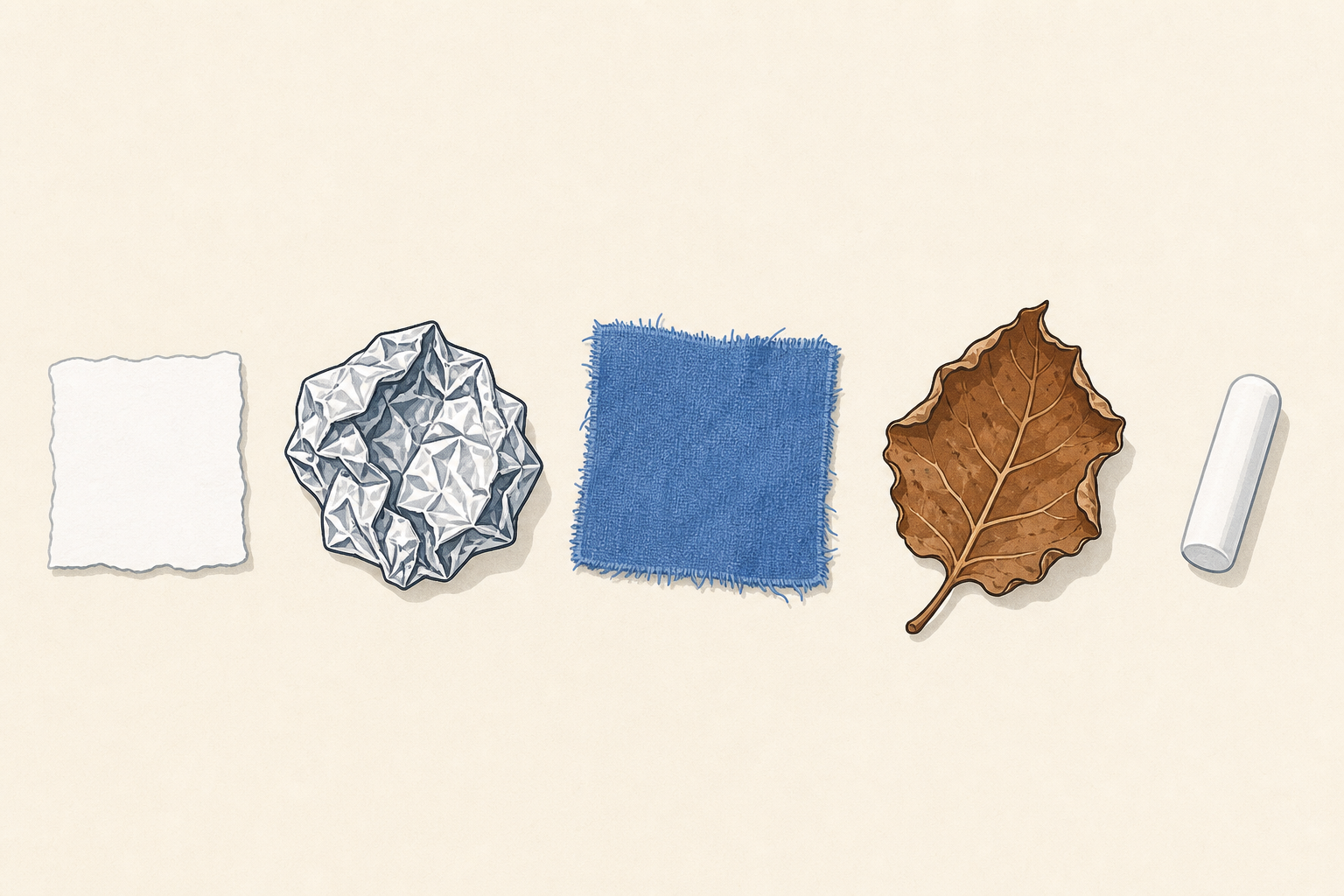
We will watch five samples: paper, shiny silver wrap, cloth, a leaf and chalk. Which one do you think the rain will change the most?
Hold up the five samples as you name them (paper, foil as shiny silver wrap, fabric as cloth, leaf, chalk stick) so every material word is tied to an object in view. Project only the short board lines above. Use the table yourself.
| Concept | Why it matters | Example |
|---|---|---|
| Weather — what it is like outside right now: rain, sun, wind or cold | Irish weather is often wet and windy, so materials left outside change | A wet playground puddle soaks paper quickly |
| Weathering — when rain, sun or wind slowly change a material left outside | Helps us notice why some things last outdoors and some do not | A chalk stick in rain can go soft and crumbly; paint on a gate can peel |
| Prediction — what you think will happen before you check | Scientists say what they think first, then look carefully | I think the paper will go soft and torn if it rains |
Board load: keep only weather and prediction as pupil-facing words. Introduce weathering lightly in your talk with one concrete yard example only (for example chalk marks fading after rain, which is a different clue from our chalk stick sample). Do not add a third definition block on the board.
Teacher aside (not for the board): later geography will use weathering mainly for rocks breaking down in place. Here we mean everyday weather-wear on materials the children can see.
Misconception to head off: children may think only big storms change things. Gentle everyday rain and sun change materials too, just more slowly.
STEM eyes: invite one quick notice of something outdoors that already looks weather-worn (rust on a rail, peeling paint, a faded poster).
Here are our five samples for the weather watch: paper, cloth, shiny silver wrap, a leaf and chalk.
Your teacher will give you two of these samples. Talk with your partner about one of them: what might rain, wind or sun do to it, and why?
Then, on your Investigation Journal page, write or draw an I think for both of your samples before we go outside.
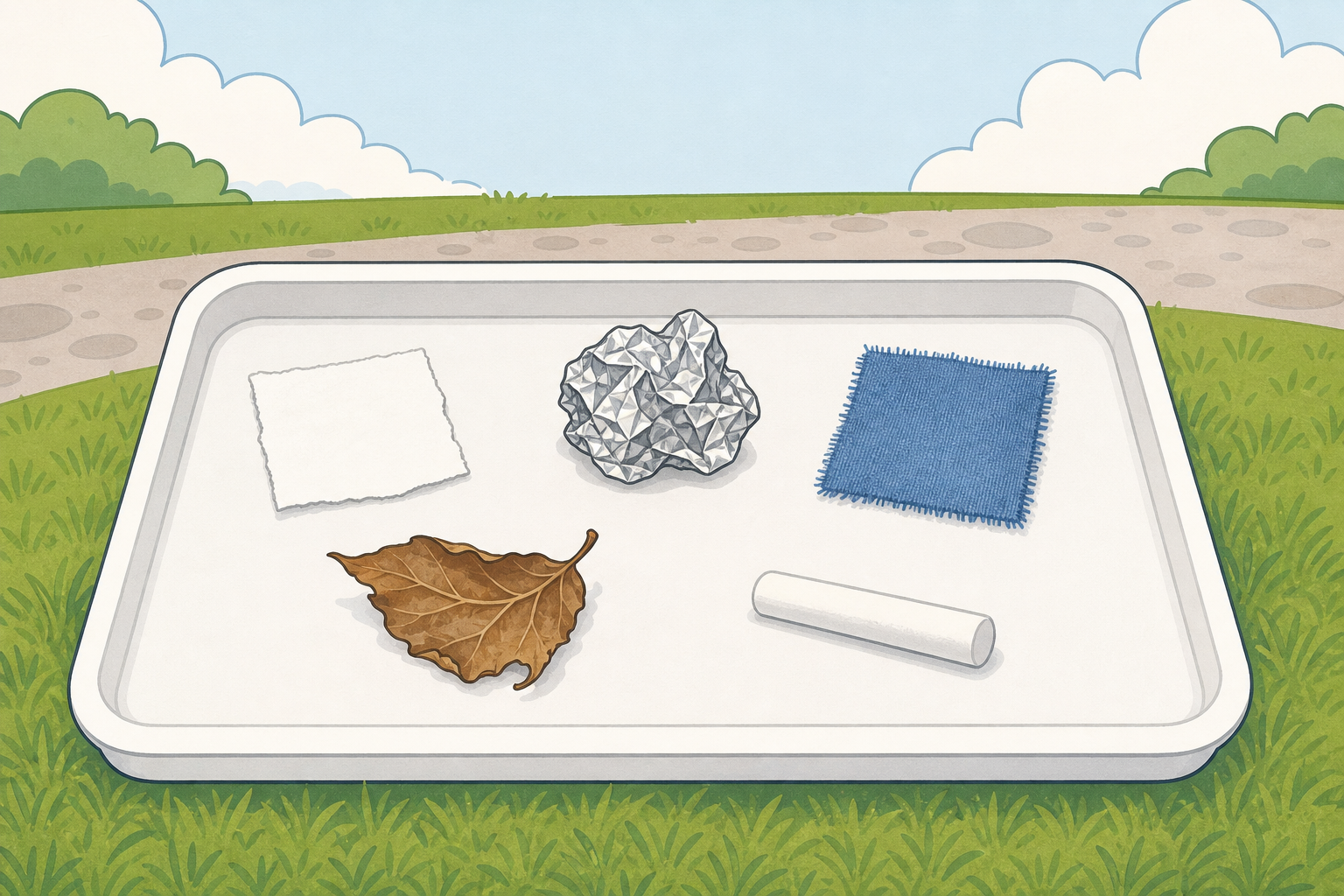
Lay out all five samples on the tray together and name each one clearly before any partner talk: paper, fabric (cloth), foil (shiny silver wrap), leaf, chalk stick. Pupils do not handle them yet.
Worked cycle to model aloud (one sample only):
Assign first, then talk: give each pupil (or pair) two samples so the class covers all five between them. Say the two sample names aloud so every child knows which ones are theirs.
Partner talk next: each child talks about one of their two assigned samples, says what rain, wind or sun might do, and tells why. Accept all ideas; predictions are never wrong. Prompt with why? once or twice.
Then capture on the journal before you leave the room:
Do not ask for full five-sample writing from every child. Keep the outdoor set-up next, but protect a few quiet minutes here for the two short journal marks.

We will place our five samples outside in a safe spot. Stay with the class. Do not pick or taste anything outdoors.
A few helpers will help place the tray. Everyone's job is to look carefully and say one thing you notice about how a sample looks or feels right now, before the weather works on it.
Lead the class outdoors. Place the samples together so they share the same weather. Choose two or three helpers to carry the tray and set it down; the rest of the class stays with the group, looks, and says one day-one notice (dry, shiny, soft, crumbly). Do not invite every child to handle or lay each sample.
Outdoor success is oral only: place, notice, say one thing. No journals, clipboards or writing outside. Day-one recording happens back in class.
Keep it simple: one class set-up is enough at this age. Groups do not need separate stations.
If weather is too wild: set the tray just outside a sheltered door or under a porch edge where rain and wind still reach it lightly, and note that on the board.
Safety: stay together; clear boundaries; no tasting or picking plants; wash hands on return.
Back in class, remind pupils you will check the same samples again over the coming days and compare with today's record.
On your Investigation Journal page, look at the two samples you already made a prediction for.
Your I think is already there. Now add what you can see today. Use words or a simple drawing.
Use these stems: Today it looks… / Today it feels…
Keep what you think separate from what you can see right now.
Pupils use the Investigation Journal page. Predictions for their two samples should already be on the page from step 3. This step is mainly the day-one look.
Coach the split clearly and keep the stems visible on the board:
Sentence starters to say aloud and leave on screen: Today it looks… / Today it feels…
Default load for 1st Class: each pupil fully records day-one looks for their two assigned samples only. Pool the other samples aloud as a class (use the class prediction board if you made one). Full five-sample writing is an optional stretch, not the main ask.
Circulate and scribe a word for pupils who need it. Do not invent extra columns or a second homemade sheet. One Investigation Journal page is the record.
You're previewing this lesson. Get full access to this lesson and hundreds more — each one ready to teach, with interactive activities, printable resources and pupil progress tracking built in.