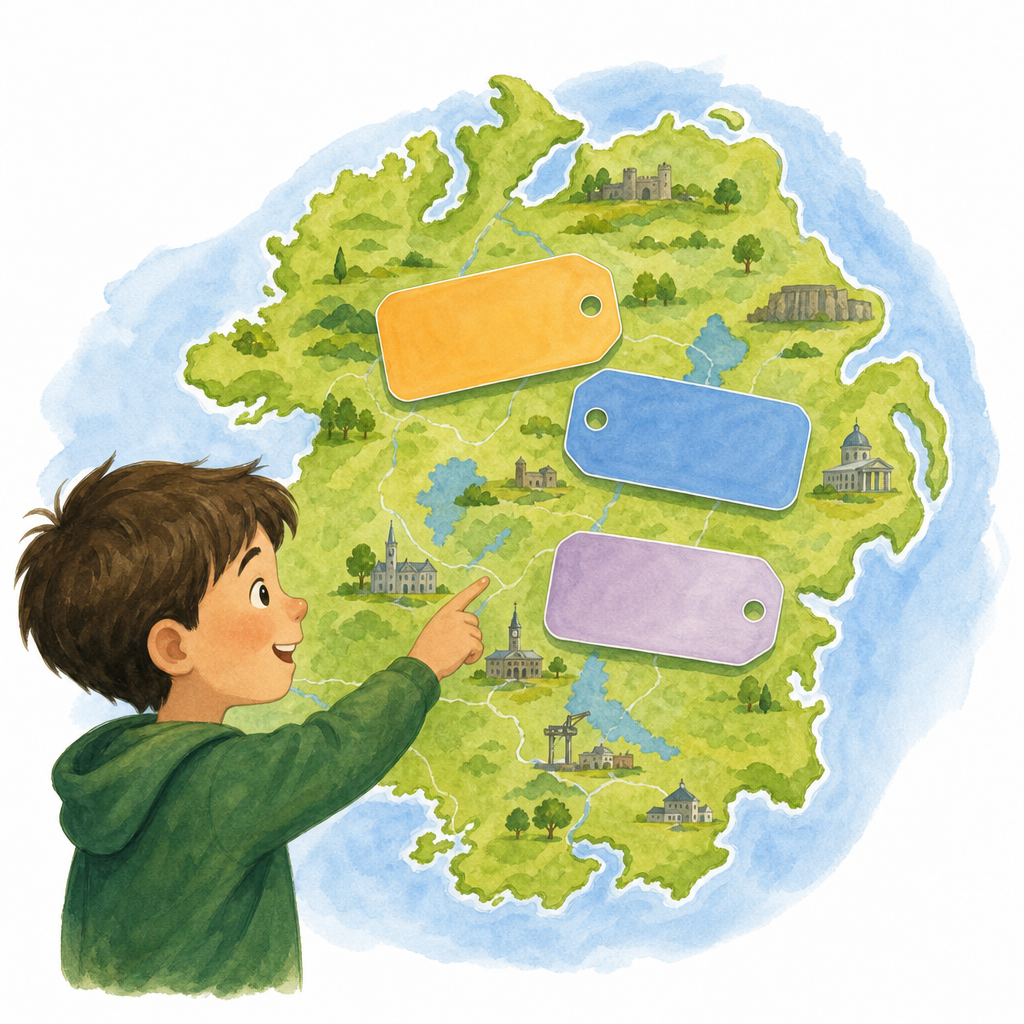
 Some Ulster placenames have kept pieces from more than one language over time. Look at this simple split on the board:
London- + doire (DIRR-a, an oak grove) → the long form of the name many people shorten to Derry.
Before we open any more names, can you guess which languages might be hiding inside Ulster place names?
By the end of this lesson, you will be able to:
- Spot different language bits inside Ulster place names
- Say which bit came from which language
- Talk about what it means when one place has more than one language in its name
Before we peel, remember three kinds of layer we might meet:
- Irish: an older root (like the oak-grove piece you just saw)
- Scots-influenced: words or sounds that came with settlers from Scotland (for example a stream called a burn)
- English: a bolt-on front or ending (like London- on the front of a name)
We open each Ulster county on the class board map, and one of you may be chosen to tap. Watch the name split into older parts. Help the class decide which piece is the older Irish root and which is the English way of writing it. Most county names have just those two layers: the Scots layer is mostly in how people speak. We take the layers off one at a time.
Now listen as a whole class. Clips may be Irish, English, or another language. The three choices stay on the board for every clip.
Show your answer with your fingers (no devices, no writing):
- 1 finger = Irish
- 2 fingers = English
- 3 fingers = another language
After each reveal, spot the sound that gave it away.
Open your copy. Keep looking at the worked example pinned on the board (for example London- + doire for Londonderry / Derry, with each layer tagged).
Write that name, or another Ulster name still visible from the map. Label which part came from which language. If you met the Scots stream-word burn, you may note it as a Scots-influenced layer too.
Copy spellings and accents carefully from the board. You do not need to remember them by heart.
💬 Discussion time
Ulster placenames often keep an older Irish root and a later English written form. Sometimes you also hear Scots-influenced speech, or meet a Scots word like burn on a local map. One road sign can hold more than one language story.
- Which layer of a name do you notice first on a road sign?
- Does knowing more than one language sits inside a name change how interesting the place feels?
- Why might people want to keep older layers visible instead of replacing them?
Unlock the full learning experience
You're previewing this lesson. Get full access to this lesson and hundreds more — each one ready to teach, with interactive activities, printable resources and pupil progress tracking built in.
This lesson is copyright of Coding Ireland 2017 - 2026. Unauthorised use, copying or distribution is not allowed.