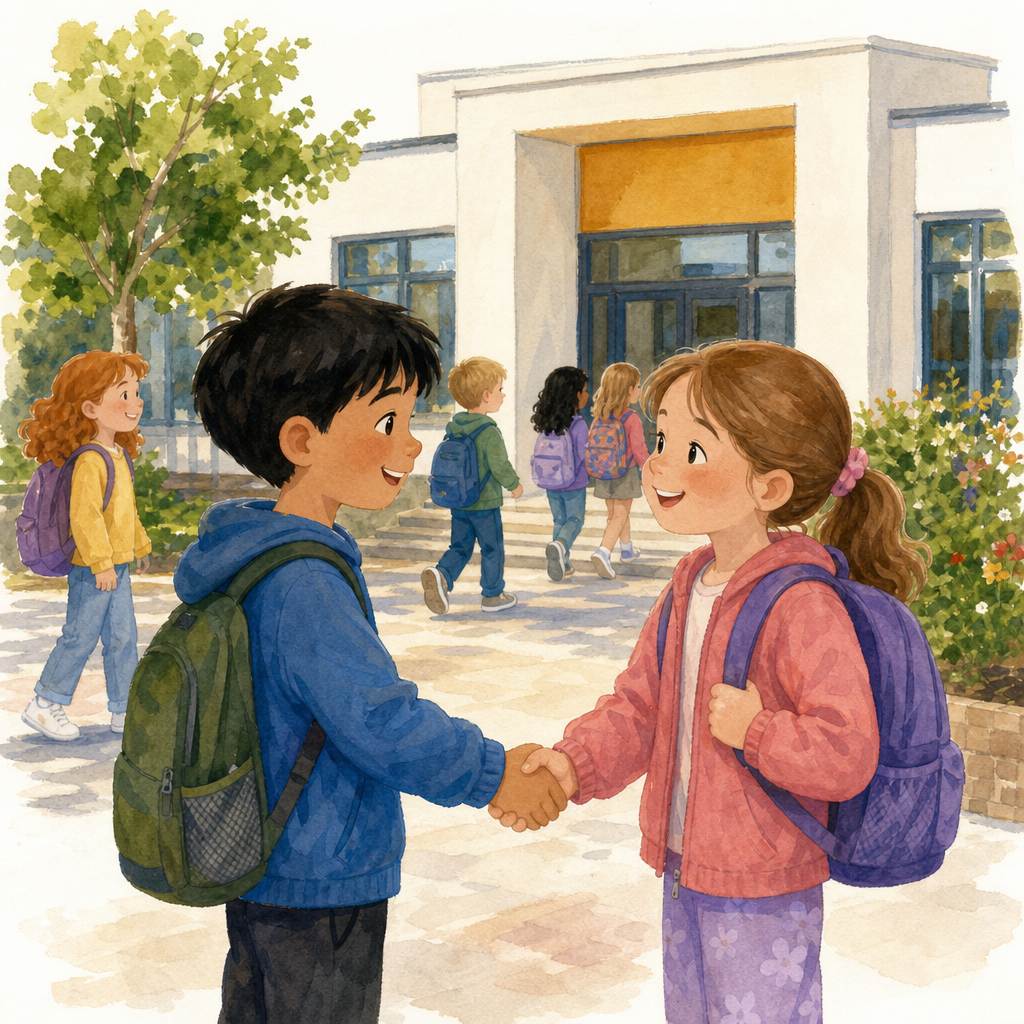
You are on an exchange at a Grundschule in Hamburg. The bell is about to go, and you have thirty seconds to meet someone from the partner class. What do you actually need?
You already know how to say hello. Today you will add your name, the question that asks for theirs, a short follow-up, and one fact about where you come from.
Set the Hamburg exchange frame in one sentence, then take a few quick answers only: a greeting, a name phrase, and a question. Do not teach the full list yet. The word-table in the next step carries every phrase with audio. If someone offers English only, smile and say you will meet the German versions together in a moment.
Here are today's introduction phrases on the board. Listen as each one is played, then say it back together as a class.
Start with the four classmate phrases (for someone your age) and repeat them twice: Ich heiße, Wie heißt du?, Und du?, Ich bin.
Only then open the formal and extra rows for one careful listen-and-repeat. The formal rows use Sie: that is the form for an adult (a teacher or a shop assistant), not a classmate.
You operate the word-table on the IWB; pupils listen and repeat, they do not tap. Lead the core classmate set first and only move on when it feels secure: Ich heiße (ikh HIGH-suh), Wie heißt du? (vee HIGHST doo), Und du? (oont doo), Ich bin (ikh bin). Class repeats twice: once all together, once by table. Celebrate the first full-class Ich heiße… with a big cheer when the soft ch lands.
Then open the extras: Wie heißen Sie? (vee HIGH-sen zee) and Und Sie? (oont zee) for an adult, plus Ich komme aus… (ikh KOM-uh ows) for one fact about yourself. Point out clearly: du is for a friend or classmate; Sie is who you would use with the German teacher or a shop assistant, not your partner today.
Worked exchange to read slowly once before you leave the table on screen:
A: Hallo! Wie heißt du?
B: Ich heiße Seán. Und du?
A: Ich bin Aoife. Ich komme aus Irland.
Listen to a short introduction on the class speakers. You will hear it twice before anyone answers. Listen for the name phrase and the question that asks for a name.
Play the full clip twice on the class speakers, pens down and eyes on the board the first time. After the second play, take answers with fingers or a partner whisper, then check together and ask what clue gave each one away. The written text is shown on screen as well as spoken.
What the clip actually says.
Emilia: Hallo! Ich heiße Emilia. Und du? (Hello! My name is Emilie. And you?)
Antonio: Hallo! Ich heiße Antonio. Ich bin neun Jahre alt. (Hi! My name is Antoine. I am nine years old.)
Emilia: Ich bin auch neun Jahre alt! Wo wohnst du? (Me too, I am nine years old! Where do you live?)
Antonio: Ich wohne in Berlin. Und du? (I live in Paris. And you?)
Emilia: Ich wohne in München. Was machst du gern? (I live in Lyon. What do you like to do?)
Antonio: Ich spiele gern Fußball und lese Bücher. (I like to play football and read books.)
Emilia: Toll! Ich zeichne gern und schwimme gern. (Great! I like to draw and swim.)
The questions the class will be asked, and the answers.
Before you start: today's words in this clip are Ich heiße, Ich bin, Und du?.
If the speakers or the interactive fail, read the lines above aloud yourself, twice, then ask the same questions.
Leave the word-table on the board. Copy one name sentence (Ich heiße … or Ich bin …) and one question (Wie heißt du?) into your copy. Check capitals: German sentences start with a big letter. Copy the ß exactly as you see it.
Pause other board work and leave the word-table visible so nobody writes from memory alone. Everyone writes: one full name sentence such as Ich heiße … (ikh HIGH-suh) or Ich bin … (ikh bin), then the classmate question Wie heißt du? (vee HIGHST doo). Walk the room and check that sentences start with a capital and that ß is copied cleanly in heiße / heißt. A quiet 'nice ß' as you pass is enough praise. Do not collect these copies.
Time to meet your Hamburg partner-class classmate for real. Keep this short script on the board for the whole turn:
A: Hallo! Wie heißt du?
B: Ich heiße …. Und du?
A: Ich bin …. Ich komme aus ….
Partner A asks, Partner B answers, then swap. With your partner use the classmate forms only (du). Save the formal forms (Sie) for an adult.
Before pairs begin, re-display the A/B script on the IWB and keep it there. Model one full classmate exchange with a volunteer first using only the script above (pronunciation: Wie heißt du? vee HIGHST doo; Ich heiße ikh HIGH-suh; Und du? oont doo; Ich bin ikh bin; Ich komme aus ikh KOM-uh ows).
Then run one quick adult model so Sie has a real addressee: invite a pupil to ask you Wie heißen Sie? (vee HIGH-sen zee); answer with your name and, if natural, Und Sie? (oont zee) back to them as a playful stretch. Say clearly: Sie is for the teacher or a shop assistant, not your partner today.
Pairs then run the classmate script twice each way. Circulate and listen for the soft ch in ich and the long ei in heiße. If a pair freezes, point them back to the board script rather than translating into English. When a pair lands the full exchange, freeze the room for a round of applause: first German introductions count.
You're previewing this lesson. Get full access to this lesson and hundreds more — each one ready to teach, with interactive activities, printable resources and pupil progress tracking built in.