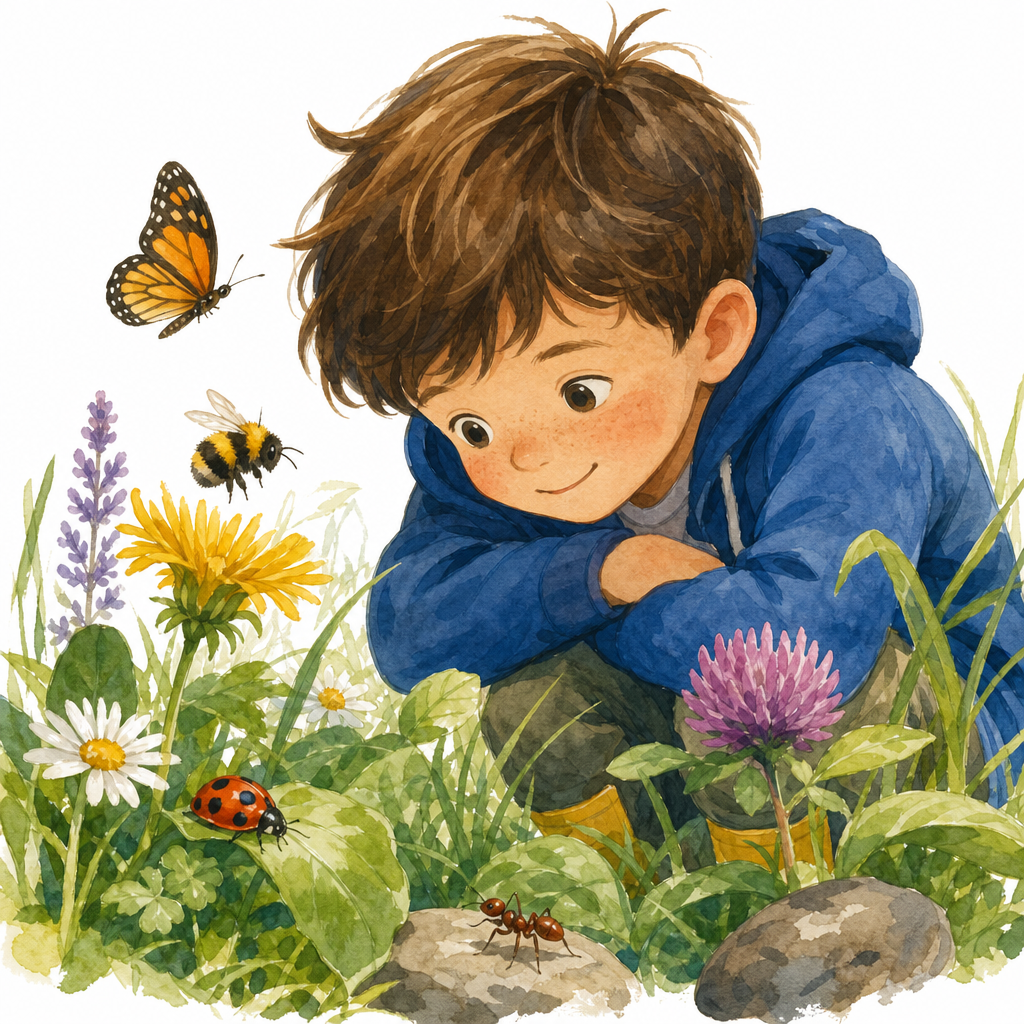
How many insects have you seen today without noticing? Think of the garden, the school yard, a window sill, even the bus stop.
Today you will name eight insects in French and say where each one lives, not just what it is called. Watch for a handy sentence pattern you can reuse again and again.
Take four or five quick answers about insects pupils have seen today. Keep it light and curious rather than a long list. Do not teach the French words yet; the word-table in the next step does that job.
If a pupil names a creature that is not on today's list, thank them and say you will stick to eight for now. That keeps the hour focused.
Listen to each insect on the board, then say it back together. Keep the article with the word every time: le, la or l'.
We will meet them in two groups of four, with a quick recall in the middle. Listen for the soft ill sound in papillon and chenille, a bit like the y in yes.
Get ready to buzz: run the list in two chunks so the first words are not lost by the end.
Group 1 (garden favourites): tap each word; class repeats twice (once all together, once by table). Point at the article every time. After the four, hide or cover the board and do a 20-second recall: call an English prompt, class returns the French with its article.
Group 2 (more garden visitors): same routine, then a second mini-recall of all eight.
Before you leave this step, put the habitat strip on the board and choral-repeat each chunk twice:
Then model the full frame slowly and have the class echo it: La fourmi vit dans le jardin. (lah foor-MEE vee dahn luh zhar-DAN). Leave both the word-table and the habitat strip visible for the next step.
Keep this model on the board: La fourmi vit dans le jardin.
Place options you can use: dans le jardin, dans la forêt, près de l'eau, près des fleurs.
Spin the wheel. When it lands on an insect, the class names it with its article, then finishes the sentence with one of the places. Everyone echoes the full line together after each spin.
Whole class on the IWB. The model sentence and the four place chunks must stay visible for every spin. Do not rely on nature words from earlier topics; only these set phrases are in play today.
Routine for each spin: (1) volunteer spins and starts La/Le/L'…, (2) chooses a place from the strip, (3) whole class choral-echoes the full sentence. Aim for six to eight spins. Give every table at least one guaranteed turn so row-3 pupils speak, not only the keen hands at the front.
Insist on the article. Bare fourmi is not enough; la fourmi is the answer. If someone freezes, point at the model and have the table finish it together before the class echo.
Picture the answers in a sunny garden in the south of France when you can: ants on the path, bees near the flowers, dragonflies by a little water, ladybirds on the roses. Keep English-place scaffolding only as a last fallback, not the default.
Warm moment: if the wheel lands on la guêpe or l'abeille, a tiny dramatic buzz before the sentence is allowed once, then straight into the proper French line.
Confident pupils only (optional, not required): after the core frame is secure, offer one alternate once or twice: On trouve la coccinelle dans le jardin. or L'abeille habite près des fleurs. Everyone else stays on vit dans / vit près de.
Open your copy. Keep the model on the board and complete two sentences using this frame:
______ vit ______.
Sentence 1 may copy or lightly adapt the model. Sentence 2 uses a different insect and one of the place chunks. Keep the article and take care with accents.
Pause the board for writing only after the wheel and the picture have given several full-sentence echoes. Leave visible: (1) the model La fourmi vit dans le jardin., (2) the habitat strip (dans le jardin, dans la forêt, près de l'eau, près des fleurs), and (3) the word-table for spellings.
Everyone writes; this is the only three minutes where every pupil's pen is moving. Walk the room and check each sentence has an article and a place from the strip. A list of bare nouns will not carry the habitat idea. Do not collect these copies.
If someone is stuck, point them back to the gap frame and the model. Copy-and-complete is success today; unaided invention is not required.
Look at this garden in the south of France. A volunteer drags each insect label onto the right part of the scene. Everyone else points and whispers the French with its article. After each correct placement, the class says the full line together (insect + where it lives).
Run this as whole-class board work with volunteers only. Do not assume devices on desks. Clear routine: one volunteer drags; the class points, whispers the article + noun, then choral-says a short habitat line using the strip still on screen.
Cue two placements first so the French scene is concrete before open volunteering: l'abeille on or near the lavender / flower patch (L'abeille vit près des fleurs.); la libellule near water (La libellule vit près de l'eau.). Then invite other labels (ant on the path, ladybird on a rose bush, spider in a corner, and so on).
If a label is placed wrongly, do not only say no: ask the class where that insect really lives and place it together. That keeps the habitat link alive before writing.
Optional backup only if you already use 1:1 devices in this room: tables may take turns on a shared tablet while the same choral routine runs. Default is the IWB.
You're previewing this lesson. Get full access to this lesson and hundreds more — each one ready to teach, with interactive activities, printable resources and pupil progress tracking built in.