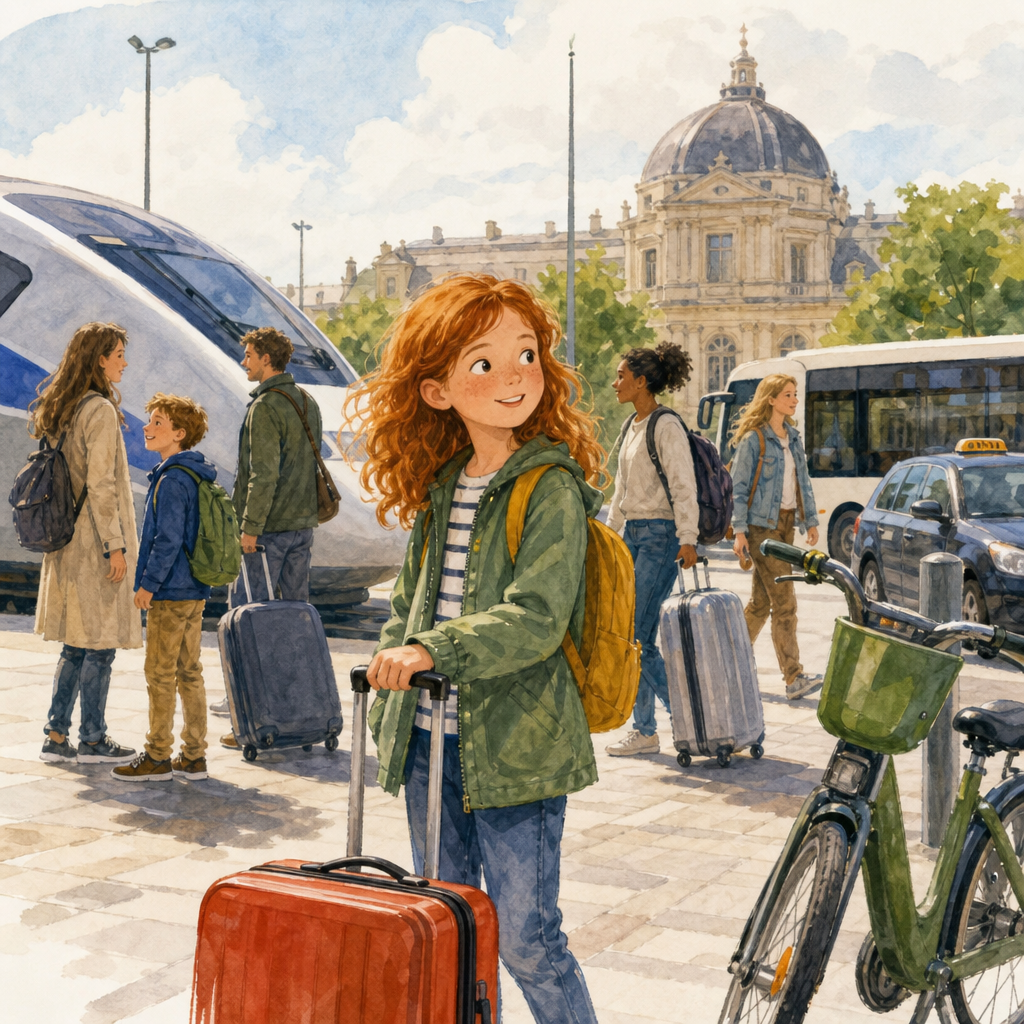
How did you get to school today? Hands up if you walked. Now hands up for a car. Now for a bus. Count the different ways in the room.
Today you will learn eight French words for getting about, so you can name what you see and match each word to its meaning.
Take a quick show of hands for how pupils arrived. Keep it to a minute: walking, car, bus, bike, other. Do not spend time debating edge cases. The point is to make the theme feel real before the French words appear.
Several of today's words are close to English (le bus, le train, le taxi, la moto), so pupils will half-know them already. Hold confirmation until the word-table.
Today's eight transport words are on the board. First we meet four that sound a bit like English: tap each one, listen, then say it back together with le or la. Next we meet four that look less familiar: same job, listen then say. After both passes, watch the apostrophe on l'avion.
Run two listen–say passes so the load does not land all at once. Pass 1 (near-cognates): le bus, le train, le taxi, la moto. Pass 2 (less familiar): la voiture, le vélo, l'avion, le bateau. Tap each word; the class repeats twice, once all together and once by table. Point at the article every time so the pair is what they hear. Trust the audio on the board for a clean model.
Coaching the trickier sounds: for la voiture, get mouths ready for vwa like blowing out a candle, then TOOR, and give a big cheer when the room nails it (it is the crowd-pleaser). For l'avion, slide the l straight onto avion with no gap, and make a runway hand gesture as they say it. Flag the elision: French drops the e of le before a vowel. After both passes, one-line recap only: most take le, voiture and moto take la, and avion takes l'.
Quick chorus check before you leave this step: say the English (or point at the picture) for the four harder words; class answers with the full French phrase. Keep it brisk and warm: praise full article+noun pairs out loud.
Pictures of today's eight transport words are on the board with empty labels. For each picture, whisper the French word with le, la or l' to your partner. Then one volunteer comes up to place the label. The class shows thumbs-up if they agree.
Run this as a whole-class turn-taking game on the IWB. The interactive shows separate labelled hotspots or images for each vehicle, not one realistic street photo. Say this aloud if pupils query the plane or the boat: they are travel connections, not clutter on one pavement.
Before the first label, point out a French cue if the scene shows one (a gare sign, a TGV-style nose, a city bike): le train is how many visitors cross France, and later we will meet the famous high-speed TGV.
Invite volunteers one at a time. Every pupil still has a job: whisper the full phrase to a partner before the click. If a wrong label is chosen, say the correct pair together and try again. Celebrate every correct label out loud: Oui ! La voiture ! Keep the pace brisk so every pupil who wants a turn gets one.
Open your copy. The eight words stay on the board: choose four, copy them with le, la or l', and order them from slowest to fastest. Take care with accents and the apostrophe on l'avion.
Pause the interactive and keep the word-table visible for the full three minutes. Everyone writes: this is the only stretch where every pupil's pen is moving. A sensible slow-to-fast order might be le vélo, le bus, la voiture, l'avion, but accept any reasoned order. Check that articles are going in front of every word. Smile at neat apostrophes on l'avion. Do not collect these.
We flip two cards on the board, the words a traveller might need at a French gare (station). When a French card appears, everyone whispers the word with le, la or l'. A volunteer comes up to find its English match.
Whole class on the IWB only: one volunteer flips, the class whispers the French with its article before the match is confirmed. No pupil devices and no pair kits for this step. Insist on the full phrase: voiture alone is not the answer, la voiture is. If a pair is missed twice, stop and say it together before moving on. Audio plays on every flip, so pronunciation is reinforced while they play. When a pair is found, the class high-fives the article too: big energy for the whole phrase.
You're previewing this lesson. Get full access to this lesson and hundreds more — each one ready to teach, with interactive activities, printable resources and pupil progress tracking built in.