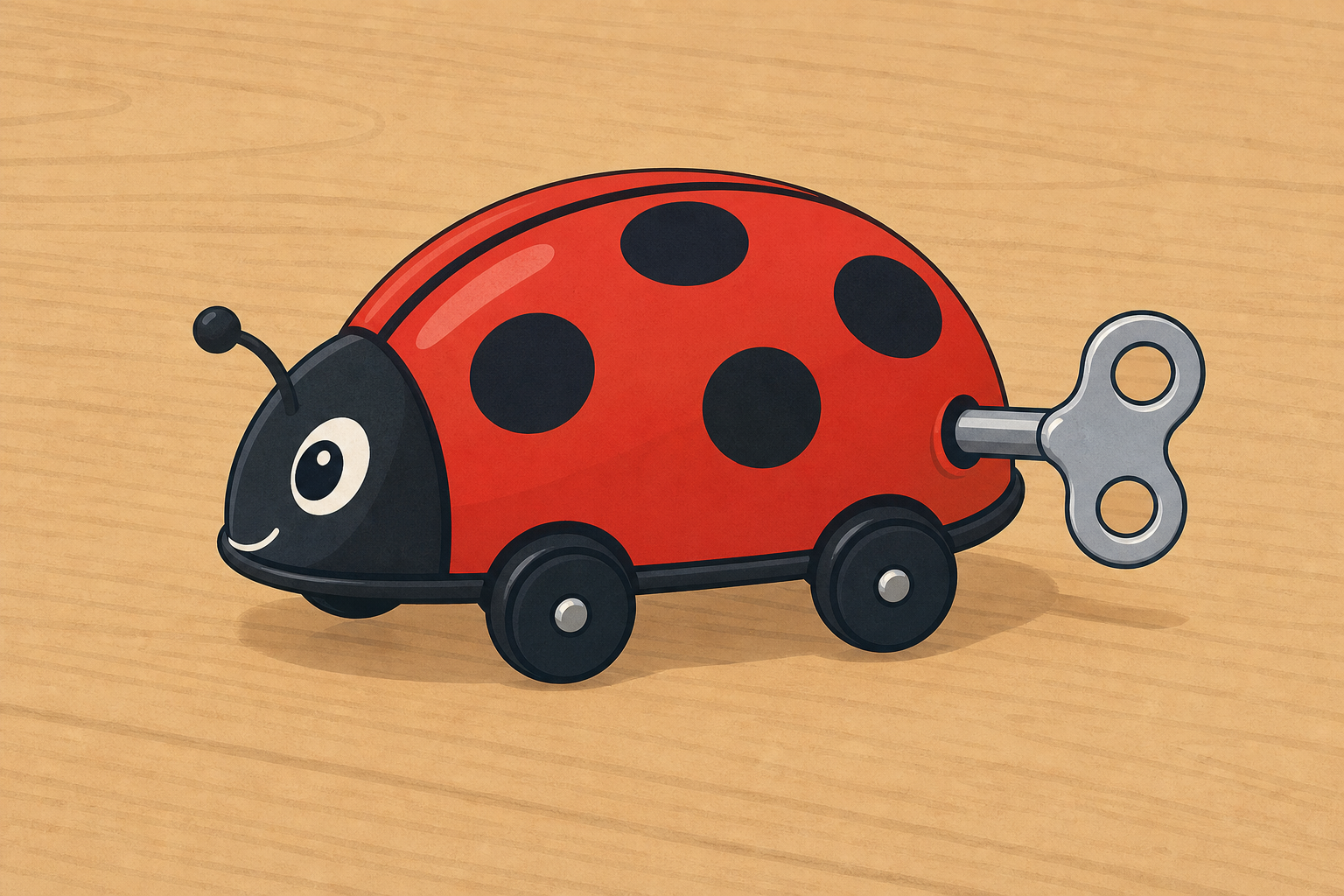
Watch this toy. It was going… and then it stopped. How do we make it go again?
Hold up one wind-up toy. Wind it once so it walks or crawls, then let it run down and stop. Ask the class: How do we make it go again? Take two or three ideas. Do not name the four go-types yet. Keep the other station toys hidden until the next step.
Before the lesson: set three short stations around the room for winding, push and wind (or on trays). Keep the two sealed torches with you for a whole-class try, not as a free-flow tray. Use plain push cars only (no pull-back mechanisms). Check every battery torch has a sealed, screwed-shut compartment. No button or coin cells. Keep any spare batteries with you, never on a child tray. Sketch four simple picture-and-word labels for the sort (key, battery shape, hand push, puff of air or cloud).
Today's big idea is what makes it go.
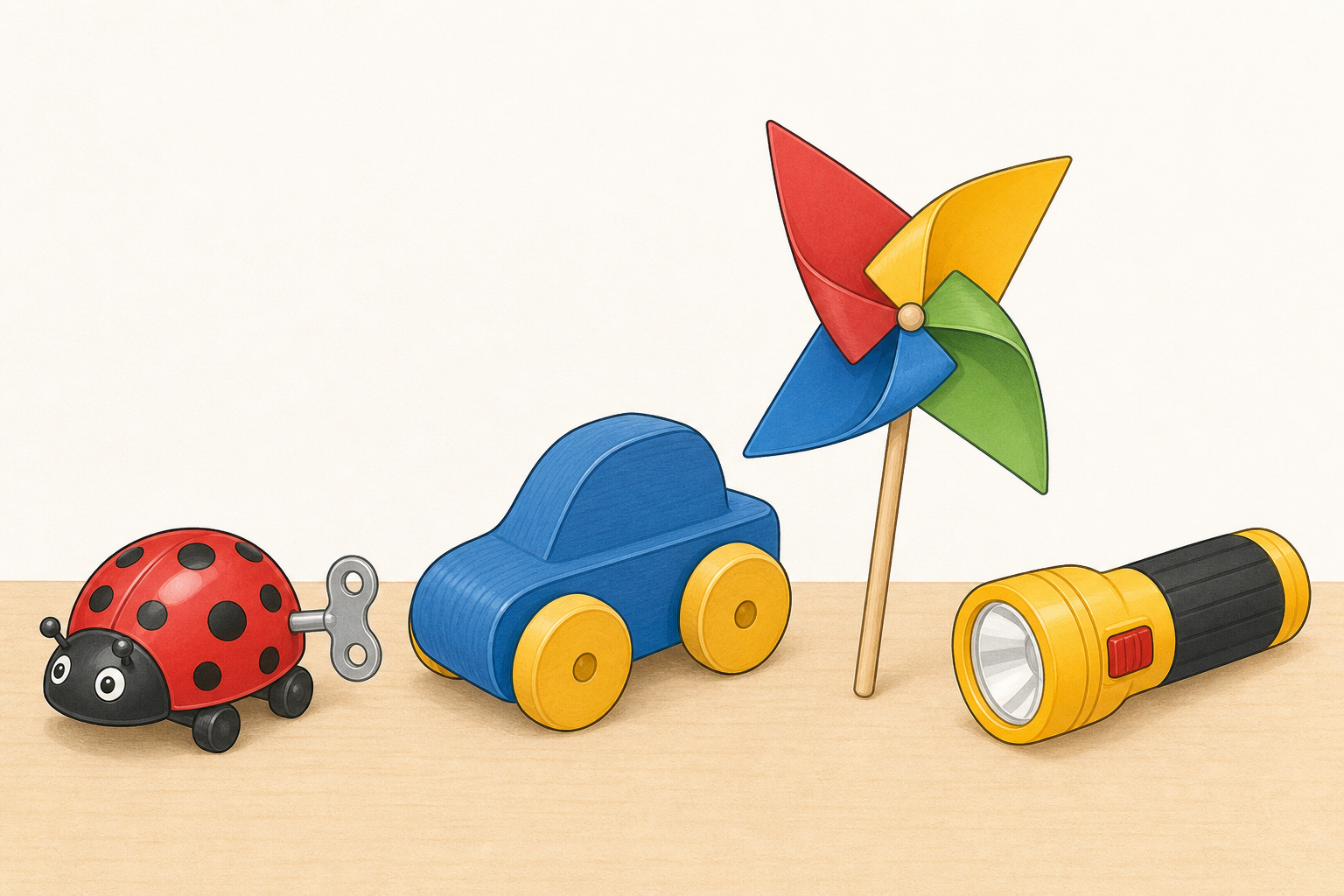
Look at our four things. What do you think makes each one go?
Show the four items one by one without letting children try them yet: wind-up toy, sealed battery torch, plain push car, pinwheel. For each, ask thumbs: What do you think makes this go? Guesses are never wrong. Keep pupil talk on the real objects. Do not put a four-word list of go-types on the board. You may lightly echo a child's idea ("Yes, we might push this one") but lock in the four names only at the sort step after trying.
Teacher language for the big idea (not for the board): what makes it go means the action that starts something moving, lighting or spinning. Things do not start by themselves; something has to give them the go.
| Concept | Why it matters | Example |
|---|---|---|
| What makes it go — the action that starts something moving, lighting or spinning | Things do not start by themselves; something has to give them the go | The torch stays dark until someone switches it on |
Winding with a key, battery, push, and the wind (a puff of air) are the four sort labels you will name after children have tried the objects. They are not a second board concept.
Misconception to head off: children may say batteries are "magic" or that big things always need more go. Keep it simple: each thing needs the right kind of go for it. Counter-phrase if size comes up: Size is not the rule. A tiny pinwheel and a big push car can both go; each needs the right kind of go.
Who helps us (teacher language only): a toy-maker decides what will make each toy go so children can play with it safely. Do not put this as a question children must answer.
First we will try the torch together. Then you will visit the stations. Wind the toy, push the car, and blow the pinwheel. Notice what you do to make each one go.
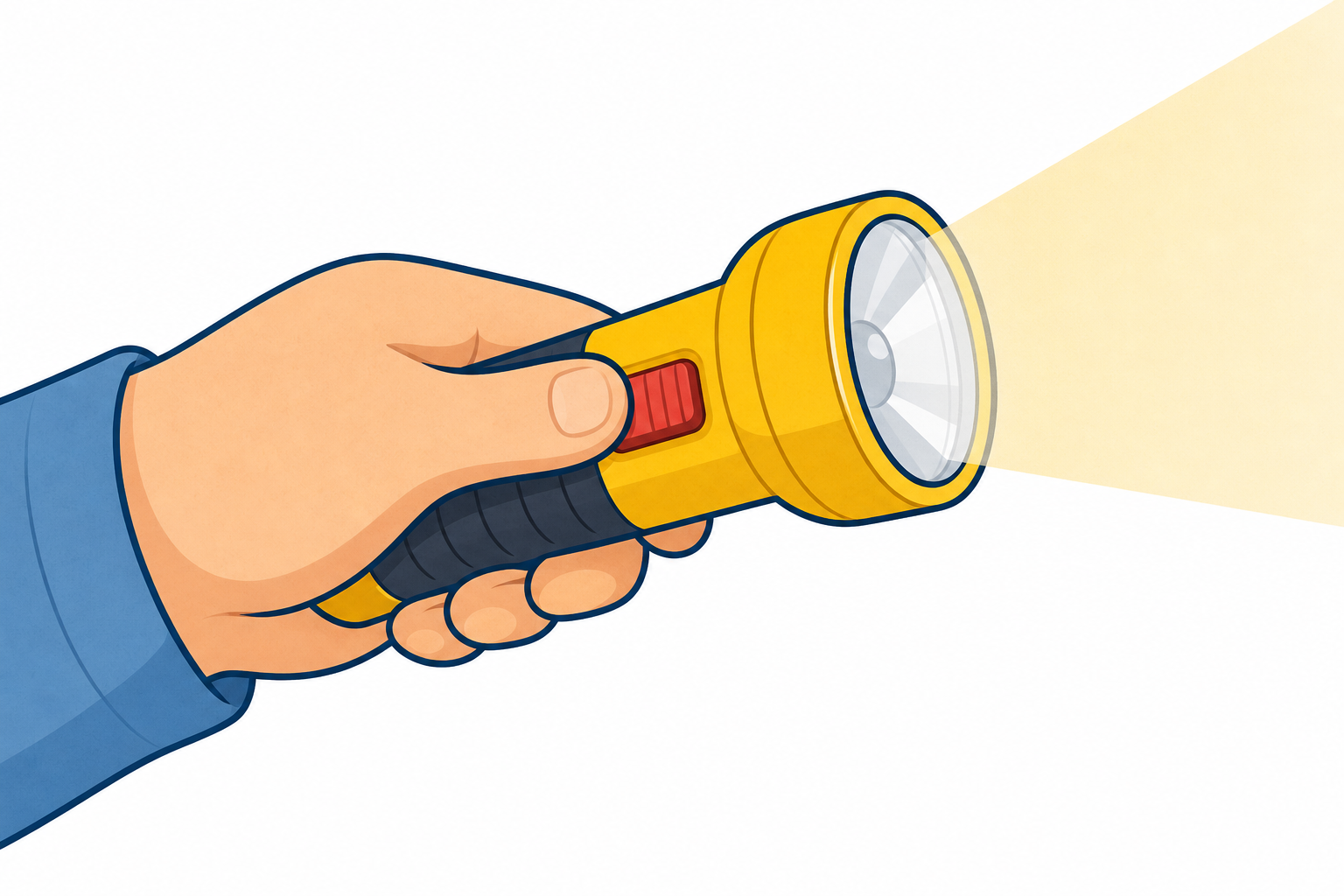
Part A — whole-class torch (about 3 minutes): Keep both sealed torches with you on the carpet. Say clearly once, with a torch held up: The switch lets it go. A battery inside gives it the go. We do not open it. Pass the two torches along two short lines or pairs so every child presses the switch on and off at least once. Covers stay closed. You keep any spare battery in view. This guarantees every child meets the battery idea before the sort, even if they never return to a torch later.
Part B — three stations (about 7 minutes): Quick model of wind, push and gentle blow, then free-flow or short rotations. Groups of about four to six. You can now circulate across all three trays because the torch is no longer a bottleneck station. Return a sealed torch to a calm tray only if you stay beside it; otherwise leave torches with you.
Key questions while you circulate: What did you do to make it go? Did it need your hands, or air?
If a station stalls: model once, then hand it back. If a wind-up key is stiff, help the first turn, then let the child finish.
Differentiation: less confident children stay at one station with you and name the action (wind, push, blow). Confident pairs visit all three and whisper to a partner what each one needed. Anyone who missed a firm torch turn gets one with you before the sort.
Help us sort. Which things go by winding with a key? Which need a battery inside? Which need a push? Which need the wind, a puff of air we blow?
Watch the torch. The switch lets it go. A battery inside gives it the go. That one belongs with battery.
Gather on the carpet with the four real objects (or a dry matching set). This is where you lock in the four go-type names with the class. Lay four hoops or four labelled trays: winding (key), battery, push, wind / blow. Use the picture-and-word labels you sketched before the lesson (a key, a battery shape, a hand push, a puff of air or cloud) so non-readers can join in. Keep those same pictures visible for the drawing step next. Say the pair once so winding and wind do not blur: winding with a key versus the wind, a puff of air we blow.
Hold up each object. Class calls the group. Place it in the hoop. The wind-up toy is winding with a key; the plain push car is push; the pinwheel is wind (blow).
Battery lock-in (do this with the torch in view before it goes in a hoop): Hold up the sealed torch. Point to the switch, then tap the closed battery end. Say slowly: You pressed the switch. The switch lets it go. We cannot see inside, but a battery inside gives it the go. So this one goes in battery, not in a 'switch' hoop. Invite the class to chorus battery as you place it. If a child says "switch" or "light", revoice: Yes, we used the switch, and the go comes from the battery inside.
Look-fors: children naming the action, not only the object; children changing their mind when they remember what they did; children saying battery for the torch rather than only switch or light.
On your paper, draw one or two things you tried. Put each drawing next to the matching hoop picture.
Hand out one sheet of plain paper per child (or the class Investigation Journal page if your pack uses a blank drawing sheet). There is no pre-printed four-box journal for this lesson. The four hoop picture labels on the floor or table are the sort groups children match to. Keep those hoop pictures where everyone can see them.
Children draw one or two things they remember, then walk their paper to the matching hoop and place it beside that picture (key for winding, battery shape for the torch, hand for push, puff of air for wind/blow). Full four-group completeness is not required. Emergent labels are welcome but not required.
If a child draws the torch, point to the battery-shape hoop and revoice once: Switch lets it go; battery inside gives it the go.
Scribe a word for a child who asks. Do not insist on writing. Circulate with the sentence stem: This one goes by…
Fast finishers: draw one more classroom thing and place it by the hoop it would join (for example a door you push, or a classroom fan for wind or battery). Keep it oral and drawn, not a new worksheet. Keep this step in class only; do not set drawing as homework.
You're previewing this lesson. Get full access to this lesson and hundreds more — each one ready to teach, with interactive activities, printable resources and pupil progress tracking built in.