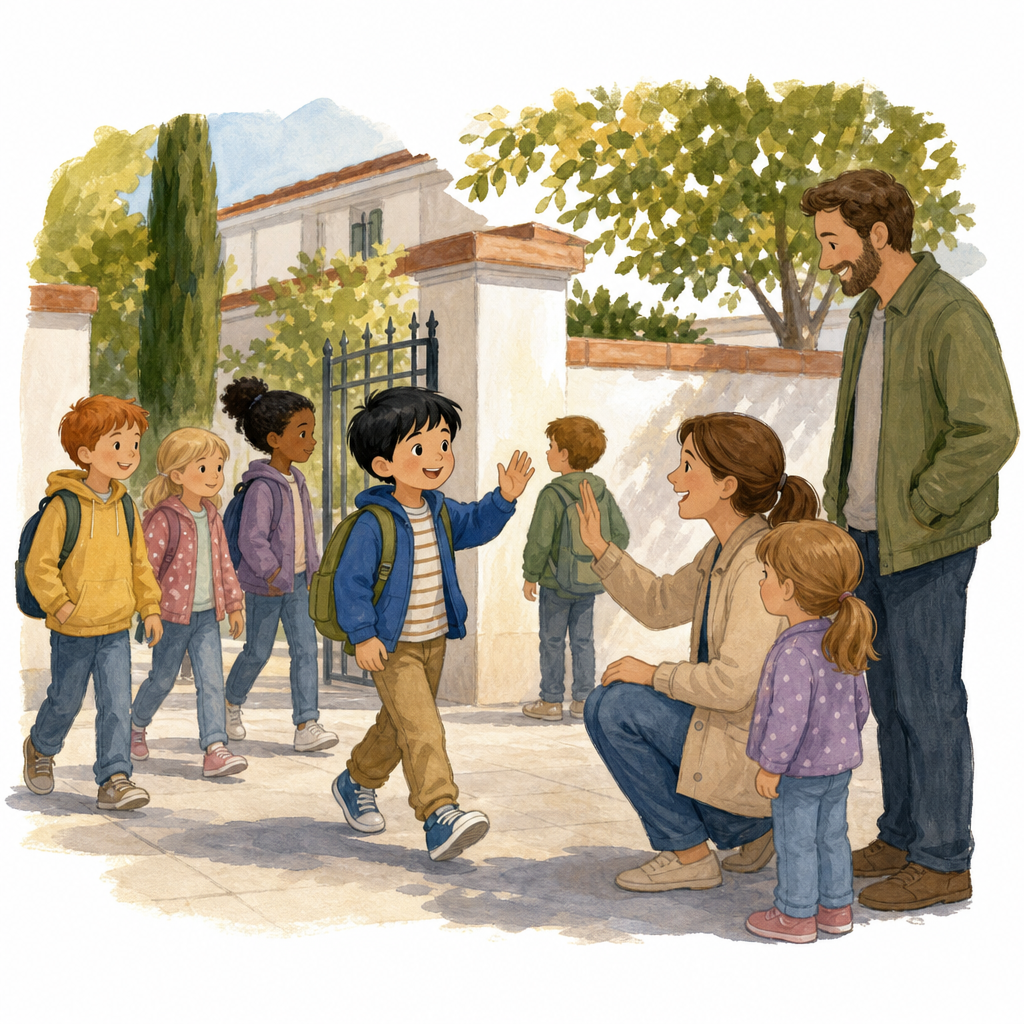
 Picture the school gate on a sunny morning in Spain. Neighbours, classmates and teachers are saying hello, but not all with the same words.
You already know some Spanish hellos from last year. Today the job gets sharper: choose the right one for the person in front of you.
Think in English first: would you greet a friend and the principal the same way? Have one idea ready to say out loud. The Spanish forms come next.
By the end of this lesson, you will be able to:
- Choose the right Spanish greeting for the person you meet
- Spot the friendly forms and the formal ones
- Say why Spanish needs two kinds of "you"
Today's eight greetings come in two groups: Friendly and Time-of-day / more formal.
Tap each one, listen, then say it back together. You will work through them in two short batches of four so your ear can keep up. Notice who each group fits: a classmate in the patio, or a principal, visitor or shopkeeper.
Click each Spanish greeting, then its English meaning. There is a pair for every greeting you have just learned. When a pair matches, say the Spanish together with the class.
Open your copy. Keep looking at the word-table on the board and copy two greetings from it (one friendly, one more formal is ideal — e.g. Hola and ¿Cómo está usted?).
Beside each one, write in English who you would say it to and who you would not.
- Hola — Hello
- Buenos días — Good morning
- Buenas tardes — Good afternoon
- Buenas noches — Good evening
- Estoy bien, gracias — I'm fine, thank you
- ¿Cómo estás? — How are you? (friendly)
- ¿Cómo está usted? — How are you? (formal)
- Mucho gusto — Nice to meet you
Practise with a partner using the two role cards below. Partner A greets, Partner B replies, then swap after two turns.
- Classmate in the patio: friendly Hola and ¿Cómo estás?
- At the panadería (bakery): polite Buenos días and ¿Cómo está usted?
Partner B answers with the "I'm fine" line from today's list. Match the register to the person.
Unlock the full learning experience
You're previewing this lesson. Get full access to this lesson and hundreds more — each one ready to teach, with interactive activities, printable resources and pupil progress tracking built in.
This lesson is copyright of Coding Ireland 2017 - 2025. Unauthorised use, copying or distribution is not allowed.