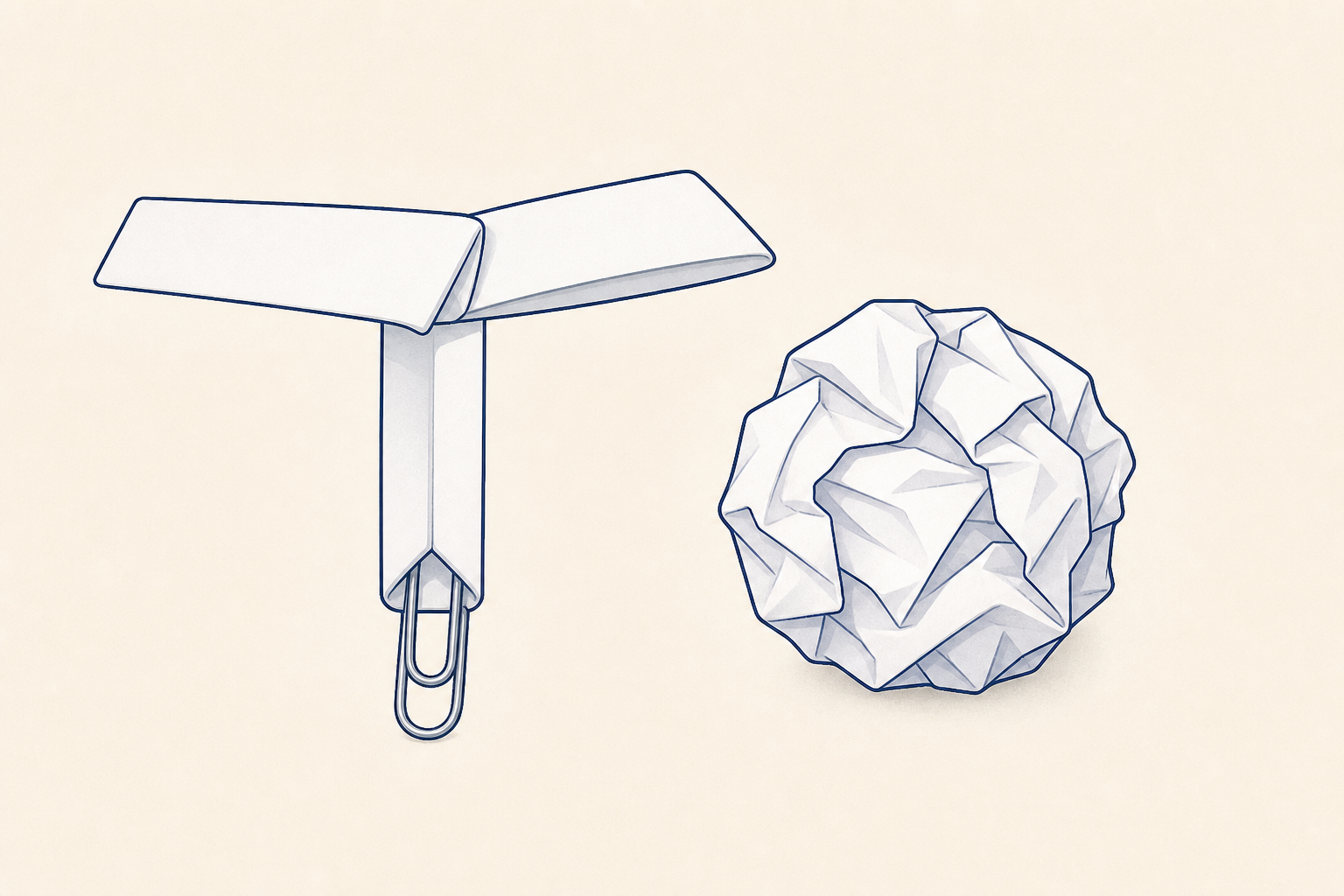
Watch as I drop this paper spinner, then a crumpled ball of the same paper. Notice how slowly the spinner falls compared with the ball.
Hands up: do you think bigger wings would make a spinner fall slower, faster, or the same?
Stand on the floor (not a chair yet). Drop one ready-made paper spinner once so the class sees the slow fall, then drop a crumpled ball of the same paper from the same height. Do not explain air resistance yet.
Key questions: What is pulling both down? Why might the spinner take longer?
What to expect: pupils often say wind, spinning, weight, or the paperclip. Accept all ideas; the fair test will sort them. Spin is fine as a wonder comment, but steer the prediction toward slower or faster fall time, which is what we will measure.
Have scissors, templates, paperclips and group timers ready but do not hand them out yet. Keep Investigation Journal pages stacked until step 2.
Today's words: air resistance (air pushing against a moving object and slowing it), gravity (the pull that brings things down), fair test (change one thing, measure one thing, keep the rest the same).
Our question: Does wing length change how long a paper spinner takes to fall?
Five cards appear on the board: wing length, fall time, drop height, the paper, the paperclip. Call out which bin each belongs in: Change, Measure, or Keep the same. We agree the bins together before anyone writes.
Next beat: you get your Investigation Journal page. Default comparison is short vs long wings. On the page write the question, a prediction with a reason, what you change / measure / keep the same, your two wing sizes, and one trust check your group chooses (for example, how you will double-check drop height, or when you will discard a messy trial).
| Concept | Why it matters | Example |
|---|---|---|
| Air resistance — a force from the air that pushes against a moving object and can slow it as it falls | It explains why some falling things take longer than others even when gravity pulls them all down | Longer spinner wings usually fall more slowly because the larger wings meet a greater upward push from the air |
| Gravity — the force that pulls objects down towards the Earth | Without gravity the spinner would not fall; gravity is the force we are working against | When you open your hand, gravity pulls the spinner straight toward the floor |
| Fair test — change one thing, measure one thing, keep everything else the same | If two things change at once, you cannot tell which one caused the result | We change only wing length; drop height, paper type and paperclip stay the same every drop |
Misconception to head off: heavier things always fall faster. Same paper and paperclip means mass stays roughly equal; wing size is what we test. Trimming wings removes a scrap of paper, but the paperclip is most of the mass, so we treat mass as roughly the same. The big difference we are testing is wing size and air resistance.
Beat 1 (about 5 min): Keep the three terms to the short board lines only. Run the fair-test-planner card sort as a whole class. Do not hand out journals or templates yet. Target placement: Change = wing length; Measure = fall time; Keep the same = drop height, the paper, the paperclip. Leave the agreed bins on the board.
Beat 2 (about 5 min): Issue one Investigation Journal page per pupil now. Tell groups the page (or ruled-paper substitute) must hold these sections: investigation question; prediction with a reason; change / measure / keep the same; two wing sizes; one trust check. Default wing choice is short vs long so decision time stays short (medium is only if a group finishes early later). One child-led design decision: each group records one trust check they will use (e.g. "we re-measure the height mark before each drop" or "we discard any trial that hits a chair or has a late stop"). Theme and measure stay teacher-set; the trust check is their method judgement.
Drive the fair-test-planner on the IWB for Beat 1 only.
Nature of STEM: This is how scientists test one idea at a time: we keep gravity and the drop the same, and only change the wings so we can see air resistance's effect.
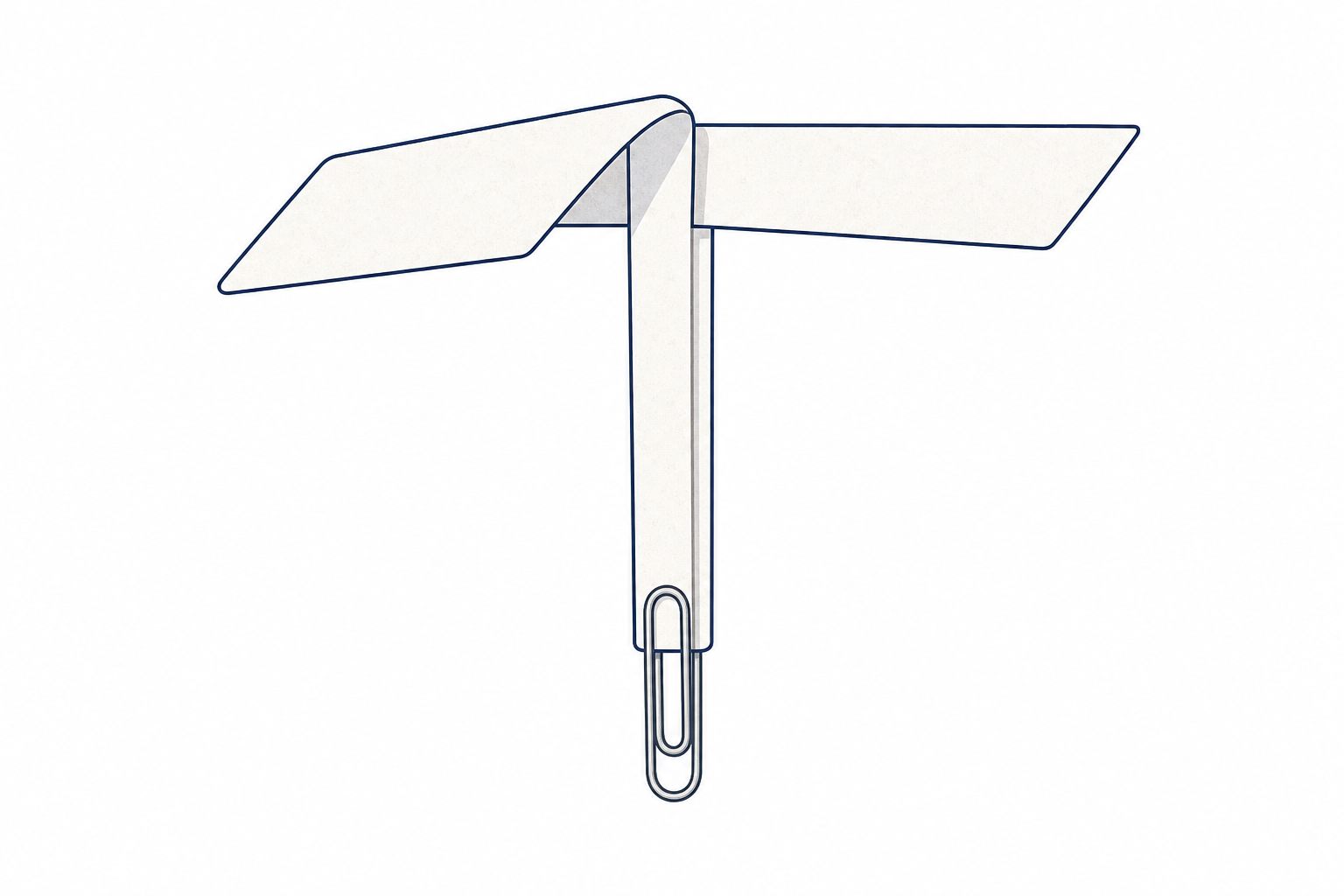
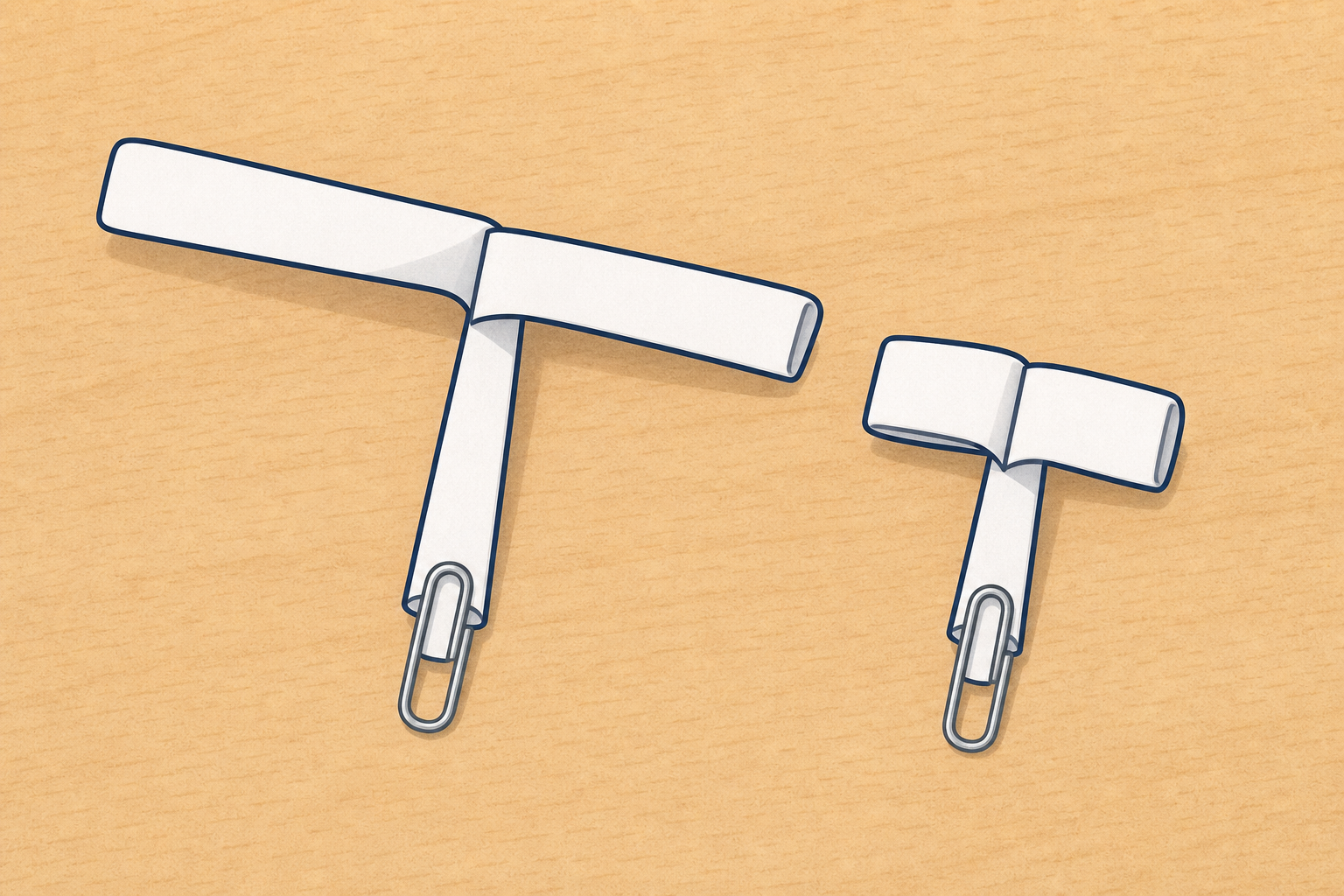
First, make two paper spinners that match your plan. Default pair: short vs long wings. Change only the wing length. Keep the paper, the paperclip and the fold the same. Use the fold steps on the board.
Agree four roles in your group: dropper (releases the spinner cleanly from the height mark), floor-spotter (watches the floor and calls "stop" on first touch), timer (starts on release and stops on the spotter's call), recorder (writes each called-out time straight onto the Investigation Journal trials grid). If your group has only three people, the timer also records. Extra pupils beyond four watch that trial and swap into a role on the next pair of drops.
Drop each spinner from your station's height mark. Do each wing size at least twice. Write every raw time on the journal trials grid as it is called — do not wait until later. Groups work at the same time at the drop stations. Watch other groups when a station is busy, and be ready to say what you notice.
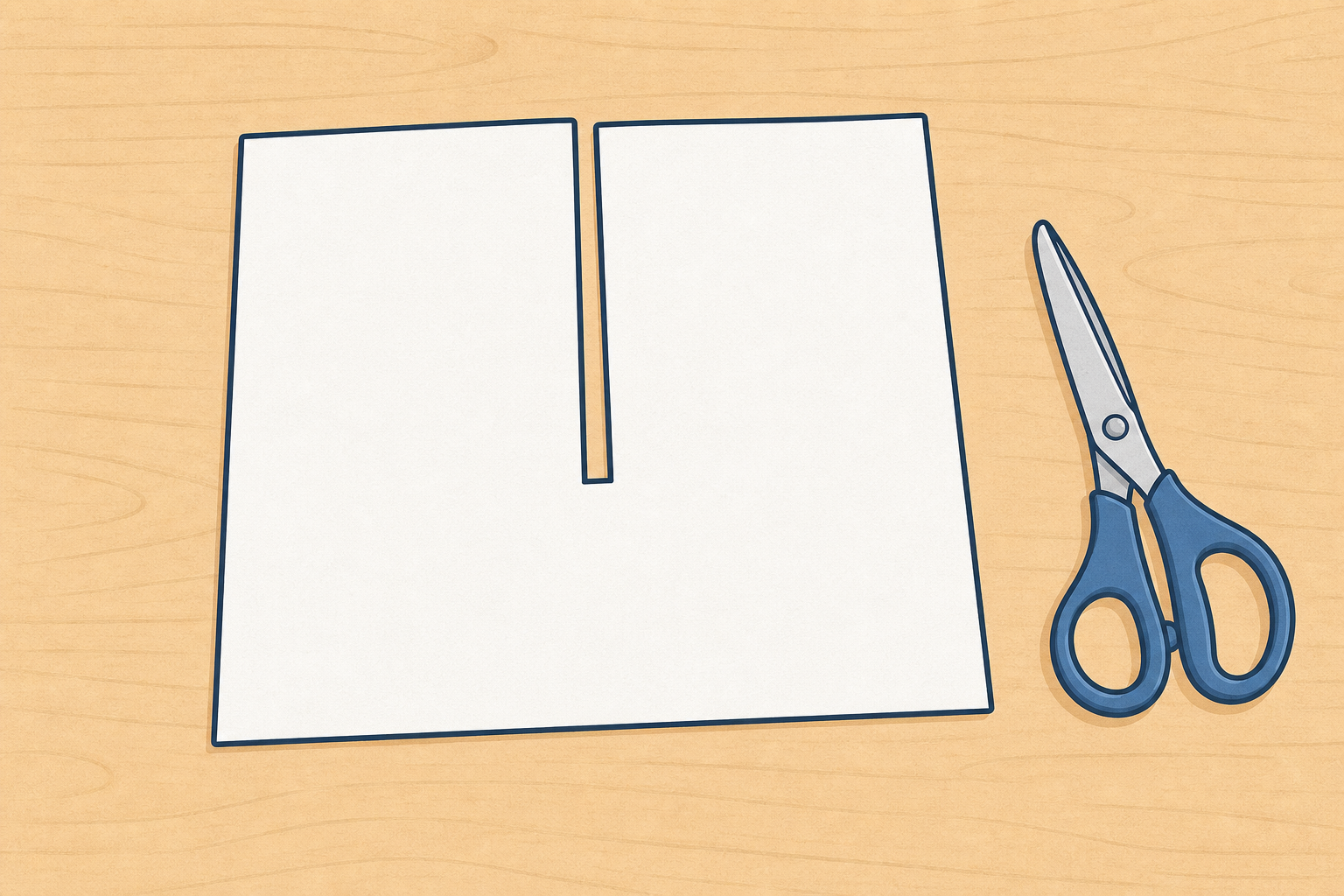
Nothing to print. Each pupil rules and cuts their own rectangle from plain paper — measuring it is part of the science. Put these measurements on the board:
If a printer is unavailable, mark the same sizes on A5 paper and follow the same five steps from the board. Pupils only fold if you pre-cut for support groups.
Show the five fold steps on the board before anyone cuts. Model one full cycle aloud with a short-wing spinner at a station, using a class stopwatch once so everyone sees the start/stop cue:
Default contrast is short vs long only — that cuts build and decision time and gives the clearest pattern. Set up as many drop stations as you can (aim for one station per two groups, minimum two or three), each with the same wall height mark (use string of fixed length if metre sticks are short). Each group has its own stopwatch or phone timer. Groups make both spinners first (about 6–8 minutes), then use free stations so several groups drop at once. Roles stay fixed for a pair of trials, then swap so more pupils drop and time.
Minimum dataset fallback: every group needs at least one clean time per wing size; target is two trials each. If the slot is tight and a group only has one clean pair (one short, one long), they use those two times and note "one clean trial each" on the journal rather than inventing a second reading. If they have two trials for one wing and one for the other, average only where two exist and still compare. Do not hold the class for perfect tables.
Watchers at a busy station: fold them in with questions ("Was that a clean release? Did the wings really differ?"). Do not set a separate desk worksheet.
Where times are written: the recorder writes each called-out time straight onto the Investigation Journal trials grid during the drops. Step 4 is for checking the grid and calculating averages only — not first-time recording.
Timing quality: fall times from standing or low chair height are often only a couple of seconds, so reaction error is large. Short vs long is best. Agree a clear start (open hand) and end (first floor touch). If a trial is spoiled (hit a chair, late stop, early release), discard and repeat when time allows. If two averages differ by only a tenth of a second, treat them as similar and re-check height and wing length before claiming a difference.
What to expect: longer wings usually give longer fall times when wings differ a lot. Same paper and paperclip keep mass roughly equal. Trimming wings removes a scrap of paper, but the paperclip is most of the mass, so we treat mass as roughly the same; the big difference we are testing is wing size and air resistance.
Safety: drop from a safe, steady height only. Chair only with adult steadying; never from high windows or climbing furniture. Round-tip scissors; walk with scissors closed. Clear the drop zone of feet and bags. Paperclips are small parts, not for mouths.
Circulate: check only wing length differs; prompt a second trial if the first drop was messy and time remains.
End of this step: every group should have raw trial times on the Investigation Journal trials grid (aim for two trials per wing size; one clean pair is the minimum).
Check your group's trial times are already on the Investigation Journal page. Do not drop again unless a time is missing and a station is free.
Work out a simple average for each wing size: add trial 1 and trial 2, then halve. Example on the board: 2.2 s + 2.6 s = 4.8 s; half of 4.8 is 2.4 s. If you only have one clean time for a wing size, write that time and note "one trial".
This step is check-and-average only. All planned drops should already be finished. No stopwatch on the IWB — keep the board free for the worked average example so the class does not restart timing rounds.
Coach averages: add trial 1 and trial 2, then halve. Write the worked example (2.2 + 2.6 → 2.4) on the board before pupils calculate. If a trial was clearly spoiled and never repeated, send the group for one quick re-drop at a free station only if time allows; otherwise they keep the clean single reading and label it.
Remind pupils: the number is what we saw; what it means about air resistance comes next.
Share your averages with the class. Which wing size took longer to fall? Did that match your prediction?
Think of a sycamore key or a parachute — same idea as our wings. What does our evidence say the air is doing?
Discuss: what force pulled the spinner down? What force slowed it? What would have made the test unfair?
Collect a few group averages on the board (short wings vs long wings). Pattern to draw out: longer wings → longer average fall time → greater air resistance acting against gravity.
Observation vs inference: "It took 2.4 s" is observation; "so bigger wings mean more air resistance" is inference from the pattern.
Unfair test examples: different drop heights, different paper, missing paperclip, one spinner crumpled.
Fold watchers in: "Do you agree with that group's conclusion? What would you try next?"
Link briefly to forces acting together: gravity pulls down; air resistance pushes against the fall. Irish context if natural: parachutes and seed "helicopters" (sycamore keys) use the same idea outdoors.
You're previewing this lesson. Get full access to this lesson and hundreds more — each one ready to teach, with interactive activities, printable resources and pupil progress tracking built in.