1 - Start ~4 mins
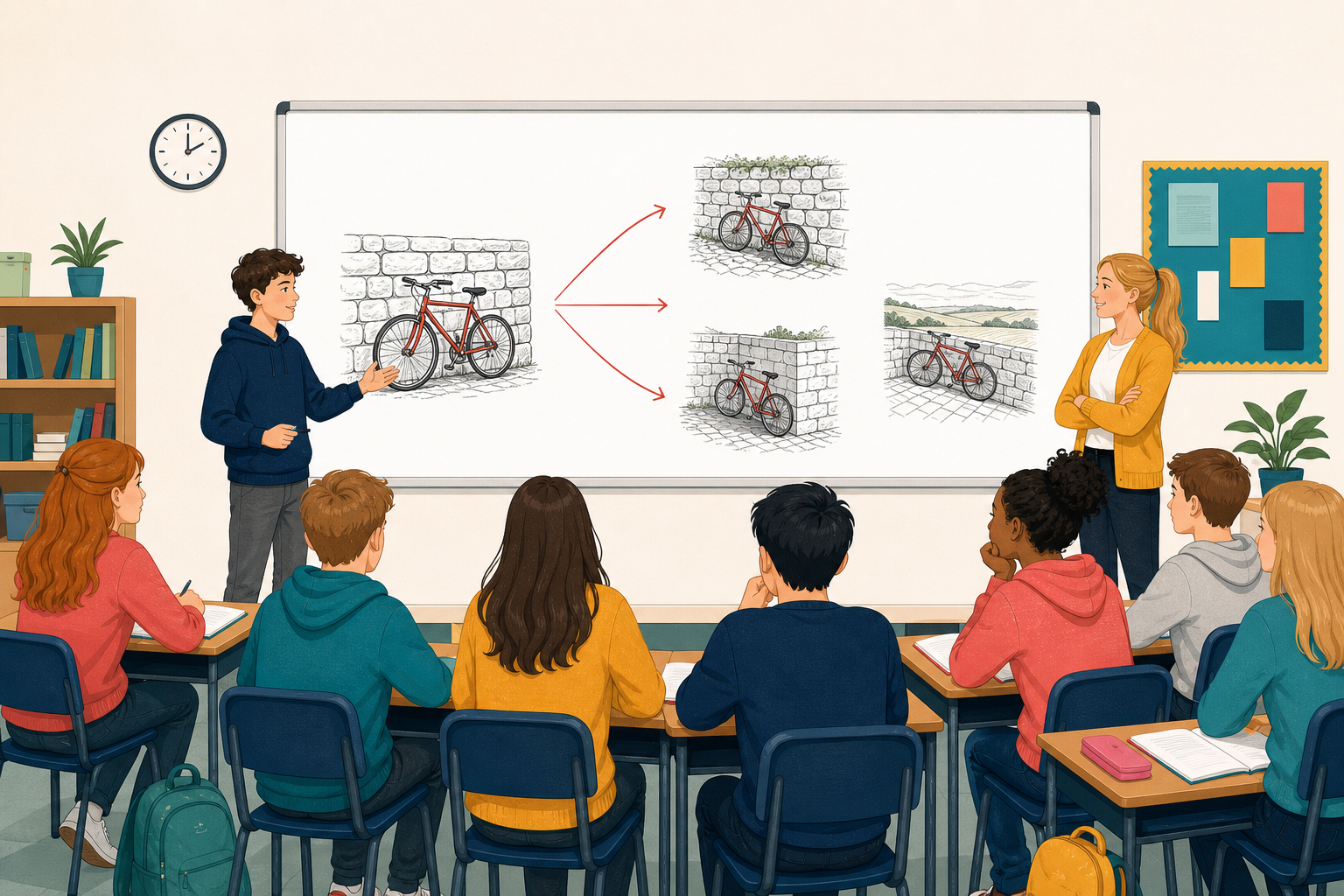 You already know a model learns from examples, and that a confident answer is not always a correct one. Today you make images with AI.
You will generate from a text prompt, change one part at a time, and deliberately push the model at things it usually gets wrong. By the end you should be able to say what the model is doing with your words.
2 - Examine and Discuss ~8 mins
The same eight-word prompt was run four times. Nothing else changed:
a red bicycle leaning against a stone wall
| Run | What came back |
|---|---|
| 1 | Close-up on wet cobbles; modern street; wheels look solid |
| 2 | Countryside lane; dry stone wall; basket on the handlebars |
| 3 | Night scene under a street lamp; rear wheel slightly warped |
| 4 | Soft watercolour style; no chain visible; wall texture vague |
In pairs, take one minute: what stayed the same across all four? What varied? What does that suggest about where the image came from?
Working alone? Write three short bullets (same / varied / suggests) before you move on.
Share two observations with the class before you move on.
Worked example: that same eight-word prompt on a typical school assistant produced the same pattern: red bike and a lean stayed stable; wall, light, angle and mechanical detail shifted every run. Your school tool will differ. The shape of the experiment is what matters.
3 - Hands-on: Generate, Vary, Break ~12 mins
If you have a school AI account, open it and run each step yourself. If the teacher is driving on the board, you still write the one-line note after every generation — same job, you are not just watching.
Must do (about four live runs): baseline prompt, one controlled change (subject or style or setting), one break test, then the class failure list. If time: do the other varies and the other break tests. Keep notes either way.
4 - Your Turn ~8 mins
Make one image you would genuinely use in a piece of your own work this term: a presentation slide, a work-experience poster, a CAO course mood board, or a club graphic.
- If you have a school account: generate the image yourself. Write down the exact prompt that produced the version you are keeping, note one change that improved it (subject, style or setting), and save the image and the prompt the class way.
- If the teacher is driving: write your full prompt (subject + style + setting), hand it up for the batch run, and record the result when your prompt is run. You can also pair up and refine a shared prompt the teacher runs. Still note one improvement and save prompt plus result the class way.
5 - Make Sense ~4 mins
The model does not look up a photo of your request. It recombines patterns learnt from training examples that matched parts of your words (subject, style, setting) into a new image each run.
That is why the same prompt varies, and why hands, readable text and exact real places often break: those details are hard to keep consistent from patterns alone.
Unlock the full learning experience
You're previewing this lesson. Get full access to this lesson and hundreds more — each one ready to teach, with interactive activities, printable resources and pupil progress tracking built in.
This lesson is copyright of Coding Ireland 2017 - 2025. Unauthorised use, copying or distribution is not allowed.