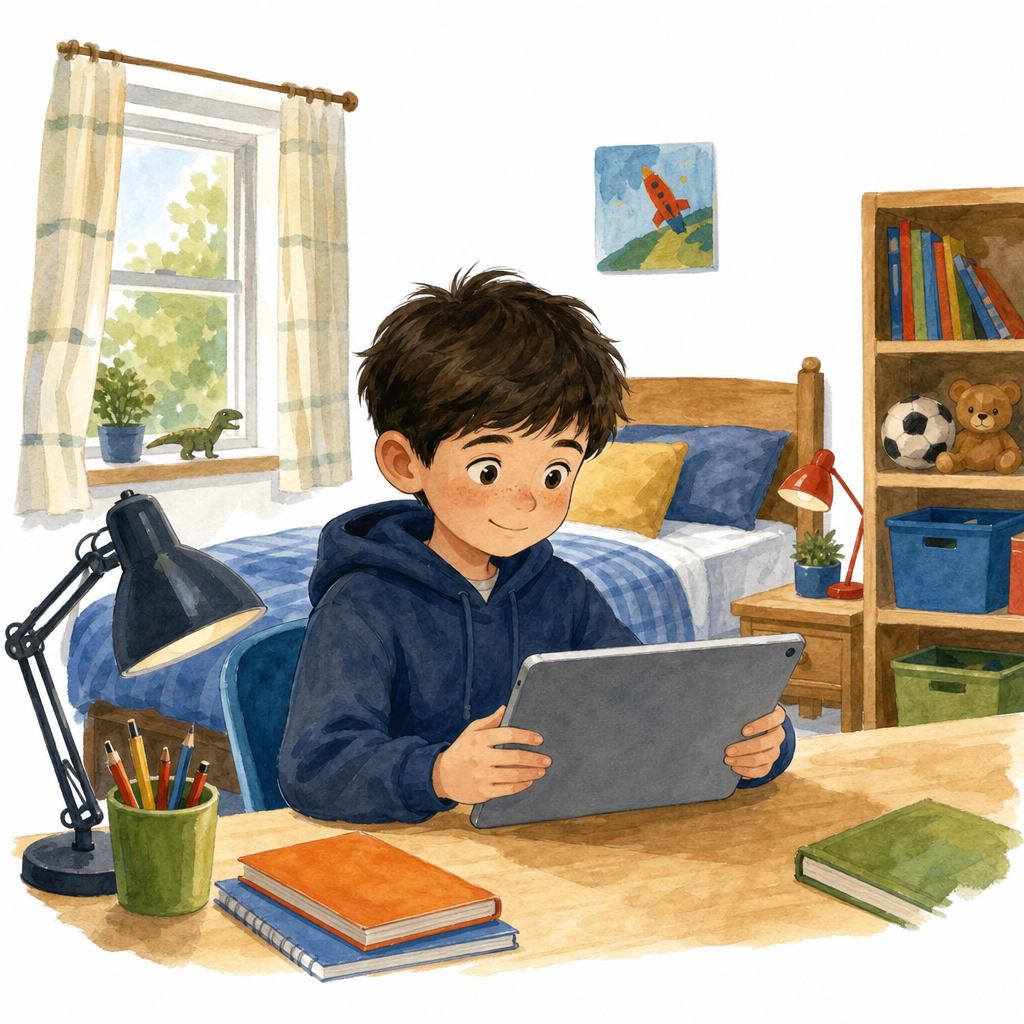
Picture your bedroom for a moment. When I say go, you have ten seconds to name everything you can think of in English. Get ready, then off you go!
Time one volunteer for ten seconds, then take two more rapid turns. Keep it light and do not correct English lists. Tell the class that today they will put those same things into Spanish sentences with a place word, not just a bare noun.
Beat 1: Here are today's eight furniture words. Tap each one, listen carefully, then say it back together with its article.
Beat 2: Now meet three place phrases. Watch the gesture, then say each one with the class:
We join them with está (is located) in a full sentence. The thing after the place phrase is always another furniture word from today's list.
Beat 1 (about 6 minutes): Tap each furniture word. Class repeats twice, once together and once by table. Point at the article every time so the pair is what they hear.
Beat 2 (about 4 minutes): Teach the three place phrases alone with gesture before any full sentence. Choral repeat each phrase twice with the matching desk gesture. Pronunciation guides (leave these on the board):
Then model two full sentences on the board, using only today's eight furniture words. Keep the fixed frame visible: La/El ___ está sobre / debajo de / al lado de la/el ___.
La lámpara está sobre la mesa. (lah LAHM-pah-rah es-TAH SOH-breh lah MEH-sah) — The lamp is on the table.
La cama está al lado del armario. (lah KAH-mah es-TAH al LAH-doh del ar-MAH-ryoh) — The bed is beside the wardrobe.
Note the contraction: de + el becomes del in al lado del armario. State clearly that the noun after the place phrase must be another of today's eight furniture words (not a free invention). Pupils do not invent new nouns here.
Setting hook: picture a bedroom in Seville with the persianas (shutters) half-closed: lamp on the desk, bed beside the wardrobe. Reuse this image once in the spin stretch prompts.
Spin the wheel. When it lands on a piece of furniture, we build a full sentence together using this frame on the board:
La/El ___ está sobre / debajo de / al lado de la/el ___.
First we say each sentence as a whole class. After the class rounds, if you are ready for a stretch, build your own sentence using only today's eight furniture words and one place phrase.
Whole class on the IWB. Keep the frame La/El ___ está sobre / debajo de / al lado de la/el ___ visible for the whole activity, with pronunciation still on the board: sobre (SOH-breh), debajo de (deh-BAH-khoh deh), al lado de (al LAH-doh deh), está (es-TAH).
Choral round first (at least four spins): Spin, pick two furniture words from the list (the landed word plus a second from the set), and lead the whole class in a full-frame sentence, e.g. La lámpara está sobre el escritorio or El sofá está al lado de la mesa. Everyone echoes. Do not move to individual turns until four choral full sentences are secure.
Then stretch (bonus, not instead of): Name a volunteer. Insist on the article: cama alone is not enough; la cama is. Prompt with the frame still visible. Stretch sentences must reuse only today's eight nouns. Optional Seville prompt: "In that Seville bedroom with the persianas half-closed, where is the lamp?"
If a pronunciation slips (especially the double-l in silla, SEE-yah, or the accent on sofá, so-FAH), say it once yourself and have the class echo before the next spin. Hand out printed bingo cards as the last spins finish so Furniture bingo can start at once.
Open your copy. First we will say two class sentences aloud together using the frame on the board. Then write at least one sentence about what is in your bedroom and where it is. Use today's furniture words and a place phrase. You may copy or adapt the gapped model:
La/El _____ está _____ la/el _____.
A second sentence is a stretch if you are ready. Take care with accents, especially on sofá and lámpara.
Pause the board. Keep both model sentences and the word-table on screen in Spanish with English underneath, plus the fill-in skeleton La/El ___ está ___ la/el ___. Highlight accents on sofá and lámpara (and any other board words pupils may copy, such as estantería).
Thirty-second oral rehearsal first: point at the skeleton and lead two whole-class sentences (reuse the models if needed) before any pens move.
Everyone then writes for the remaining time. Require at least one supported sentence; a second sentence is the stretch. Look for the full frame (La / El … está sobre / debajo de / al lado de …) rather than a bare noun list. Do not collect these. If a pupil is stuck, point them back to the two model sentences from Eight pieces of furniture (La lámpara está sobre la mesa / La cama está al lado del armario).
Mark each furniture word on your bingo card as you hear it. First full line calls out. Say the Spanish quietly to yourself as you mark each one.
How to Play Bingo:
Option 1: Students on Devices (Digital Version)
Option 2: Print Out the Bingo Cards
You're previewing this lesson. Get full access to this lesson and hundreds more — each one ready to teach, with interactive activities, printable resources and pupil progress tracking built in.