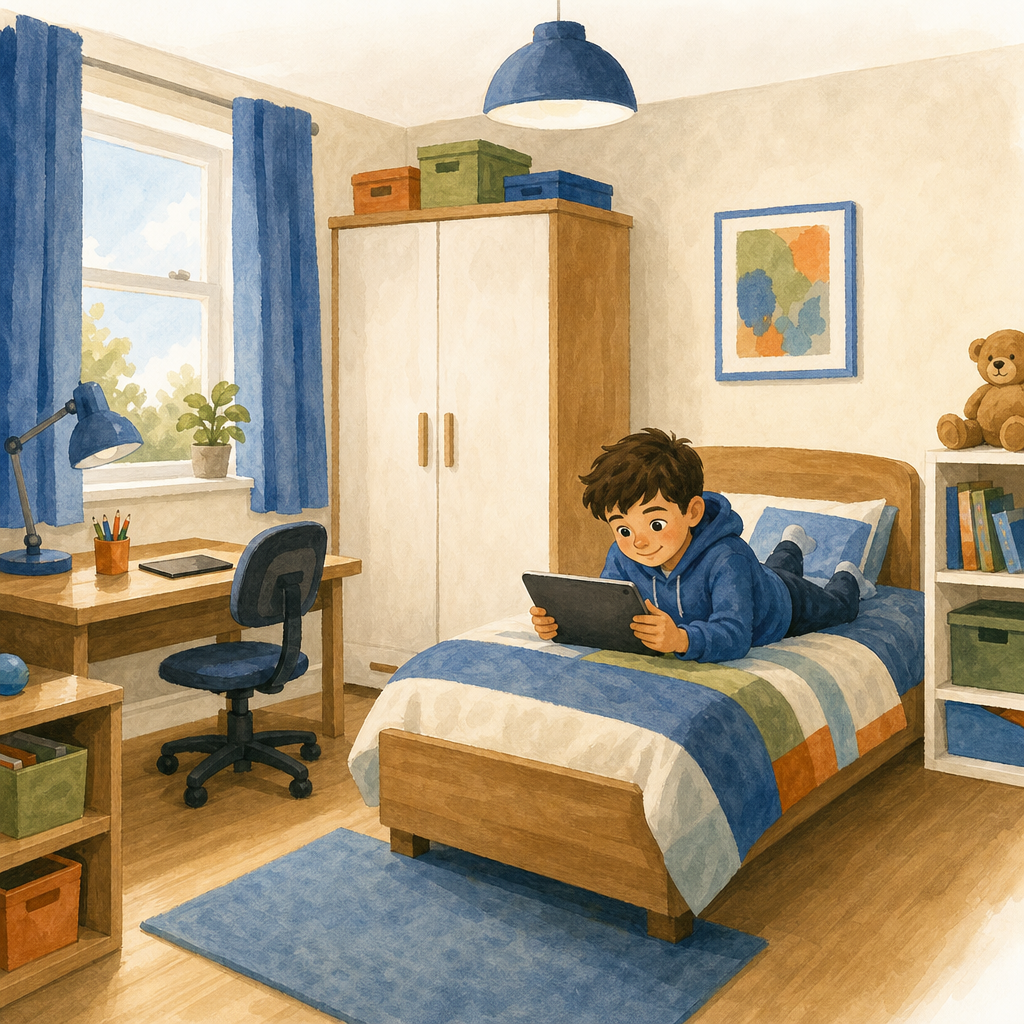
 Close your eyes and picture your bedroom. In English, name everything in it in ten seconds. Ready? Go!
Today we put those things into French sentences, and we say where they are: on, under or beside something else.
By the end of this lesson, you will be able to:
- Name eight pieces of furniture in French
- Say what is in a room and where it sits
- Notice how homes are furnished for climate and lifestyle
Part 1: Here are today's eight pieces of furniture. Tap each one, listen, then say it back together. Watch the article every time (le, la or l').
Part 2: Now add where things sit. Three words do the work:
- sur (syoor) = on
- sous (soo) = under
- à côté de (ah koh-TAY duh) = beside
After à côté de, French contracts: use du / de la / de l' (not de le).
Use these sentence patterns:
- Le/La/L' ___ est sur le/la/l' ___.
- Le/La/L' ___ est sous le/la/l' ___.
- Le/La/L' ___ est à côté du / de la / de l' ___.
Picture a small shuttered bedroom in Paris while you listen to the models.
Spin the wheel. When it lands on a word, say the French aloud with its article, then finish the pattern by pointing at a second object in the bedroom scene:
- Le/La/L' ___ est sur le/la/l' ___.
- Le/La/L' ___ est sous le/la/l' ___.
- Le/La/L' ___ est à côté du / de la / de l' ___.
Think of a small Paris apartment bedroom with shutters closed against the noon sun.
Open your copy and write two sentences saying what is in your bedroom and where it is. Use today's furniture words and a position phrase in each sentence. Take care with accents and articles.
Everything you need is here on this page while you write: the word list below, three model sentences, the du / de la / de l' reminder for à côté de, and a gapped example, Le lit est ___ la table.
Three model sentences you can copy and change:
- Le lit est à côté de l'armoire.
- La lampe est sur le bureau.
- La chaise est sous la table.
Remember: after à côté de, write du, de la or de l', never de le. For sur and sous, keep le, la or l' as usual.
- le lit — the bed
- la table — the table
- la chaise — the chair
- le canapé — the sofa
- l'armoire — the wardrobe
- le bureau — the desk
- la lampe — the lamp
- le miroir — the mirror
Your bingo card should already be on your desk (printed Bingo Cards PDF). Listen carefully. When you hear a furniture word that is on your card, cross it off. When every word on your card is crossed off, call Bingo!
Stretch round: listen for a whole shuttered-bedroom sentence, not just the noun: mark the furniture you hear.
Unlock the full learning experience
You're previewing this lesson. Get full access to this lesson and hundreds more — each one ready to teach, with interactive activities, printable resources and pupil progress tracking built in.
This lesson is copyright of Coding Ireland 2017 - 2025. Unauthorised use, copying or distribution is not allowed.