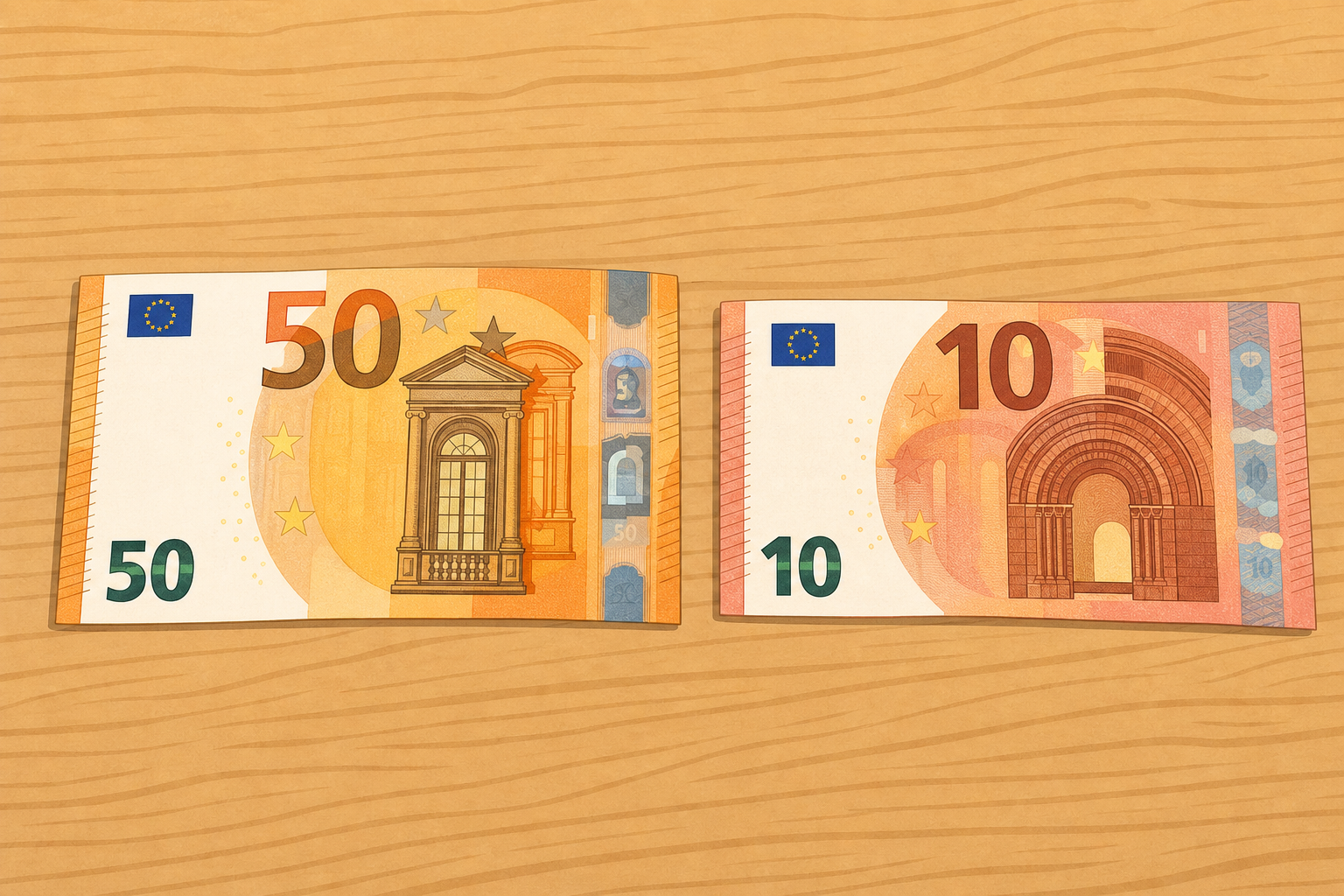
Here is a real problem to warm us up: a €60 prize is being split so that Aoife gets two fifths of it. Before we work anything out, what is the whole here? And which fraction of it do we actually need?
Take two or three hands-up answers, not open call-outs. Push pupils to name the whole out loud (€60) before anyone reaches for the fraction. That single move heads off the most common slip in this lesson.
Real problems rarely say 'find a fraction of'. You have to read carefully, decide what the whole is, then work the fraction. Watch three worked here: for each one, find the whole, split it into equal parts, then take the parts you need.
2/5 of €60: five equal parts, one part €12, two parts €24 for Aoife. Say it as divide by the bottom, multiply by the top.
3/4 of 2 litres: whole is the 2 litre bottle. Each quarter 0.5 l, three quarters 0.5+0.5+0.5 = 1.5 l, one quarter 0.5 l left. Stress the unit stays litres, not "2".
Spent 2/3 of €30: three parts of €10, spent €20, €10 still there. Ask "what fraction is left?" before revealing — this bridges to the remainder idea in the challenge.
Today we work three problems together. First 2/5 of €35, then 3/4 of 24, and finally a two-step problem: a €48 voucher, Liam spends 1/2, then gives 1/3 of what is left to his sister. How much does he keep?
This round is for talking it through together. Pupils take turns at the board and the class agrees or corrects out loud.
Name the whole before each: €35, then 24 sweets, then €40. On the two-step voucher, pause after 'spends 1/2', because the whole for the next step is now €20, not €40. This is the key one of the round. Let a pupil predict the sister's share before you split the second bar, and confirm that Liam keeps the remaining 2/3 so nothing is left unaccounted.
In your maths copy, for each problem underline the whole and ring the fraction, then show your working and box the answer. Work these three:
Walk the room glancing for the underlined whole and the ringed fraction before pupils calculate, because that habit is the whole point of this beat. No individual marking; this is whole-class copybook practice, not assessment.
Crack a five-clue fraction mystery from a shop, a GAA club and the school breakfast. For each clue, find the whole, split it into equal parts, then take the fraction. Work each one, and check it before the next.
Model the remainder trap on the board before copies open. Whole starts at €30. Spend 1/3: 30 ÷ 3 = 10, so €10 on the bus, €20 left. New whole is €20, not €30. Spend 1/2 of 20: 20 ÷ 2 = 10, so €10 on snacks. Check: 10 is less than 20, sensible. Slip to watch: using the original €30 for the second fraction.
Mystery answers, confirm aloud before the next clue: clue 1 €80 (120 ÷ 3 = 40, 40 × 2 = 80); clue 2 60 tickets (80 ÷ 4 = 20, 20 × 3 = 60); clue 3 50 yoghurts (60 ÷ 6 = 10, 10 × 5 = 50); clue 4 €40 (50 ÷ 5 = 10, 10 × 4 = 40); clue 5 €18 on fruit (first whole €40, 2/5 of 40 = 16 on bread, €24 left; new whole €24, 3/4 of 24 = 18). Check 18 is less than 24.
Pace brisk. On clue 5 let a pupil name the new whole before anyone multiplies. Close into the journal prompt.
You're previewing this lesson. Get full access to this lesson and hundreds more — each one ready to teach, with interactive activities, printable resources and pupil progress tracking built in.