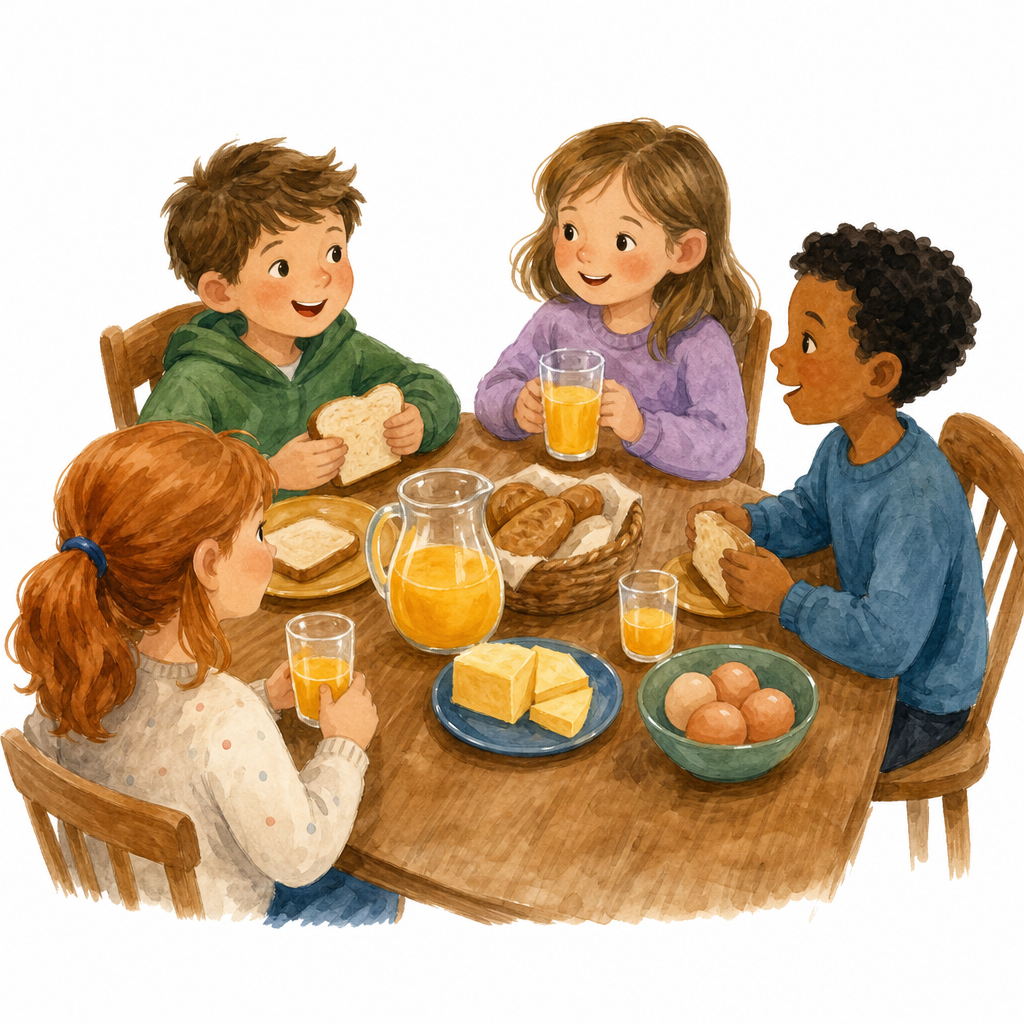
 What did you eat for breakfast? Would you eat it every day? Say it in English in one sentence, then we will learn how to say what we like and what we do not, with a reason, in Spanish.
By the end of this lesson, you will be able to:
- Name eight foods in Spanish
- Say a like and a dislike, each with a reason
- Sort food words into el and la
Look, listen, then say. For each food you will hear Spanish with el or la, repeat it together, then flip to check. Keep the article with every word: el pan, not just pan.
Listen to a short café scene about ordering food. Play it twice, then answer the questions. Listen for any of today's food words and for how people say what they want.
Open your copy. Write two Spanish sentences using the frames on the board. Choose a food from today and one reason from the bank for each.
Me gusta ______ porque es ______.
No me gusta ______ porque es ______.
Reason bank (use one chunk exactly as written):
- es rico (ehss REE-koh)
- es delicioso (ehss deh-lee-SYOH-soh)
- es fuerte (ehss FWER-teh)
- es bueno (ehss BWEH-noh)
- el pan — Bread
- el queso — Cheese
- la pizza — Pizza
- el helado — Ice cream
- el arroz — Rice
- la sopa — Soup
- el pollo — Chicken
- la ensalada — Salad
Drag each food word into the correct column: masculine el or feminine la. Say the full phrase quietly as you place it.
Unlock the full learning experience
You're previewing this lesson. Get full access to this lesson and hundreds more — each one ready to teach, with interactive activities, printable resources and pupil progress tracking built in.
This lesson is copyright of Coding Ireland 2017 - 2025. Unauthorised use, copying or distribution is not allowed.