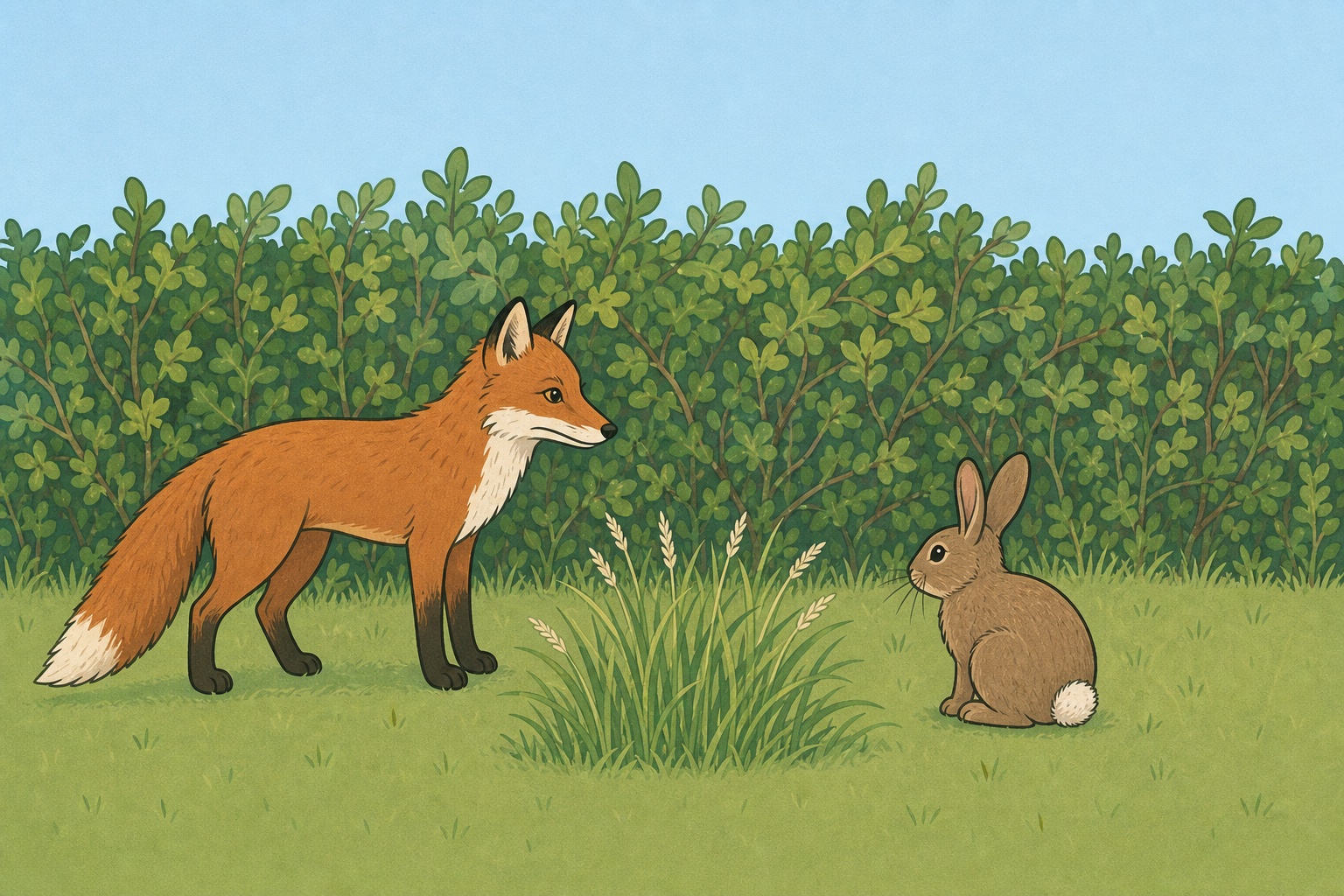
A fox needs a rabbit. A rabbit needs grass. Grass needs the sun. What do you think happens if the grass disappears?
Talk with the person beside you for thirty seconds, then we will hear a few ideas.
Keep this beat light: one curiosity question only. Do not hand out cards or explain the full vocabulary yet.
What to listen for: pupils may say the rabbit starves, the fox goes hungry, or "everything falls apart". Accept all ideas; you will return to them after the build.
Key question: Who depends on whom in a hedgerow or school garden?
Have one set of food-chain cards face-down nearby so you can move straight into the teach step, but do not open them yet.
Every meal in the hedgerow starts with sunlight. Plants catch that energy first. Then a rabbit eats the plant, and a fox eats the rabbit: the energy has moved along a path we call a food chain.
We call the plant a producer and the animals consumers. The arrows show which way the energy travels.
Board stays short: energy path plus producer, consumer and food chain only. Hold food web and interdependence until the group build and remove-a-link talk so the board matches what pupils are about to do. Use the full table below for yourself, then model one chain live before any group work.
| Concept | Why it matters | Example |
|---|---|---|
| Producer — a living thing that makes its own food using sunlight (almost always a green plant) | Every food chain in our grounds starts with a producer; without plants, animals have nothing to eat | Grass in the school field, clover in the lawn, oak leaves on the playground tree |
| Consumer — a living thing that gets energy by eating plants or other animals | Naming consumers helps us see who depends on whom when something changes | Rabbit eats grass; fox eats rabbit; thrush eats slug |
| Food chain — a line that shows energy moving from a producer to the animals that eat it | Arrows point the way energy flows (toward the eater), not "who chases whom" | grass → rabbit → fox |
| Food web — several food chains joined because animals often eat more than one food | Real habitats are webs, not single lines; removing one link can ripple through many animals | A thrush in both a slug chain and a caterpillar chain |
| Interdependence — living things depend on one another | This is why biodiversity matters: lose one link and others feel it | Fewer rabbits can mean hungrier foxes and thicker grass |
Hold up three cards and think aloud through a full cycle so pupils see the pattern before they build:
Misconception to head off: pupils often draw arrows toward the prey ("the fox chases the rabbit"). Keep correcting gently: arrows show energy flow, toward the animal that eats. Also head off "the sun is a producer": the sun is the energy source; the first living producer is the plant.
Nature of STEM: briefly note that ecologists map food webs the same way when they study a hedgerow or bog, so they can see what might happen if one species declines.
Now we build an Irish food chain together on the board. The cards ready to place are sun, grass, rabbit and fox, but not yet in order.
Call out which card should come first, then next. Which way should the arrows face? Why must a plant come near the start?
Remember: the sun is the energy source, not a living producer. The first living thing in the chain is the plant.
Drive the interactive in explore mode. Cards appear ready to place: sun, grass, rabbit, fox. Do not show a finished sequence on the board text; pupils decide the order by calling out while you drag.
Drag them into order as pupils call out; ask the watching class whether each placement is right before you lock it.
Target order (for you only): sun → grass → rabbit → fox, with arrow labels energy to / eaten by / eaten by.
Prompts while building:
Clarify once: the sun is the energy source, not a living producer. The first living thing in the chain is the plant (grass).
Now we build a different Irish chain together. The cards on the board are sun, oak leaves, caterpillar and robin, but not yet in order.
Call out which card should come first, then next, until the energy path is right. Remember: arrows show where the energy goes. The sun is the energy source; the first living producer is the plant.
Keep the same interactive in explore mode. Cards appear ready to place: sun, oak leaves, caterpillar, robin. This is a new sequence, not a rebuild of the grass–rabbit–fox chain, so calling out placements solves a fresh problem. Do not read the finished order aloud; keep the target in this note and in the activity config only.
Drag them into order as pupils call out; ask the watching class whether each placement is right before you lock it.
Target order (for you only): sun → oak leaves → caterpillar → robin.
Prompts while building:
If the class is confident, clear the chain once and rebuild the earlier grass → rabbit → fox path aloud without cards on screen, to show the pattern transfers.
A food web is several food chains joined because animals often eat more than one food. Look at this tiny shape: grass → slug → thrush and oak leaves → caterpillar → thrush. Two paths share one thrush card, with two arrows into it.
In your group, build a simple Irish food web with the picture cards and arrow cards. Each living thing appears only once. Every path starts with a plant. Join two short paths around at least one shared animal.
Be ready to point to a producer and a consumer.
Print the provided food-web cards (one full set per group) and cut them apart. Print arrow cards too (about eight arrows per group). Put each set in an envelope or tray with a short length of string or wool for marking shared links. Keep one spare set ready if you prefer to rebuild a simple class web at the front later rather than borrowing a group web.
Read the short food-web definition and the thrush example shape from the pupil description. Sketch or hold up cards for grass → slug → thrush and oak leaves → caterpillar → thrush so groups see one shared animal with two arrows in. Then open trays.
Producers
Card A — Grass: A green plant that makes its own food using sunlight. Rabbits and slugs eat grass.
Card B — Oak leaves: Leaves from an oak tree. Caterpillars feed on the leaves.
Card C — Clover: A small flowering plant mixed through grass. Rabbits and slugs may eat it.
Consumers (plant-eaters and hunters)
Card D — Rabbit: Eats grass and other plants. Foxes and buzzards hunt rabbits.
Card E — Caterpillar: Eats oak leaves. Robins and thrushes eat caterpillars.
Card F — Slug: Eats plants and soft leaves. Thrushes and hedgehogs eat slugs.
Card G — Earthworm: Lives in soil among dead leaves and helps recycle plant material. Robins and hedgehogs eat earthworms. Optional card only: join as food for robin or hedgehog. Do not force a full producer → worm chain; earthworms are extras for who-eats-whom links, not chain starters.
Card H — Robin: Eats caterpillars, worms and small insects.
Card I — Thrush: Eats slugs, snails and worms.
Card J — Hedgehog: Eats slugs, beetles and worms.
Card K — Fox: Hunts rabbits and may also eat beetles and fallen fruit.
Card L — Buzzard: A bird of prey that hunts rabbits and other small animals.
Arrow cards
Card M — Arrow: Print simple arrow shapes labelled is eaten by (energy flows toward the eater).
Pupils do not build two fully separate chains and then merge duplicates. Each organism appears once. They lay linked feeding relationships around shared animals (several arrows into or out of one card). String is optional visual help for a join, not a second copy of the animal.
Example web shape: grass → slug → thrush and oak leaves → caterpillar → thrush (two arrows into the single thrush card).
Groups of three or four work at desks. Circulate and ask each group to name their producer out loud before they add hunters.
Look-fors:
If a group finishes early: challenge them to add another shared link, or to include the buzzard without breaking the producer-first rule.
Differentiation: offer a starter trio (grass, rabbit, fox) already clipped together for groups that need a foothold; confident groups start from a shuffled pack only.
Timing note: keep the expected web small (two short paths, one shared animal) so groups finish the oral check inside this protected block.
You're previewing this lesson. Get full access to this lesson and hundreds more — each one ready to teach, with interactive activities, printable resources and pupil progress tracking built in.