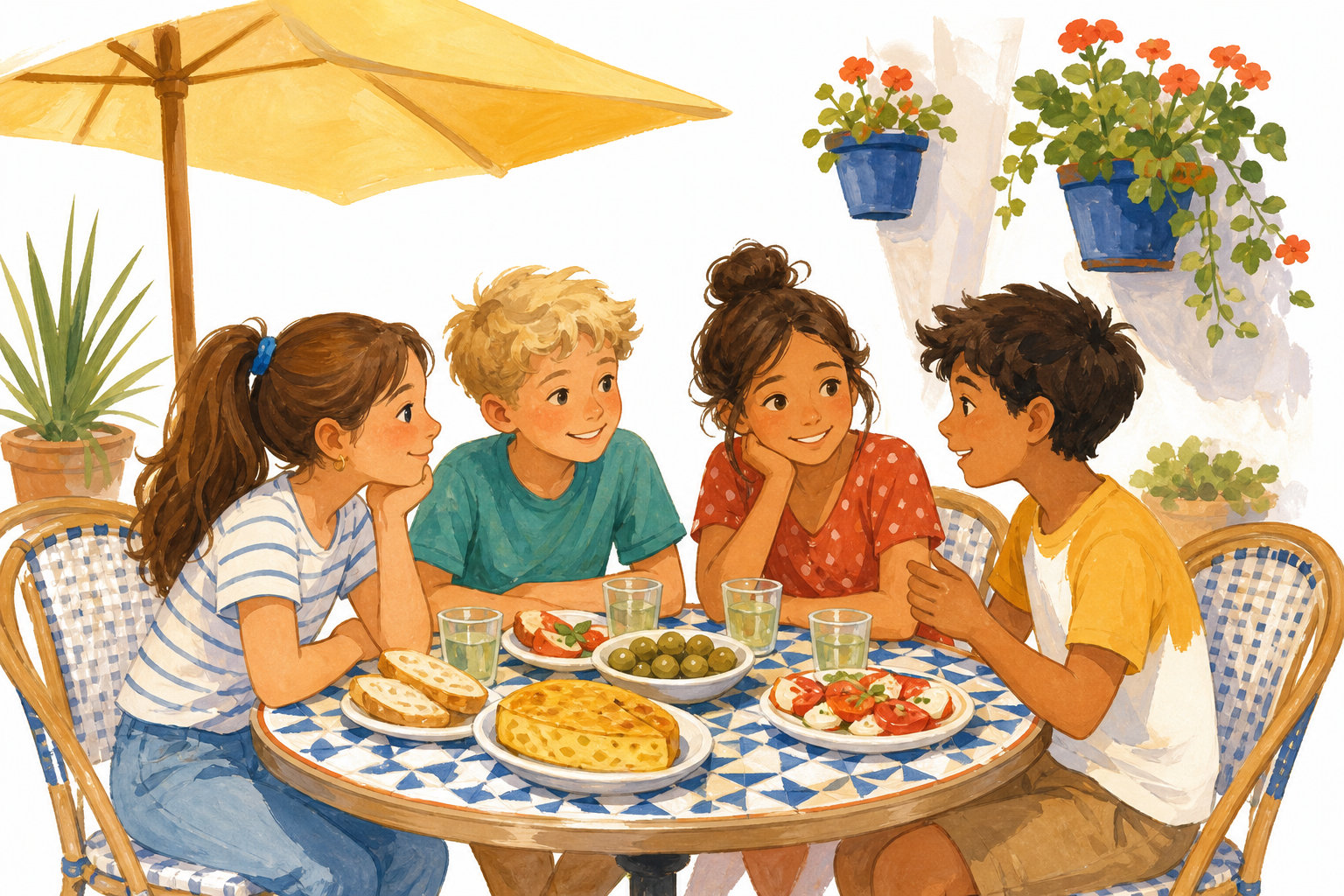
Imagine you are on a sunny terrace café in Valencia at about 2pm. The menú del día is all in Spanish and you cannot read a single word. What would you order? How would you ask?
Take four or five quick ideas about how they would cope without a readable menu (pointing, pictures, guessing). Do not teach any Spanish food words yet; the word-table in the next step does that job. Keep the energy curious rather than anxious: the point is that a few solid food words open a real café door.
Here are today's eight foods. We will learn them in two groups of four.
First four: listen to each one, then say it back together with its article (el or la).
Quick check: when a food is pointed to on the board, say the Spanish word with its article.
Second four: same again — listen, then say it back with the article stuck to the word.
All eight stay on the board afterwards as your reference wall.
Do not dump all eight into one choral pass. Teach in two batches so the first items still stick when listening starts. You drive the board: tap each word yourself for audio; pupils only listen and say.
Batch 1 (about 4 minutes): el pan (el PAN), el queso (el KEH-soh), el arroz (el ah-RROTH, roll the rr), el pollo (el POH-yoh, the ll sounds like y). Tap each for audio, class repeats twice (whole class, then by table). Point at the article every time. After the four, do a 20-second point-and-say: point at each word on the board; class calls the full pair.
Batch 2 (about 4 minutes): la sopa (lah SOH-pah), la ensalada (lah en-sah-LAH-dah), la pizza (lah PEET-sah), el helado (el eh-LAH-doh, silent h). Same routine, then a second point-and-say on these four only.
Leave the full word-table visible as a reference wall for the rest of the lesson. Linger on the rolled rr in arroz and the y-sound in pollo.
Someone is ordering food in a café. Listen all the way through once with eyes on the speaker.
Before the second play, look at the questions on the board (and the food words still showing). On the second listen, point at the food word on the board when you hear it.
Then choose the answers that match what you heard.
Run order: (1) Play the recording once on the class speakers with books closed and no talking. (2) Open the listen-answer questions on the IWB and keep the word-table strip visible as a muted reference so pupils can point at foods they hear. (3) Play a second time; pupils point at the board word each time they catch one. (4) Model one answer with the class, then complete the rest. If a word from today's list appears, pause and have them say it with the article.
After answers reveal (warmth beat): "That was real café Spanish — if you caught even two food words, that is a win; we will catch more on the replay."
Ordering clues in scope for feedback (do not require polite phrases such as por favor / gracias; those come later): food nouns from today's list, any numbers or quantities, and a short back-and-forth that sounds like customer then server rather than free chat.
Sunday-night recovery key (use if audio or the interactive fails): Read this short exchange aloud yourself, customer then server, slowly:
Foods that appear in this fallback clip: la sopa, el pan, el pollo, el helado. (When the interactive works, follow its marking of which foods occur; this script is the live backup only.)
Question stems and expected answers to model:
After answers, replay (or re-read) and pause on each food noun so a non-specialist can confirm without translating a long monologue.
Open your copy and write the three foods from today you would most like to eat, with el or la, and one you would not. Copy the spelling exactly from the word table and keep the article with each word.
Pause the board. Everyone writes; this is the only three minutes where every pupil's pen is moving. Keep the word-table on screen while they copy. Check that each word has el or la in front of it, not a bare noun. None of today's eight forms carry written accent marks, so do not ask pupils to hunt for accents. Do not collect these.
Warmth beat while you circulate: "Articles glued on? That is exactly how Spanish speakers hold the word — well done."
A menú del día is on the table in a neighbourhood café in Seville — bread, soup, chicken, salad and more — but the labels fell off.
Look at the meal on the board. Hear the English name for each food, then say the Spanish label with el or la. Place each label on the matching part of the picture.
Run this on the IWB with volunteers only. Do not switch to pupil devices for this step.
Prompt order (keep this fixed): you say the food in English; the whole class answers with the Spanish pair (article + noun); then a volunteer places the label. Every pupil speaks before the label lands, so the volunteer is never alone — loud and proud with el/la.
If a label is wrong, replay the word-table audio for that item, say the correct pair once as a class, and try again. This is recognition after listening, so keep the pace steady rather than rushed.
You're previewing this lesson. Get full access to this lesson and hundreds more — each one ready to teach, with interactive activities, printable resources and pupil progress tracking built in.