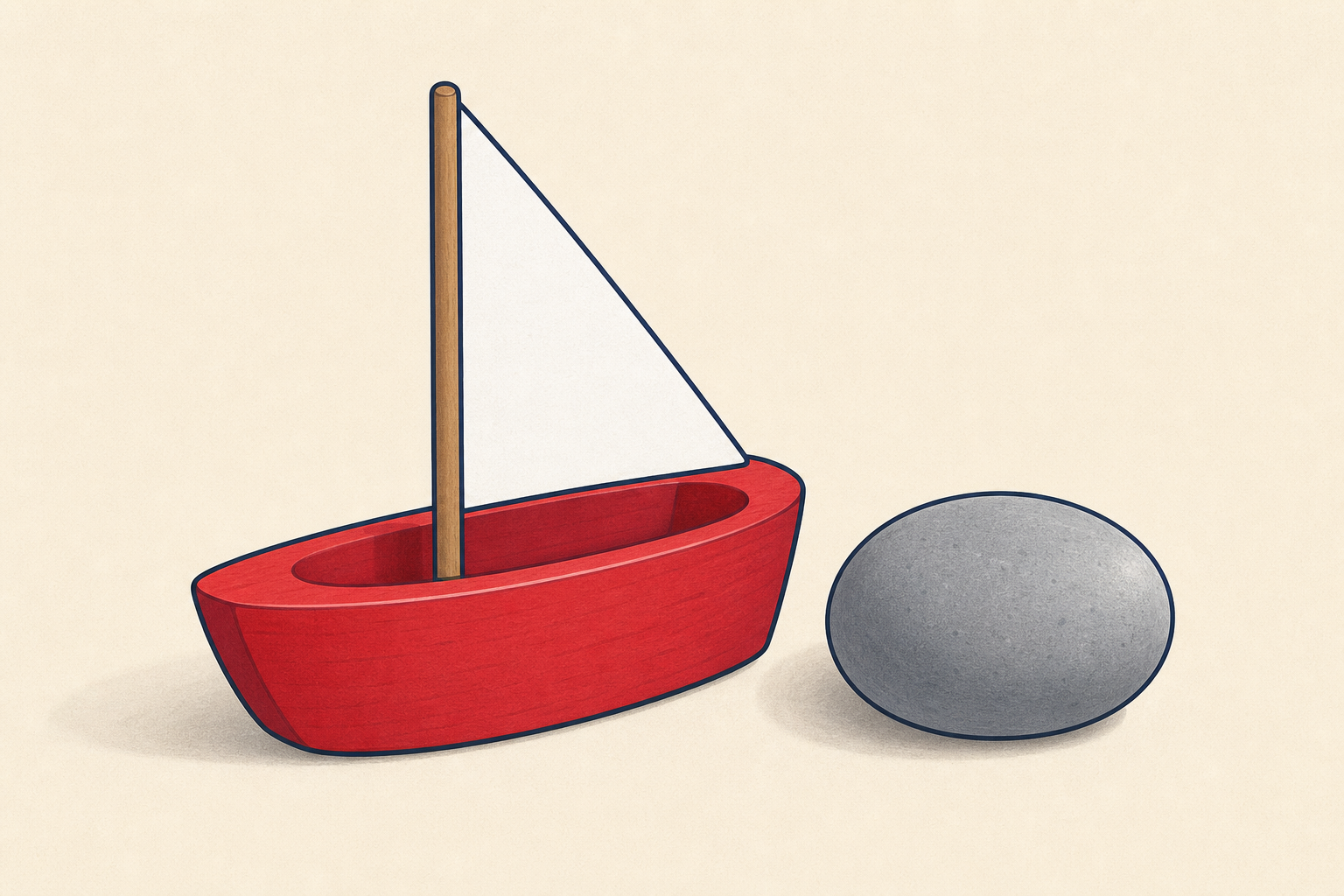
Look at this toy boat and this stone. If we pop them in water, which one will stay on top? Which one will go down?
Hands up for your guess!
Hold up a small toy boat in one hand and a stone in the other. Do not put either in water yet. Take a quick show of hands for each guess. Keep the beat light and playful.
Have the water tray filled and covered or set aside so it is ready for the next steps but not yet the centre of attention.
Float means it stays on top.
Sink means it goes down.
We will guess first, then watch.
Say each word with a big gesture so the board text can stay tiny: hand flat on top of the water surface for float; hand swooping down for sink. Invite the class to copy the gestures once.
| Concept | Why it matters | Example |
|---|---|---|
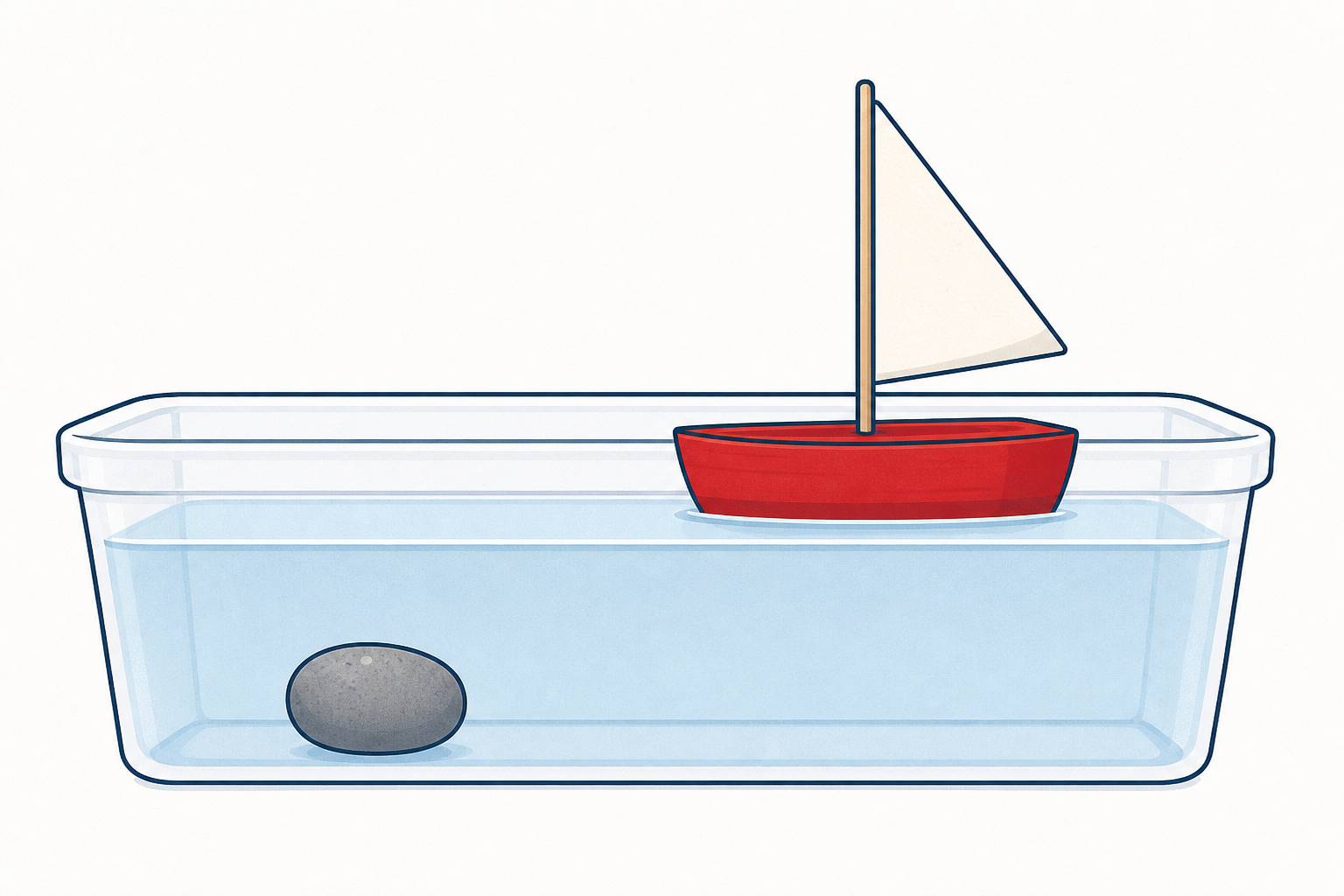
| Float — when something stays on top of the water | Boats, corks and some toys stay up so people and cargo can travel on water | A toy boat sits on the surface of the water tray |
| Sink — when something goes down through the water to the bottom | Some materials go under; size alone is not the rule — we watch each object | A stone drops straight to the bottom of the tray |
Misconception to head off gently: children often think big things always sink and small things always float. Keep language simple: we watch what each thing does, and size is not the rule by itself.
Worked cycle to model later with one object (the cork): I wonder if the cork will float or sink. I think it will float. I put it in gently. I see it stays on top. I think the cork floats.
Five things are on the board: a cork, a spoon, a stone, a sponge and a toy boat.
For each one, we say float or sink before anything goes in the water. Our guesses stay on the screen.
Drive the float-or-sink interactive on the IWB in explore mode. The five objects on screen are exactly: cork, spoon, stone, sponge, toy boat.
For each object: hold up the real matching item from the tray, ask the class to call out float or sink, then tap the matching guess on screen. Do not drop anything in the interactive until every object has a guess. The Drop control stays locked until a prediction is in, so the class cannot skip guessing.
Keep energy high and short. Guesses are never wrong; they are the start of the fun.
Leave the guesses visible. You will come back to them after the real water tray.
Sleeves up! At the water tray we try our things one at a time.
Put it in gently. Watch. Does it stay on top or go down?
With the whole class watching one tray, run the full spoken cycle with the cork only:
Keep language to float and sink. Cheer surprises (for example a big sponge that floats).
What to expect: cork, dry sponge and toy boat float; metal spoon and stone sink. A sponge may soak and sit lower; still talk about it staying mostly up at first. If a toy boat tips, reshape the talk gently: boats need a good shape to stay up.
Safety: no tasting water; wipe spills straight away; mind slippery floors. An adult stays at every water station in use.
Look back at our board guesses. What did the water really do?
Which things stayed on top? Which went down?
Gather briefly at the IWB and scroll back up to the guessing step, where the float-or-sink activity still holds the class guesses. Drop each object there so the result sits beside the guess the class made. Use the real wet objects on a tray as you talk.
Prompts to ask aloud:
Keep this oral and short. Do not ask children to write. Revoice their words: float and sink.
You're previewing this lesson. Get full access to this lesson and hundreds more — each one ready to teach, with interactive activities, printable resources and pupil progress tracking built in.