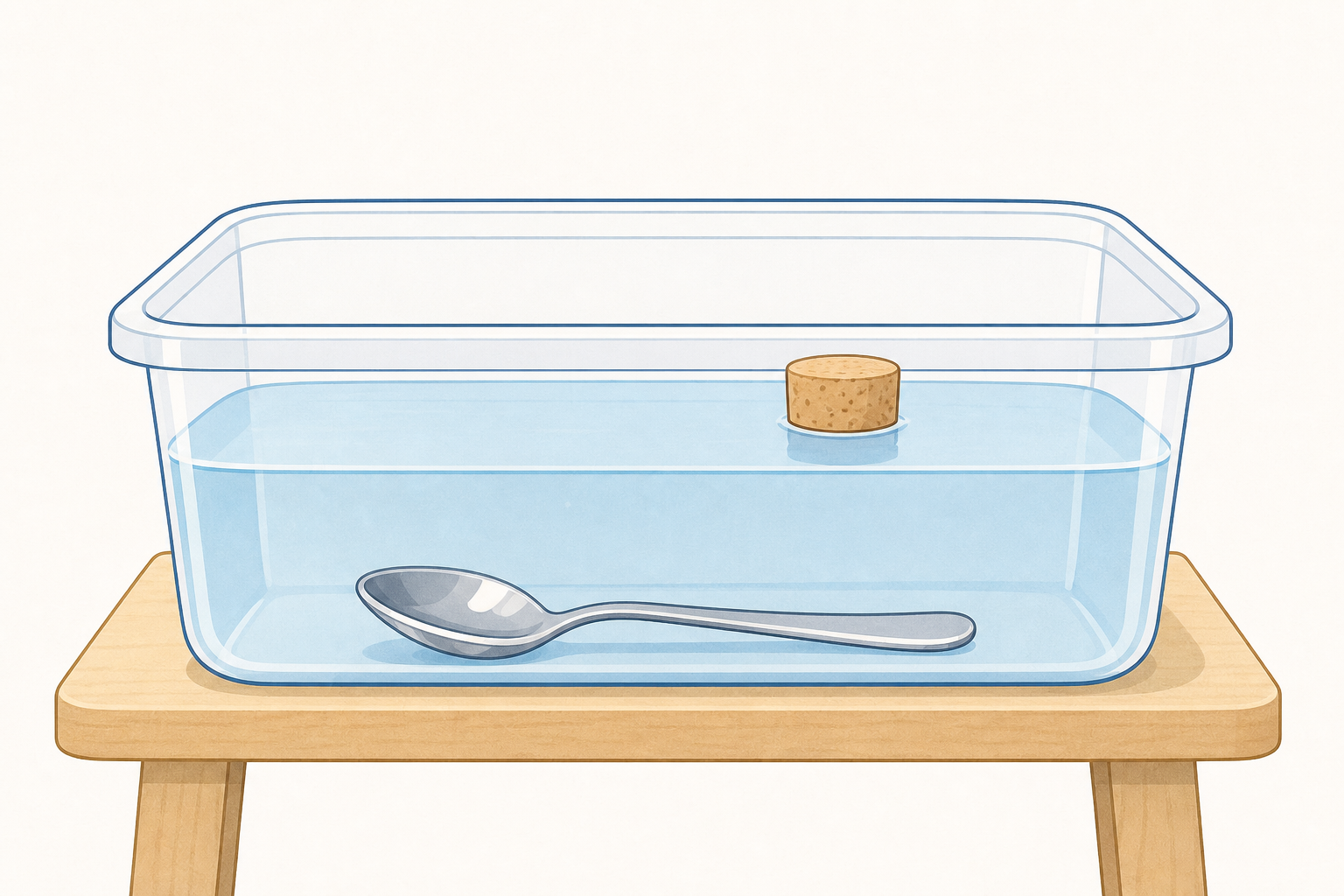
Watch carefully. One thing stays on top of the water. One thing goes down. Why do you think that happened?
Have a clear jar or jug of water ready with a cork and a small stone beside it. Drop the cork first so it bobs, then the stone so it sinks. Keep the hook light: one short wonder only. Do not name every tray object yet and do not set out the full apparatus.
Important: cork and stone are for this demo only. Do not hold them up again for thumbs guesses in the next step, and do not put them on the board interactive. Every later guess must be a real prediction.
Ask: Why did one stay on top and one go down? Accept all ideas. Do not correct yet. Later in the make-sense talk, name someone who makes boats as a person who needs to know what floats.
Safety: teacher handles the jar; wipe any drip straight away.
Look at each thing I hold up. Thumbs up if you think it will float and stay on top. Thumbs down if you think it will sink and go down to the bottom.
Name the words aloud as children show thumbs: float means stays on top of the water; sink means goes down to the bottom. Hold up each dry object one at a time so everyone can see it: spoon, sponge, toy boat, lolly stick, coin. Do not hold up the cork or stone again; the class already saw those in the jar. Children look carefully (size, feel if you pass one around quickly) then show a silent thumbs-up (float) or thumbs-down (sink). Guesses are never wrong; they are the start of the fun.
| Concept | Why it matters | Example |
|---|---|---|
| Float — stays on top of the water and does not go down | Knowing what floats helps us make boats, life jackets and bath toys that stay up | The cork in our jar stayed on top of the water |
| Sink — goes down through the water to the bottom | Some things are meant to sit on the bottom, like a stone in a pond | The small stone went down to the bottom of the jar |
| Guess first — say what you think will happen before you try | Scientists and makers often make a good guess, then find out | Thumbs up or thumbs down before anything goes in the tray |
Misconception to head off gently later: children often say heavy things sink and light things float. Do not lecture now. The surprising pairs on the board and the sponge versus the stone will open that up in the make-sense talk.
What to look for: children looking at the object before guessing, not copying a neighbour without thinking.
Guess first, then we drop and watch. We will start with the big log and the small nail.
Open the float-or-sink interactive on the IWB in explore mode. Four objects only: big log, small nail, sponge, coin. Cork and stone stay off the board; the class already saw those in the jar, so every board guess stays a real prediction. For each object, the class must commit a guess before you can drop it. Leave the guesses visible so children can see what they thought and what the water did.
Drive it like this (brisk):
Keep surprise talk oral after the last drop, not packed into the pupil line: Which one surprised us? and Did the big one always sink? Draw out that size is not the rule: the big log floated and the small nail sank.
This board beat protects the prediction habit. The real water tray comes next. Four cycles keep the beat inside three minutes so groups have enough tray time. The float-and-sink sort later uses real hoops and dry objects, not this board.
At the water tray, pick one thing. Guess float or sink first. Then put it in and watch. Try the next one the same way.
At the front tray, think aloud with the toy boat only (not the cork, which they already saw float):
Then send groups to their trays.
Ask each group to guess-then-test this core set first so every child gets several full turns: toy boat, lolly stick, spoon, sponge. These include at least one result that was not fully settled on the board (the spoon and the real wet sponge). Cork, stone and coin may already feel familiar from the jar or board; treat them as optional extras only if a group is flowing and still guessing carefully.
Children take turns: guess aloud or with a thumb, then test, then watch. Circulate and revoice: You guessed sink — what did it really do?
Expected results (so you are not surprised): toy boat and lolly stick usually float; spoon and coin sink; cork usually floats; stone sinks. A fairly dry sponge usually floats. If it soaks up lots of water it may sink or sit very low — treat that as a useful surprise, not a mistake. Have a second dry sponge ready if you want a clear float example.
If a group rushes: hold the next object until they have said a guess. If water gets deep or splashy, pause and top up calmly with less water.
Safety: roll sleeves; wipe spills straight away; no tasting; keep the coin and small stone in sight.
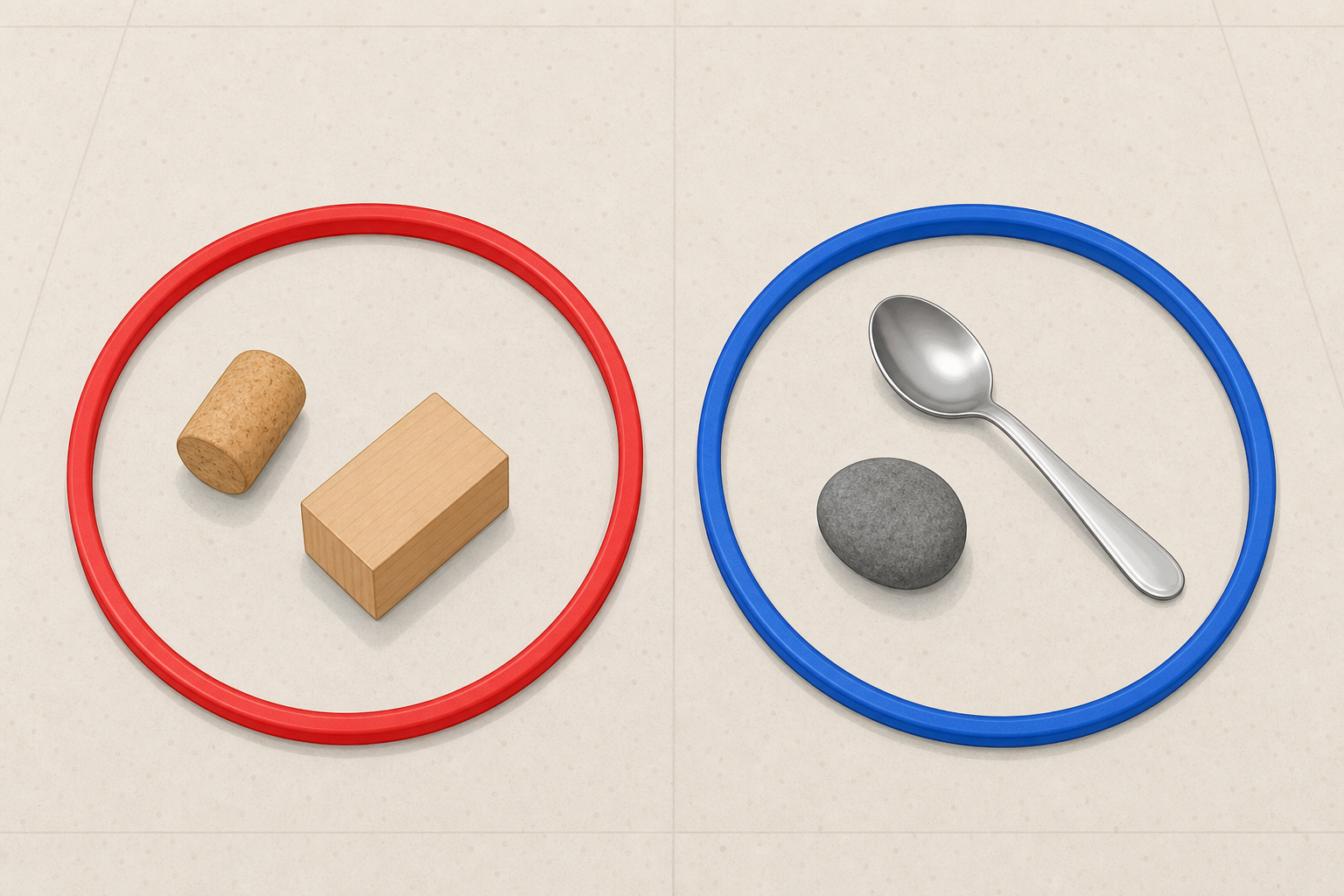
Use the dry things in the tub, the ones that stayed dry. Put the ones that floated in the float hoop. Put the ones that sank in the sink hoop.
Each group has two hoops (or two labelled trays) and the dry copies of the same objects. Mark the hoops with picture cues, not words alone: e.g. a simple drawing of something sitting on top of water for float, and something resting on the bottom for sink (or two clear colours the class agrees). Point to each cue and say the word as you set them out so non-readers can sort from what they saw.
After tray hands are dried, start with the core four every group tested: toy boat, lolly stick, spoon, sponge. Children place each dry copy into float or sink from what they just saw at the water tray, not from a new guess. If time and calm allow, add cork, stone and coin from the dry tub. If they reach for wet objects, gently redirect them to the dry tub.
Look for: children saying a short reason as they place, e.g. The stone goes here because it went down. If two children disagree, send that one object back for a quick re-test rather than deciding for them.
Typical sort:
Leave the hoops visible for the make-sense talk. Do not use the board interactive for this sort; real hoops and dry objects are the activity.
You're previewing this lesson. Get full access to this lesson and hundreds more — each one ready to teach, with interactive activities, printable resources and pupil progress tracking built in.