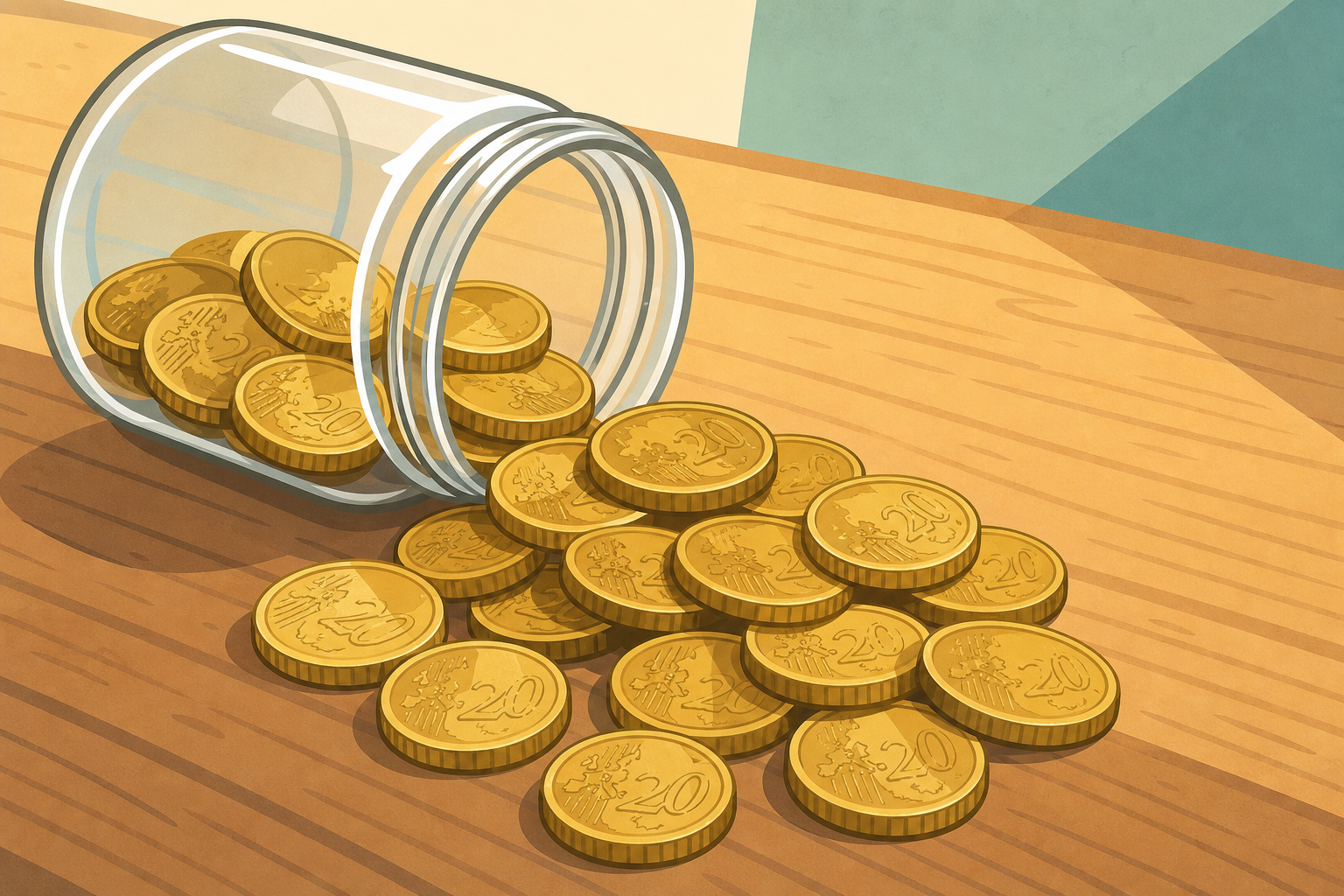
Here are 20 coins in a jar. If one quarter of them is 5, how much do you think three quarters would be? Have a guess before we work it out.
Take three hands-up guesses, not open call-outs. Don't confirm yet, just gather predictions.
Listen for the pupil who says 15 and can explain "three fives" — you'll revoice that in Watch and Notice.
Look at each strip split into equal parts, with some of them shaded. Each time, work out the size of one part first, then count how many parts we want. Keep your eye on that first step.
Say both steps every time: one part is this, so this many parts is that.
Three quarters of 20: split into 4, one quarter is 5, three parts give 5 and 5 and 5, so 15. Stress finding one quarter first before jumping to three, this is the whole move.
Two thirds of 12: split into 3, one third is 4, two parts give 4 and 4, so 8. Ask a pupil to name the size of one part before you reveal it.
Three fifths of 10: split into 5, one fifth is 2, three parts give 2 and 2 and 2, so 6. Pause on how many parts are we shading, take one answer, then reveal.
Today we work these together on the board, always in two steps. We'll shade three quarters of 12 first, then two thirds of 15, then three fifths of 20, and finally three quarters of 16. Each time we find one part first, then take the parts we need.
This round is for talking it through together — pupils take turns at the board and the class agrees or corrects out loud.
For each one, insist on the two steps spoken aloud: "one part is …, so … parts is …". The class checks the shaded strip against the number.
Rotate four pupils to the board.
In your maths copy, write out the two steps for three quarters of 20, like this:
Then do two thirds of 9 the same way: find one third first, then take two of those parts.
Walk the room glancing that pupils wrote the one-part step first — that's the habit we're building. No individual marking; this is whole-class copybook practice, not assessment.
Today we work through these together on the board: show three quarters of 8, then two thirds of 12, then three fifths of 15, and finally three quarters of 24. They get a little bigger each time, so find one part first every time.
These are the practice questions — pupils take turns at the board, check each answer, and the class confirms before moving on. Keep the board work brisk rather than over-explaining.
You're previewing this lesson. Get full access to this lesson and hundreds more — each one ready to teach, with interactive activities, printable resources and pupil progress tracking built in.