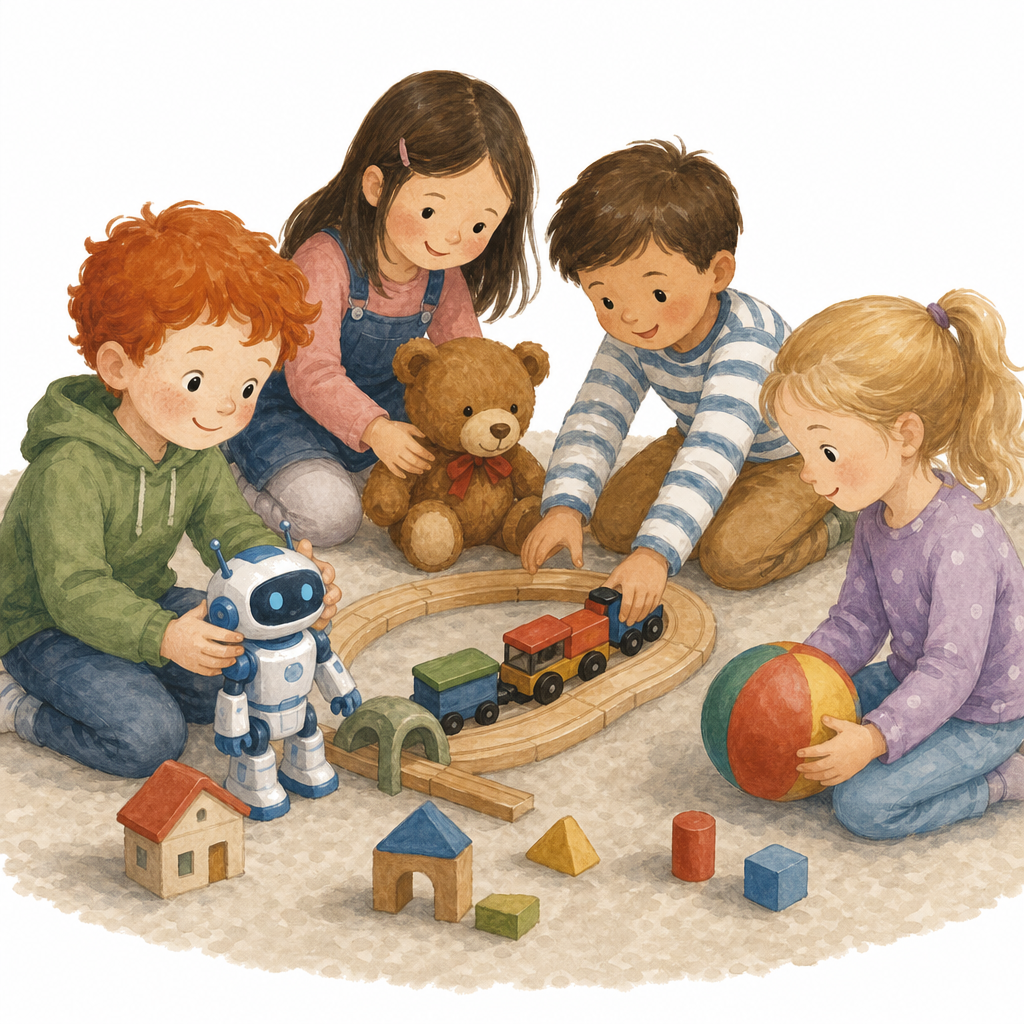
Think back to when you were six. What did you play with most? A ball, a doll, a train set, something else?
Today you will name toys in German and describe one with two words: its colour and its size.
Some of these words (especially die Eisenbahn) are also serious adult hobbies in Germany and Austria. We will come back to that later.
We'll turn those old favourites into proper German sentences today. Take three or four quick answers in English only. Do not translate yet; the flashcards will carry the new words. Flag the adult-hobby thread lightly so 11–12-year-olds do not feel talked down to: model railways and collecting kits are taken seriously by grown-ups in Germany and Austria. Link back to colours they already know from earlier in the year, because those colour words will reappear in the describing sentences.
Imagine a toy aisle in a German shop. Hear each toy in German first, look at the picture, and repeat the full phrase with the class (article included). Only then check the English meaning.
We will learn the eight toys in two groups of four. After the cards, we will lock in two size words and build one describing sentence.
Size words:
Worked example: colour and size together
Der Ball ist groß und rot. (The ball is big and red.)
Playmobil comes from Germany, and adults still collect the sets. Steiff teddy bears are a German classic too.
Run the flashcards on the board. German audio and image first, whole-class choral repeat with the article, then reveal the English. Do two full chorus passes on each card before any volunteer recall from English. Never ask pupils to invent the German cold on first meeting.
Chunk 1 (four cards): der Ball, die Puppe, der Teddybär, das Puzzle. Quick chorus of all four. Chunk 2: das Spielzeugauto, der Roboter, die Eisenbahn, der Drachen. Quick chorus of all four, then a mixed whip-round of the eight.
Size micro-beat before the worked sentence: board groß (grohs) with arms-wide gesture and klein (kline) with pinched fingers. Recycle one known colour (rot) so the load is toy nouns + two sizes, not a new colour set. Then model: Der Ball ist groß und rot (dair BAHL ist grohs oont roht). Class chorus. Second model with a known colour only: Die Puppe ist klein und rot (dee POO-puh ist kline oont roht).
Pronunciation checklist (article + noun):
Point out that every German noun is capitalised. Colour bank to recycle later: rot, blau, grün, gelb, braun, schwarz, weiß. Fun double meaning: der Drachen is a kite and a dragon — if they giggle, lean into it. Brief aside: Playmobil is German; adults still collect the sets; Steiff is famous for teddy bears.
First, say two full sentences with the class, still looking at the board pattern:
Now pack die Spielkiste (the toy box). On the board, match each German toy phrase to its English meaning so every toy goes into the box.
When you find a pair, whisper the full German phrase (article included) to your partner before you lock it in.
Pattern still on the board: Der / Die / Das ___ ist ___ und ___.
This beat is a real matching-pairs interactive (German phrase to English), framed as packing a German toy box so it does not feel like a second flashcard pass. Keep the sentence frame on the board: Der / Die / Das ___ ist ___ und ___.
Chorus first (1–2 minutes): class repeats the two model sentences above. Swap colours only from the known bank (rot, blau, grün, gelb, braun, schwarz, weiß). Every pupil must say the full colour-and-size pattern aloud before the pairs game.
Matching (rest of the slot): run matching-pairs on the IWB (German phrase to English meaning). On each successful pair, freeze briefly and have partners whisper the full German phrase with the article. Correct by modelling the full form, not a long grammar stop. Theme images from earlier cards can stay visible as a side support strip if helpful, but the interactive itself pairs German with English.
Optional 1-minute extension if pairs finish early: you say one German toy; pupils show arms wide for outdoor (der Ball, der Drachen) or hands on the desk for indoor (the rest). Accept either pile for the car or robot with a smile — the point is hearing and saying the German.
Open your copy and write one sentence describing a toy with its colour and its size. Choose any toy from today's set on the board.
Pattern: Der / Die / Das ___ ist ___ und ___.
Support on the board: today's eight toys with articles · size: groß / klein · colours: rot, blau, grün, gelb, braun, schwarz, weiß
Model left up: Der Ball ist groß und rot.
Only now do pupils write, after they have chorused the pattern in the Spielkiste beat and said it individually on the spin. Pause the board interactives and keep the support strip visible: the eight toys with articles, groß/klein, the short colour bank, and one full model sentence. Every pupil writes one full sentence with article, toy, size word and colour word. Walk the room and check capitals on the noun and the matching article. Do not collect the copies. Support: allow the word bank to stay fully in view. Extension: a second sentence about a different toy.
Watch the wheel. When it lands on a toy, the chosen pupil says one full German sentence with a size word and a colour word.
Pattern: Der / Die / Das ___ ist ___ und ___.
Use groß or klein, plus a colour you know (rot, blau, grün, gelb, braun, schwarz, weiß). A classmate listens and gives a thumbs-up if they hear both adjectives.
Pin the pattern and the banks on the IWB for the whole round so nobody freezes with a blank board. Cold-call with the wheel so nobody can predict who is next. Accept any sensible size (groß grohs, klein kline) and a colour from the known set. If a pupil freezes, point at the three blanks and let them fill only those. After each turn, a classmate thumbs-up keeps the speaker from feeling alone on the sentence. Celebrate full sentences out loud — "Great, full sentence, article and all!" — before the next spin. After three or four spins, invite a second short round if time allows. This individual oral production must finish before any copy writing.
You're previewing this lesson. Get full access to this lesson and hundreds more — each one ready to teach, with interactive activities, printable resources and pupil progress tracking built in.