Describe your pet in English in five words. No pet at home? Describe the one you would most like.
Take four or five quick answers only. The point is to get them thinking about pets and colours before the French words arrive. Do not translate yet. If someone names a colour they already know, smile and park it: you will bring those colour words back when you model the sentence pattern.
Tap each pet on the board, listen, then say it back together. Watch which take le and which take la.
Colours we already know (we reuse these today):
Sentence pattern: J'ai un/une ___ ___ (I have a ___ ___).
Say together: J'ai un chien noir (zhah un shee-EN nwar). Then: J'ai une tortue verte (zhah ewn tor-TEW vert).
Remember: le/la when you name the animal; un/une after J'ai (le chien → un chien, la tortue → une tortue).
Special name: le poisson rouge already includes colour in its name (it means goldfish). Say J'ai un poisson rouge and stop there. Do not add a second colour from the strip.
Teach the eight pets in two chunks of four. Chunk 1: tap, class repeats twice (whole class, then by table). Chunk 2: same pattern. Point at the article every time so the pair is what they hear.
When you reach le poisson rouge, pause and name the trap out loud: rouge is part of the fixed name for goldfish, not a free colour like the strip. Pupils must not invent un poisson rouge noir or swap rouge for vert. The only model for that pet is J'ai un poisson rouge.
Then lock one sentence frame only: J'ai un/une + pet + colour for the other seven pets. Show the side-by-side swap on the board: le chien → un chien, la tortue → une tortue. Choral-repeat the two model sentences (and one more if time: J'ai un chat blanc) so every pupil has said the pattern, not only heard it. Stress the soft zh in J'ai (zhah) and make a fuss of a strong first attempt: “Beautiful soft zh!”
Keep adjective agreement light: only the four colour pairs on the strip. Save Je voudrais for extension later, not this beat.
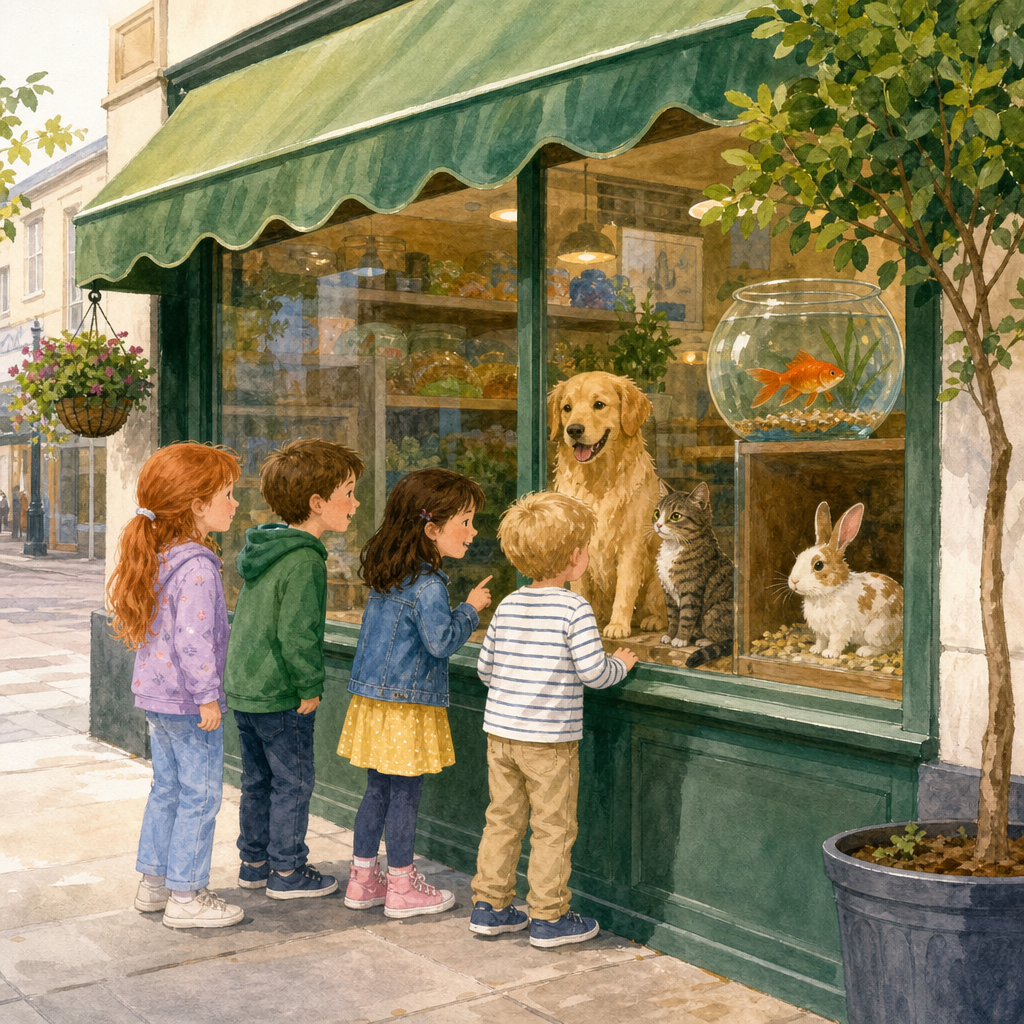
Look at this French pet-shop window (la vitrine de l'animalerie). When it is your table's turn, say the full phrase (for example le chien) before we lock the label. Everyone else whisper-says it too.
Run this on the board with volunteers first, then let tables take turns. Insist on the full phrase with the article: le chien, not bare chien. If a label is missed twice, pause and say it together before moving on — keep the energy light (“Nearly — one more listen!”). Keep the sentence pattern warm by asking one volunteer, after a correct label, to add a colour from the strip: un chien noir. If the goldfish is labelled, accept le poisson rouge only; do not push a second colour onto it.
Open your copy and write one sentence saying which pet you have, or would like, and what colour it is.
Frame: J'ai un/une ___ ___ (I have a ___ ___)
Model: J'ai un chien noir — I have a black dog
Pause other board activity but leave the word-table, the colour strip and the sentence frame visible. Before pens move, choral-build two example sentences aloud with the class (point-and-say from the strip), plus the goldfish exception once: J'ai un poisson rouge. Walk the room and check each sentence has an article (un/une), a pet and a colour (or the fixed goldfish form). Praise any full sentence out loud: “J'ai une tortue verte — super phrase!” Accept one supported sentence rather than free invention. Extension only: a second sentence, or Je voudrais un/une … if the core frame is solid. Do not collect these.
Models to put on the board: J'ai un chien noir (I have a black dog) · J'ai une tortue verte (I have a green turtle) · J'ai un poisson rouge (I have a goldfish — the name already carries the colour, so no extra colour word).
Colour bank: noir/noire · blanc/blanche · gris/grise · vert/verte. Keep the pet word-table visible. One pet, one colour, copied carefully. A pupil who picks the goldfish writes only J'ai un poisson rouge.
Flip two cards at a time and find each French pet with its English meaning. Say the full French phrase quietly as you turn each card.
Whole class on the IWB, volunteers taking turns. Audio plays on every flip, so use that as a second chance to hear the word. If a pair is missed twice, stop and say it together before moving on. Keep insisting on the article with every French card. This extra seeing and hearing is the bridge into the copybook sentence.
You're previewing this lesson. Get full access to this lesson and hundreds more — each one ready to teach, with interactive activities, printable resources and pupil progress tracking built in.