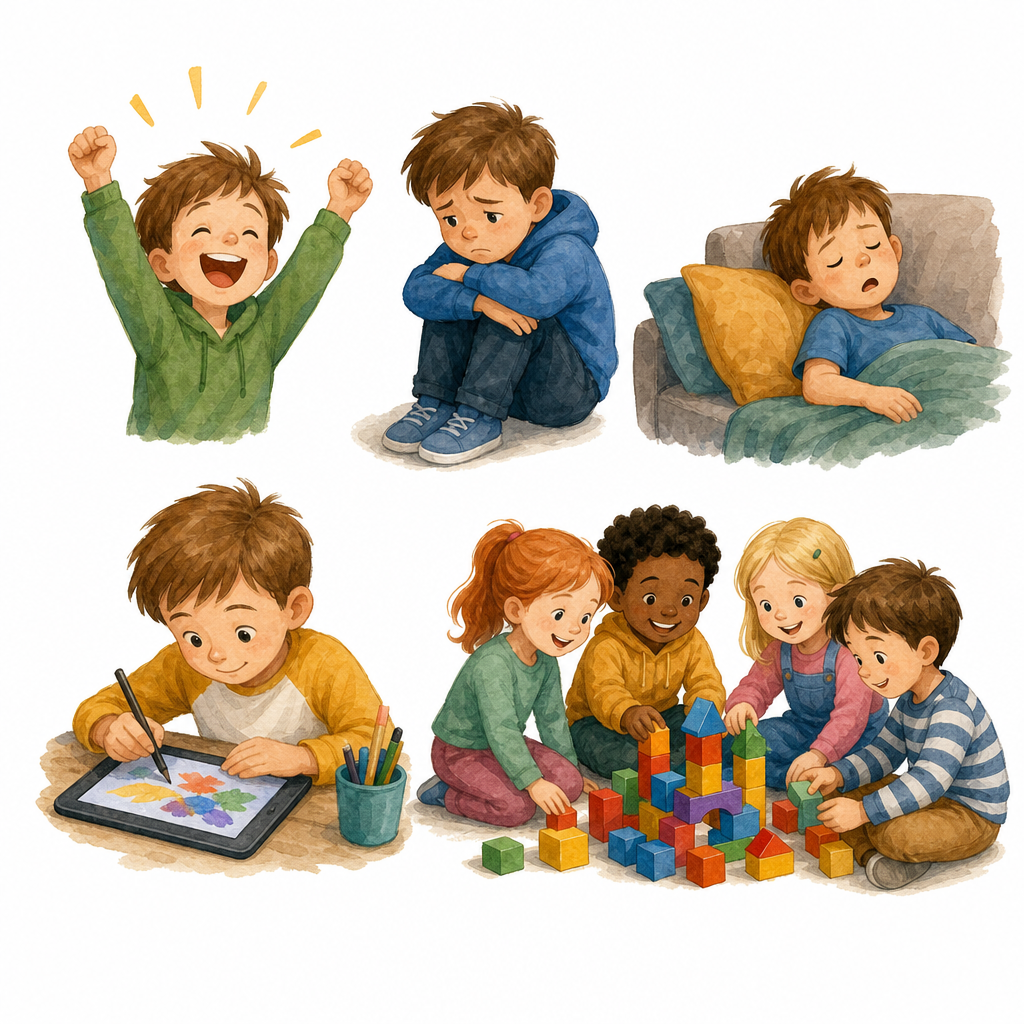
 How are you today, and why? Answer in English with a because. You already know how to say a few things about yourself in Spanish. Today you learn to name feelings and join on a reason, ready to tell a partner later on.
By the end of this lesson, you will be able to:
- Name eight emotion words in Spanish
- Say how you feel and give one reason with porque
- Ask a partner how they feel, and why
We meet eight feeling words on the cards, in two sets of four. For each card: listen to the Spanish, repeat it with the class, then flip to check the English.
Work through the first set fully, take a quick choral revisit of those four, then meet the second set the same way.
After each word, say the short frame together: Estoy + the feeling.
Gender tip: many of these adjectives change ending when you talk about yourself or someone else. You will hear both the -o ending and the -a ending (for example enfadado/enfadada). Feliz and triste stay the same for everyone.
Click each Spanish emotion, then its English meaning. When a pair is found, the class says the Spanish together, then tries Estoy + that feeling.
Open your copy and write one sentence saying how you feel and one reason why. Use Estoy, an emotion word from the word bank on the board, and porque.
You may copy the emotion spelling from the bank. Whisper your sentence to yourself first if you like, then write it.
Frame: Estoy _____ porque _____
Example: Estoy emocionado porque es mi cumpleaños
- feliz — happy
- triste — sad
- enfadado — angry
- cansado — tired
- asustado — scared
- nervioso — nervous
- sorprendido — surprised
- emocionado — excited
Now tell a partner. Read the conversation on screen together first: tap the play button beside each line to hear it. Then make it your own. Partner A asks ¿Cómo estás?, then ¿Por qué? (why?). Partner B answers with Estoy, a feeling from today, and porque with a reason. Then swap, and try a different feeling if you can. A reason in English after porque is fine.
Model:
A: ¿Cómo estás?
B: Estoy nervioso / nerviosa.
A: ¿Por qué?
B: Porque hay un examen.
Unlock the full learning experience
You're previewing this lesson. Get full access to this lesson and hundreds more — each one ready to teach, with interactive activities, printable resources and pupil progress tracking built in.
This lesson is copyright of Coding Ireland 2017 - 2025. Unauthorised use, copying or distribution is not allowed.