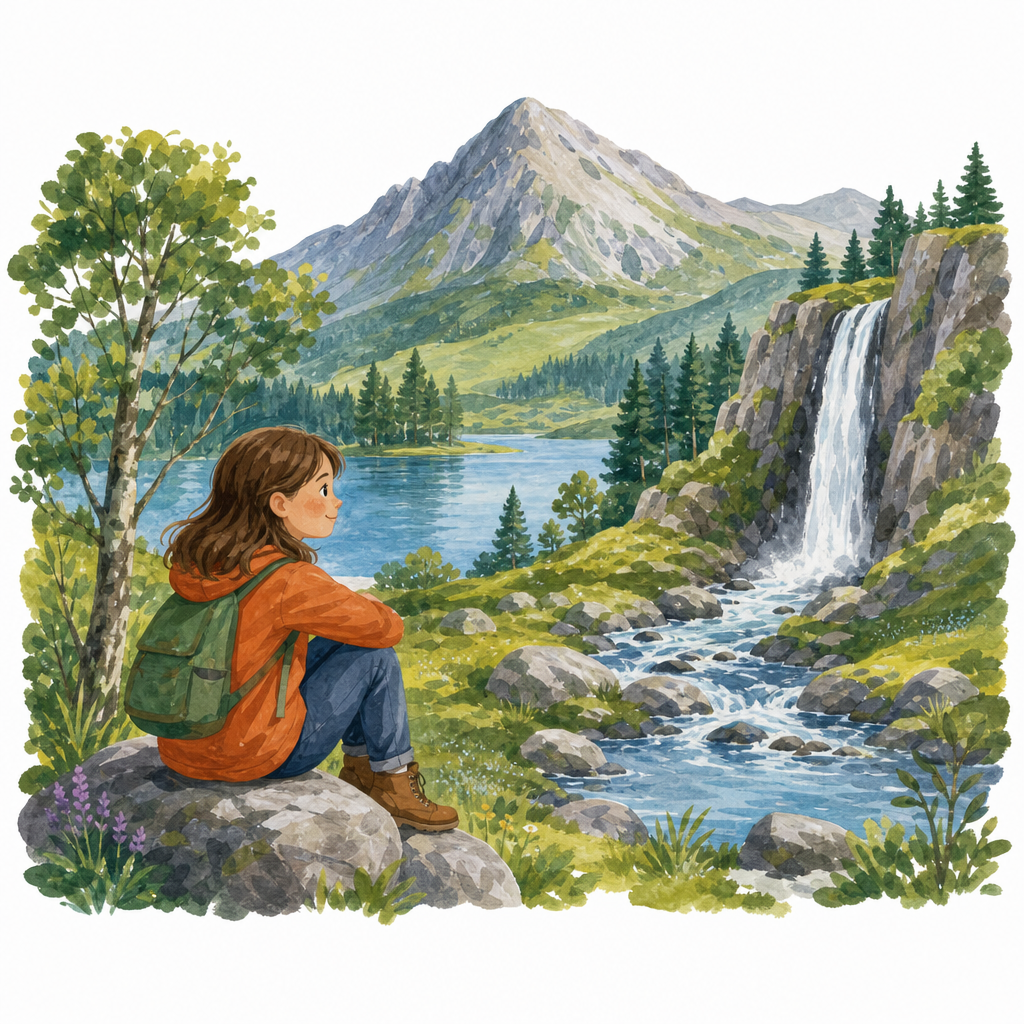
Look out of the window for a moment. What can you see that was not made by people? A tree? The sky? A hill?
In Spain you might see los Picos de Europa, una cascada, or a village bosque. Today we learn eight Spanish words for the natural world, so you can name what is out there.
Collect four or five answers from the class (tree, sky, cloud, grass, bird). Keep it brisk: the point is to shift attention from classroom objects to the natural world before the word-table appears. Do not translate into Spanish yet; that is the next step. The Spain line is a light teaser only; full place detail comes later with the Picos and El Retiro.
Listen to each nature word, then say it back together. We will learn them in two groups of four. Watch which ones take el and which take la, and listen for the soft ny sound in montaña.
Keep the full word-table on the IWB so images stay visible as anchors, but teach in two waves so eight new items do not land at once.
Wave 1 (land): el árbol, la flor, la montaña, el bosque. Tap each so the class hears the audio, then repeat twice: once all together, once by table. Point at the article every time. Flag the accent on árbol and the ñ in montaña. Montaña has that lovely ny sound: scrunch your nose and have fun with it as a class.
Mini-check (about 30 seconds): Hands up: which of those four take la? (Answer: la flor, la montaña.)
Wave 2 (water and ground): el río, el lago, la cascada, la hierba. Same listen-then-repeat pattern. Quick second check: which take la? (la cascada, la hierba.)
Pupils stay in seats; you tap the IWB. Nobody needs to come up for this step.
We will label the landscape together on the board. When it is your turn, say the Spanish word with el or la as you place the label. Everyone else, whisper the word from your seat.
Run this on the IWB with volunteers only (no pupil devices). Before the first click, model one yourself: point at the mountain and say la montaña (lah mon-TAH-nyah) aloud, then place the label. Rotate by table or hands up so every pupil who wants a turn can place at least one label; aim for each pupil to speak at least once, either at the board or as a clear whisper from their seat when a classmate places a label. If a label lands in the wrong spot, say the correct word together before moving on. Insist on the article every time. If the class nails all eight labels, give a silent partner high-five before you sit down.
Open your copy and write four nature words with their articles, and tick the ones you could see from your own home. If you have time, draw a quick sketch beside one of them. Copy carefully from the list, including el or la and any accents.
Pause the interactive. Everyone writes; this is the only three minutes where every pupil's pen is moving. Keep the word-table on screen while they copy so spellings, accents and the ñ are visible. Walk the room and check that el or la sits in front of every word, and that accents and the ñ are there. Quiet praise for careful copying beats rushing. Do not collect these.
Listen to two children at the park deciding what to play on. You will hear it twice on the class speakers before anyone answers, then choose the best answer for each question.
You will not know every word, and you do not need to. Catch what you can. Afterwards we will ask which of today’s nature words you would need to describe the park around them.
Play the full clip twice on the class speakers, pens down and eyes on the board the first time. After the second play, take answers with fingers or a partner whisper, then check together and ask what clue gave each one away. The written Spanish is shown on screen as well as spoken.
What the clip actually says. Two children, Julia and Marco, are at a playground. Julia: ¡Me encanta el parque! ¡Es genial! Marco: ¡Sí! ¿Quieres ir al columpio? Julia: No, prefiero el tobogán. Marco: ¡Vale! ¡Vamos! In English: I love the park, it is great. Yes, do you want to go on the swing? No, I prefer the slide. Fine, let us go.
The questions the class will be asked, and the answers. (1) True or false, the girl likes the park. True. (2) What does the boy suggest first? The swing. (3) What does the girl prefer? The slide.
Be clear with yourself before you start: none of today’s eight nature words are in this clip. Do not ask the class to listen out for them. What this step practises is catching known words inside real speech, which is a different skill from naming a picture. The two words they will hear and ask about are el columpio (koh-LOOM-pyoh, the swing) and el tobogán (toh-boh-GAN, the slide). Both are bonus words, not on today’s list.
Then bridge back to the lesson. Ask: if you were describing the park these two are standing in, which of today’s words would you need? Expect el árbol, la hierba, la flor, and el lago if the park has one. That is the link to today’s vocabulary, and it comes after the listening rather than during it.
If the speakers or the interactive fail, read the four lines above aloud yourself, twice, then ask the same three questions.
You're previewing this lesson. Get full access to this lesson and hundreds more — each one ready to teach, with interactive activities, printable resources and pupil progress tracking built in.