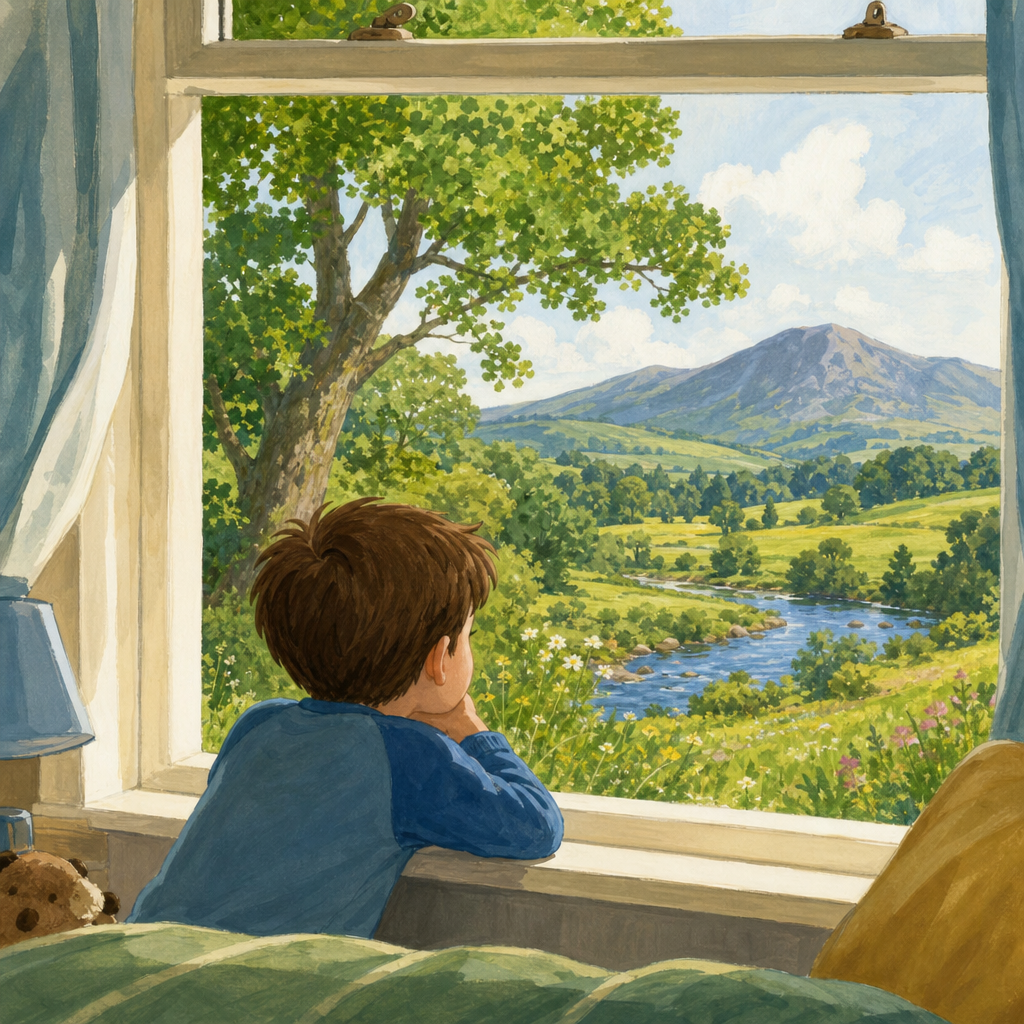
 Close your eyes for a moment. What can you see from your bedroom window? A tree, a field, a hill, the sky?
Describe that view in English in one short sentence. Today we learn the German words so you can join two or three details together, not just name one thing.
By the end of this lesson, you will be able to:
- Name eight nature words in German with der, die or das
- Describe a place you know using two of those words in a short German sentence
- Compare walking rights in German forests with life at home
Listen first, then say the German out loud with its article (der, die or das). English is on the front to help you. Flip only after you have repeated the German to check you heard it right.
When all eight words feel steady, we will learn one handy frame for joining two of them: Es gibt … und …
der Wald becomes einen Wald after Es gibt: Es gibt einen Wald und einen Fluss.
Look at the landscape picture and click the correct German label for each feature. Say the word quietly as you place it, article and all.
When the picture is full, we will build three short Es gibt sentences together from what we can see:
- Es gibt einen Wald und einen Fluss.
- Es gibt eine Blume und einen Strand.
- Es gibt ein Blatt und einen See.
Open your copy. Using the support box below, write two sentences with the frame Es gibt … und … to describe a place you know. Keep the article with every noun, and mind the capital letters on German nouns. You may copy and adapt a model sentence.
- Es gibt einen/eine/ein ___ und einen/eine/ein ___.
- einen Baum · einen Berg · einen Fluss · einen See · einen Wald · einen Strand
- eine Blume · ein Blatt
- Es gibt einen Wald und einen Fluss.
- Es gibt eine Blume und einen Berg.
- der Baum — The tree
- der Berg — The mountain
- der Fluss — The river
- der See — The lake
- der Wald — The forest
- die Blume — The flower
- der Strand — The beach
- das Blatt — The leaf
Spin the wheel. When it lands on a feature, say the German word with its article, then tell the class where you have seen one in real life in one short English sentence.
Optional stretch if the matching frame is on the board: Es gibt einen/eine/ein … in …
Unlock the full learning experience
You're previewing this lesson. Get full access to this lesson and hundreds more — each one ready to teach, with interactive activities, printable resources and pupil progress tracking built in.
This lesson is copyright of Coding Ireland 2017 - 2025. Unauthorised use, copying or distribution is not allowed.